

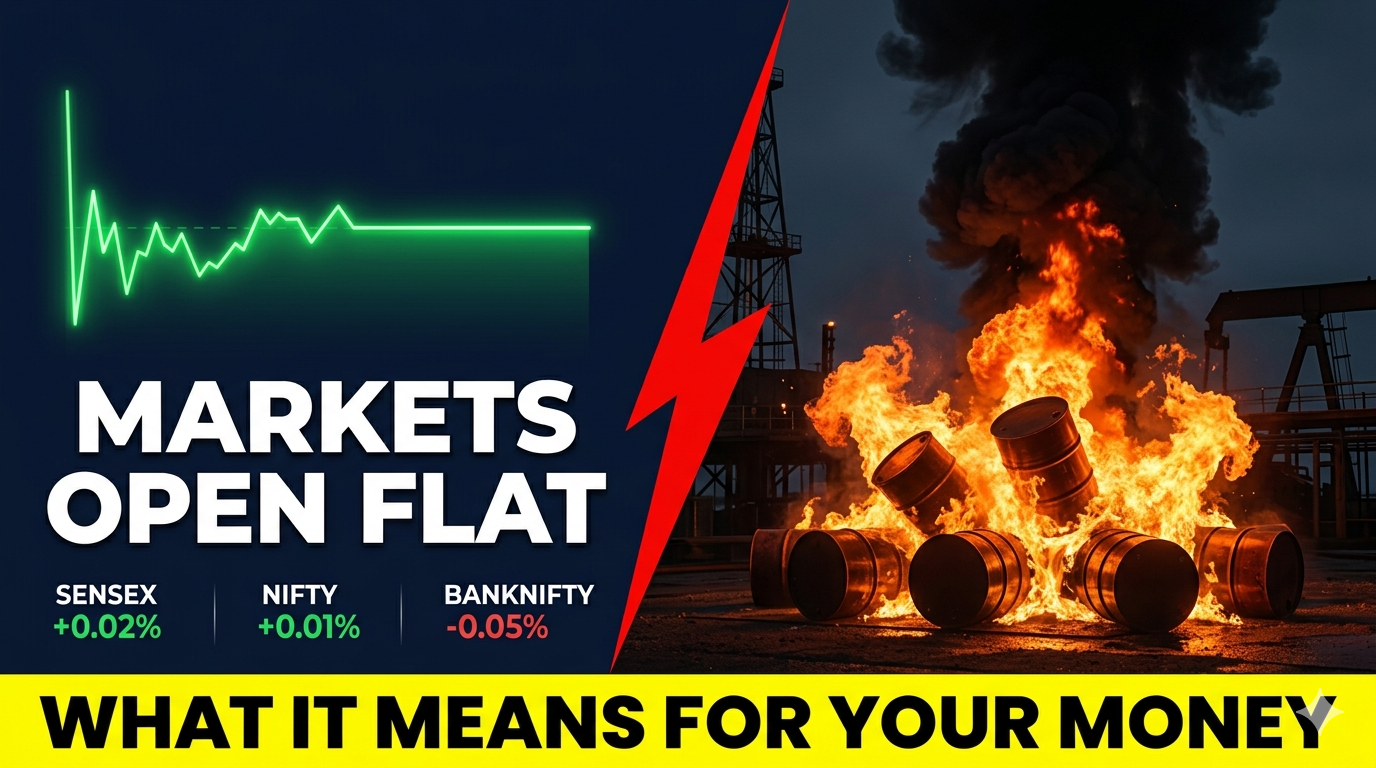
Meta Description: Sensex and Nifty open flat as crude oil jumps, US strikes in Iran rattle global markets. Here’s what the geopolitical storm means for your investments — explained clearly.
Introduction: When the Market Says Nothing, It’s Actually Saying Everything
You open your trading app on a Monday morning. Sensex: barely moved. Nifty: practically flat. Your first instinct? Nothing happened.
But here’s the truth experienced investors know well — a flat opening during global turbulence is rarely “nothing.” It’s the market holding its breath.
Right now, with US strikes in Iran dominating headlines, Brent crude surging past $110 per barrel, and investors worldwide recalibrating their risk appetite, the flat open you’re seeing in Indian equities is actually a story packed with tension, opportunity, and risk.
In this post, we’ll break down exactly what’s driving the cautious market open, what sectors are in the spotlight, and — most importantly — what you should (and shouldn’t) be doing with your portfolio when geopolitical tremors shake global markets.
Whether you’re a seasoned trader or a long-term SIP investor, this one’s for you.
What Does “Markets Open Flat” Actually Mean?
Before diving into the geopolitics, let’s establish something foundational.
When the Sensex and Nifty open “flat,” it means the indices open within roughly ±0.2% of the previous session’s closing price. It signals equilibrium between buyers and sellers — a moment of collective indecision.
But indecision isn’t the same as calm.
In a recent volatile Monday session, benchmark indices recovered from sharp early losses to end nearly flat — with the Nifty 50 closing at 23,649.95, up just 6.45 points (0.03%), while the Sensex settled at 75,315.04, gaining a marginal 77.05 points (0.10%). Beneath that surface calm, the Sensex had plunged as much as 890 points in early trade before buyers stepped in.
That kind of intraday swing — 890 points down, then nearly full recovery — is not a flat market. It’s a battlefield with a photo finish.
The Iran Factor: Why US Strikes Are Shaking Global Markets
If there’s one variable dominating investor thinking right now, it’s the escalating US–Iran conflict.
US President Donald Trump issued an ultimatum warning that Washington could strike key Iranian power and energy infrastructure if Tehran did not reopen the strategic Strait of Hormuz to maritime traffic. Iran responded by threatening to completely close the strait and retaliate against critical infrastructure.
Why does this matter so much to Indian investors? Because the Strait of Hormuz is the world’s most critical oil chokepoint — roughly 20% of global oil supply flows through it, according to the U.S. Energy Information Administration. Any disruption there is felt within hours at petrol pumps and corporate balance sheets across India.
Global crude oil prices remained elevated, with Brent crude trading around $110 per barrel amid concerns over disruptions around the Strait of Hormuz.
For context: India imports over 85% of its crude oil requirements, according to the Ministry of Petroleum and Natural Gas. Every $10 rise in Brent crude adds approximately ₹1 lakh crore to India’s annual import bill. That’s real money — the kind that widens the current account deficit, pressures the rupee, and squeezes corporate margins.
Crude Oil Jumps: The Ripple Effect on Indian Stocks
When crude oil spikes, it doesn’t hit all sectors equally. Here’s a quick map of how rising oil prices cascade through Indian markets:
Sectors That Get Hurt
- Aviation: Jet fuel (ATF) is the single largest operating cost for airlines, with IndiGo, Air India, and SpiceJet seeing margin pressure almost immediately.
- Paint Companies: Raw material costs (titanium dioxide, petrochemical derivatives) climb in tandem with crude.
- Oil Marketing Companies (OMCs): HPCL, BPCL, and IOC face under-recovery risk if retail fuel prices aren’t raised in sync — a situation the Petroleum Planning and Analysis Cell monitors closely.
- Fertilisers: Gas-based fertiliser producers face higher input costs, as tracked by the Department of Fertilisers.
- Logistics & Transport: Freight rates rise, compressing margins across supply chains.
Sectors That Benefit
- Oil Exploration (ONGC, Oil India): Higher crude = higher realisations. But political pricing caps can limit the upside.
- Refiners (Reliance Industries): Complex refiners can capture crack spreads when crude is volatile.
- Renewable Energy: High oil prices make the economic case for solar and wind even stronger, reinforcing India’s National Solar Mission targets.
Market experts quoted by Business Standard noted that rising oil prices driven by Middle East tensions are fuelling risk aversion among investors, particularly in IT, metals, and auto sectors. Gold is simultaneously witnessing fresh safe-haven buying amid escalating geopolitical and economic risks.
Monday’s Market Surge That Preceded the Flat Open
To understand the current flat opening, you need to understand what happened in the session just before.
When there’s a surge on a Friday or over a weekend — driven by ceasefire hopes, diplomatic progress, or short-covering — Monday often opens flat as the market “digests” those gains and waits for confirmation.
India’s BSE Sensex rose sharply, up about 3.6% to 77,296 in early trade, tracking a global market rally after a US-Iran ceasefire eased geopolitical tensions and lifted risk appetite. The index hit its highest level since March 11, after President Trump agreed to a conditional two-week ceasefire with Iran, helping push oil prices below $100 per barrel — a significant positive for India as a major oil importer.
That surge was real. But when ceasefires are “conditional” and diplomacy is fragile, markets don’t sustain those gains without fresh positive catalysts.
This is the classic “buy the rumour, sell the news” pattern playing out in real time.
Banking and Energy Stocks: Why They’re in Sharp Focus
When geopolitical risk is elevated, two sectors become the market’s pulse-checkers: banking and energy.
Banking Stocks: The Safe Harbour Play
During external shocks, large private-sector banks often become “quality refuges” — investors rotate from riskier, cyclically sensitive stocks into well-capitalised banks.
Domestic equity markets snapped a five-day losing streak as markets were buoyed by strong results from banking majors. “The trend of flight to quality is likely to be sustained, given the good numbers from banking majors like HDFC Bank and ICICI Bank, where valuations remain fair,” noted V K Vijayakumar, Chief Investment Strategist at Geojit Financial Services.
Both Sensex and Nifty recovered from sharp early losses on the back of value buying in select sectors, particularly information technology and banking stocks. You can track live Nifty Bank Index performance on NSE India.
The lesson? In volatile markets, quality banking stocks don’t just survive — they often lead recoveries.
Energy Stocks: A Double-Edged Sword
Public sector energy companies like ONGC benefit from higher crude prices in theory. But domestic pricing policies, subsidy burdens, and government intervention complicate the picture. Private refiners like Reliance Industries, with their global trading operations, often navigate this volatility more efficiently.
Global Geopolitical Tensions: The Bigger Picture Every Indian Investor Must Understand
Zoom out for a moment. Beyond Iran, global markets are navigating a multi-front uncertainty landscape:
| Risk Factor | Market Impact | India-Specific Effect |
|---|---|---|
| US–Iran conflict | Crude oil spike, risk-off sentiment | Import bill rise, rupee pressure |
| Strait of Hormuz threat | Supply disruption fears | Energy security concern |
| US trade policy uncertainty | Equity volatility globally | FPI outflow risk |
| Elevated global bond yields | Capital rotation from EM | Pressure on Indian equities |
| Sticky global inflation | Rate-cut hopes deferred | Valuation headwinds |
“India’s robust foreign exchange reserves should cushion any significant impact on the external accounts,” according to Garima Kapoor, economist at Elara Capital — a view supported by the Reserve Bank of India’s weekly reserve data, which shows reserves comfortably above $680 billion. The Ministry of Petroleum and Natural Gas has directed state-run oil-marketing companies to maintain enough inventories to last several weeks — a meaningful buffer against short-term supply shocks.
This is important context: India is not defenceless in this environment. Strong forex reserves, a proactive government, and a resilient domestic consumption story provide meaningful buffers.
Investor Sentiment: Reading Between the Lines of a Flat Opening
Here’s something that often gets overlooked in breathless market commentary: sentiment is data.
When markets open flat amid genuinely frightening headlines — US military strikes, oil above $110, a weakening rupee — the flat open itself tells you something: domestic institutional investors and long-term money are holding firm.
According to NSDL’s daily FPI tracker, FPIs were net sellers to the tune of ₹1,874 crore, while domestic institutions provided buying support worth ₹5,592 crore.
Translation: foreign portfolio investors are nervous and selling. But domestic mutual funds, insurance companies, and retail SIP investors are buying the dip. This tug-of-war explains the flat-to-volatile sessions we’re seeing.
Over the past three years, this dynamic has repeated itself during every major global shock. AMFI (Association of Mutual Funds in India) data consistently shows that on every occasion, patient domestic investors who held through the volatility were ultimately rewarded.
What Should You Actually Do Right Now? A Practical Investor Playbook
Let’s get to the part that matters most — your portfolio decisions. Here’s a clear, experience-backed framework:
✅ What to Do
1. Don’t panic-sell quality holdings. If you own well-run companies with strong balance sheets, a flat or negative opening driven by external factors is not a fundamental reason to sell. SEBI’s investor education resources emphasise that geopolitical shocks typically normalize within 4–12 weeks unless there’s a structural escalation.
2. Review your sector exposure. If you’re heavily overweight in aviation. OMCs or paint companies. Consider whether you’re comfortable with that concentration given elevated crude. You can screen sector-wise holdings using NSE’s sector performance dashboard.
3. Continue your SIPs without flinching. AMFI data consistently shows that SIP investors who pause during volatile periods underperform those who stay the course. Market flat zones and dips are actually good for SIP returns — you buy more units at lower prices, an effect known as rupee cost averaging.
4. Watch the Strait of Hormuz, not just the headlines. The real risk trigger isn’t a tweet or a press conference — it’s actual physical disruption to oil shipping lanes. Track Brent crude futures on the ICE exchange and tanker traffic data as leading indicators.
5. Consider selective banking and IT exposure. These sectors have shown resilience and pricing power even during geopolitical shocks. High-quality banks and export-oriented IT companies with dollar revenues can provide a natural hedge. The Nifty IT Index and Nifty Bank Index are your quick reference points.
❌ What Not to Do
- Don’t try to time the exact bottom. Even professional fund managers rarely get this right consistently — a point the S&P SPIVA India Scorecard has documented year after year.
- Don’t over-react to a single session’s opening. Intraday moves during geopolitical events are driven by sentiment, not fundamentals.
- Don’t load up on crude oil ETFs or commodities unless you understand derivatives risk. SEBI’s framework on commodity derivatives classifies these as high-risk instruments for retail investors.
- Don’t ignore the rupee. A weakening INR amplifies import costs. Track the RBI’s reference rate daily.
A Word From the Trenches: What Experienced Investors Do Differently
From working with clients and observing market behavior across multiple geopolitical cycles — the 2020 COVID crash, the 2022 Russia-Ukraine shock, the 2025 Middle East escalation — one pattern stands out consistently.
The investors who build lasting wealth are not the ones who predicted the crisis. They’re the ones who had a plan before the crisis arrived and stuck to it.
A flat market opening amid geopolitical noise is the market’s invitation to you: are you going to make decisions based on fear, or based on your investment thesis?
The Dalal Street Journal’s analysis of market recoveries shows that investors who held during major geopolitical events — from the Kargil war to COVID — would have seen their wealth multiply many times over had they simply stayed invested and continued their SIPs.
The answer to that question, repeated across hundreds of trading sessions over a lifetime, is what separates the wealthy investor from the anxious one.
Quick Reference: Key Metrics to Watch This Week
| Indicator | What to Watch For | Why It Matters | Where to Track |
|---|---|---|---|
| Brent Crude (USD/barrel) | Any move above $115 is a red flag | Direct impact on India’s import bill | Reuters Commodities |
| USD/INR | Watch for sustained move above 85 | Signals capital outflow pressure | RBI Reference Rate |
| FPI flows (daily) | Net buyer or seller? | Sentiment barometer for foreign money | NSDL FPI Tracker |
| Nifty Bank Index | Leading indicator for broad market | Banking health drives market recovery | NSE India |
| GIFT Nifty (pre-market) | Sets the tone before Indian open | Best early signal for day’s direction | NSE IFSC |
| US 10-year Treasury yield | Above 4.5% puts pressure on EM | Affects FPI allocation decisions | U.S. Treasury |
FAQ: Real Questions Indian Investors Are Asking Right Now
1. Why do Indian markets open flat even when global markets are volatile?
A flat open often means domestic institutional investors (DIIs) are absorbing FPI selling. It’s actually a sign of market maturity — the market isn’t crashing despite external pressure because local money is providing support. You can verify this daily through the NSE’s DII/FII activity report.
2. How much does a $10 rise in crude oil actually hurt the Indian economy?
Economists estimate that every $10 per barrel increase in crude oil adds approximately 0.4–0.5% to India’s current account deficit as a percentage of GDP, as analysed in RBI working papers. For a $3.5 trillion economy, that’s material — though India’s strong forex reserves provide significant cushion.
3. Should I buy banking stocks when markets open flat during geopolitical stress?
Banking stocks — particularly large, well-capitalised private sector banks — have historically been defensive buys during external shocks. Their core business (domestic loans, retail deposits) isn’t directly affected by crude oil prices. Check RBI’s quarterly banking stability report for a data-backed view of sector health before investing.
4. What happens to the rupee when crude oil spikes?
India pays for crude oil in US dollars. When oil prices spike, India needs more dollars, increasing dollar demand and putting downward pressure on the rupee. The RBI typically intervenes by selling dollars from its reserves to prevent excessive depreciation — a mechanism explained in detail on the RBI’s official website.
5. Is this a good time to invest in gold?
Historically, gold performs well during geopolitical uncertainty, dollar weakness, and elevated inflation — all current conditions. World Gold Council data shows gold has averaged positive returns in 7 of the last 10 major geopolitical crises. Gold can serve as a portfolio hedge (ideally 5–15% allocation via sovereign gold bonds or gold ETFs listed on NSE/BSE).
6. How do US strikes in Iran affect Indian IT stocks?
IT stocks are somewhat insulated from direct crude oil impact since they’re service exporters earning in dollars. However, if geopolitical tensions cause a US economic slowdown, IT discretionary spending could be cut. The NASSCOM industry outlook tracks how global macro conditions affect Indian IT sector revenues — a useful reference before adjusting IT allocations.
7. Should I stop my SIPs during this volatile period?
No — and the data strongly supports this. AMFI’s long-term SIP return data consistently shows that investors who maintained SIPs through volatility (the COVID crash of 2020 being the most dramatic example) significantly outperformed those who stopped and restarted. Pausing SIPs during downturns means missing the lowest NAV prices — the exact units that drive long-term wealth.
8. What is GIFT Nifty and why does it matter for predicting the Indian market open?
GIFT Nifty (formerly SGX Nifty) is a futures contract on the Nifty 50 index that trades on the NSE International Exchange (NSE IFSC) in GIFT City, Gujarat. It trades nearly 24 hours and reflects overnight global developments. A GIFT Nifty within ±50 points of the previous close typically signals a flat open for domestic markets.
Conclusion: The Flat Opening Is a Test — Here’s How to Pass It
Markets open flat. Crude oil surges. Geopolitical headlines scream. Your phone buzzes with alarming push notifications. And in the middle of all this noise, you have to make a decision.
The right decision, almost always, is to do less than your anxiety is telling you to do.
The data is clear: Indian markets have weathered US–Iran tensions, crude oil spikes, a falling rupee, and FPI selling — repeatedly, and every time, the domestic fundamentals eventually reasserted themselves. SEBI’s own market data archives document each of these recovery cycles clearly. A flat opening during global stress isn’t a warning sign to exit. It’s evidence that Indian markets are mature enough to absorb external shocks without panicking.
Stay invested. Monitor the real indicators (crude, rupee, FPI flows). Don’t mistake short-term volatility for long-term damage. And if you’re unsure, speak to a SEBI-registered investment advisor before making portfolio changes.
The market will open flat again tomorrow. The question is whether you will be calm enough to see the opportunity in that.
Read More
💬 Found this helpful? Share it with an investor friend who needs to hear it.
📩 Subscribe to our weekly market intelligence newsletter — clear, jargon-free insights every Sunday evening before the market week begins.
👇 Drop your question in the comments — What’s your biggest concern about investing during geopolitical volatility? Let’s talk it through.
Disclaimer: This article is for informational and educational purposes only. It does not constitute investment advice. Please consult a SEBI-registered investment advisor before making investment decisions. Past market performance is not indicative of future results.

