

Meta Description: Sensex falls ~200 pts on May 26 as Nifty opens at 24,004. IndiGo, SBI Life lead losses amid Strait of Hormuz fears. Here’s what investors should do now.
The Quick Answer: Why Did the Market Fall on May 26, 2026?
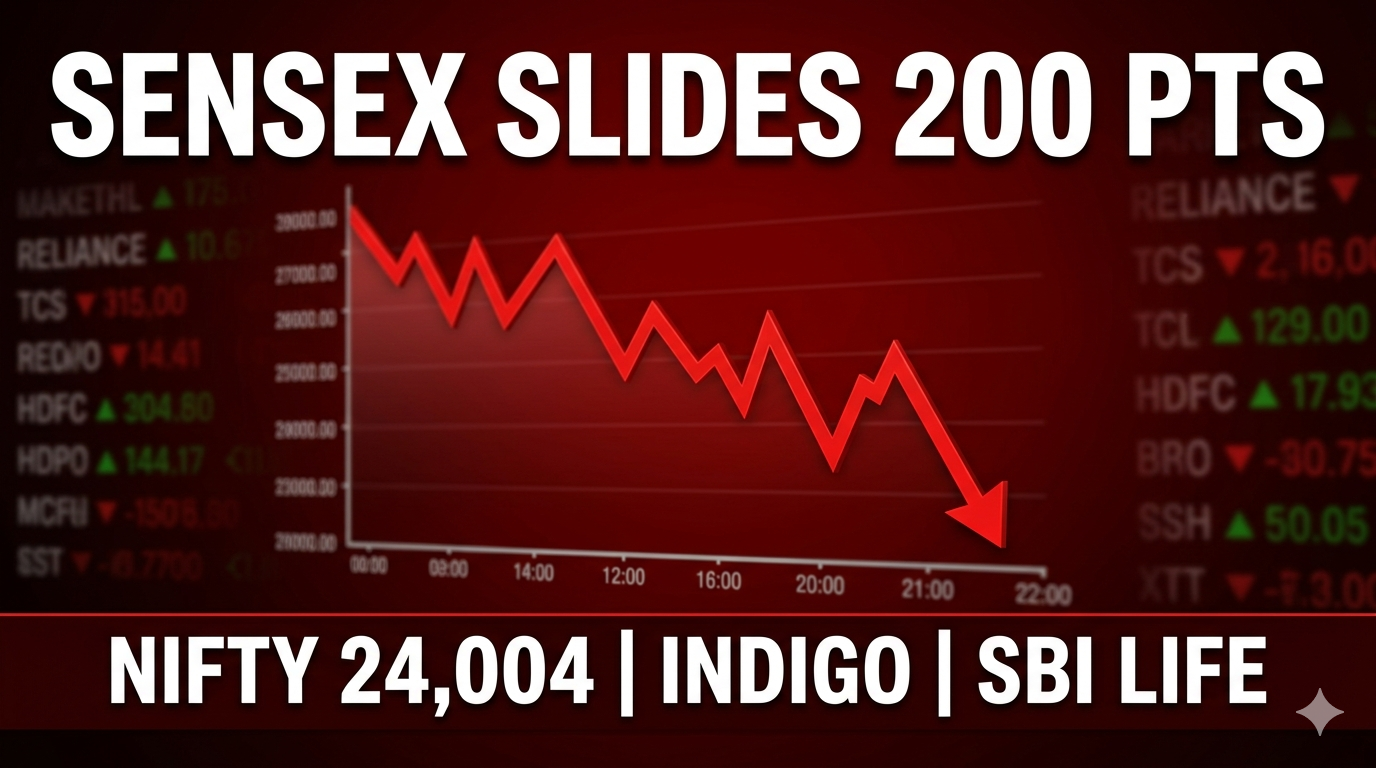
The BSE Sensex opened approximately 264 points lower at 76,224 on Tuesday, May 26, 2026, while the Nifty 50 slipped to 24,004. The primary culprits: fresh anxiety over potential attacks in the Strait of Hormuz, mixed Asian market signals, and broad-based investor caution that has been building for weeks. IndiGo and SBI Life Insurance were among the hardest-hit names in early trade.
The good news? Markets showed early resilience — by 9:41 AM, the Nifty had clawed back into positive territory at 24,057. But don’t let the partial recovery fool you into complacency. The underlying pressures are real, and if you hold stocks in aviation, insurance, or financials, you need to pay close attention.
What Happened This Morning? A Clear Breakdown
If you woke up and checked your portfolio on Tuesday morning, you may have felt that familiar gut-punch of red numbers. Here’s exactly what the data says, sourced directly from NSE and BSE exchange feeds:
- BSE Sensex opened at 76,224.14 — down 264 points (0.34%) from Monday’s close of 76,488.96
- Nifty 50 opened at 24,004.10 — down 27 points (0.11%) from the previous close of 24,031.70
- By 9:41 AM, both indices had partially recovered, with Nifty trading at 24,057 (+0.11%) and Sensex at 76,561 (+0.09%)
(Source: Upstox Market Data, May 26 2026 | Business Today Opening Bell, May 26 2026)
Top Losers in Early Trade
| Stock | Sector | Approximate Decline | Source |
|---|---|---|---|
| IndiGo (InterGlobe Aviation) | Aviation | ~0.76%+ | Business Today |
| SBI Life Insurance | Insurance | Notable decline | Upstox |
| Bharti Airtel | Telecom | ~0.80% | Business Today |
The losses, while not catastrophic on the surface, are part of a bigger, more worrying story.
The Real Reason Markets Are Nervous: Strait of Hormuz, Explained Simply
Here’s something most financial news headlines won’t spell out clearly for you.
The Strait of Hormuz is a narrow waterway — about 104 miles wide at its narrowest — separating Iran from the Arabian Peninsula. According to the U.S. Energy Information Administration (EIA), around 20% of the world’s oil supply passes through it every day. For India, which imports the vast majority of its crude oil, this isn’t just a distant geopolitical curiosity. It’s a direct line to your fuel bills, your airline ticket prices, and ultimately your stock portfolio.
Since the geopolitical conflict involving the US and Iran began escalating in 2026, Indian markets have been on edge. India’s crude basket peaked at $113.57 per barrel — and the anxiety has been relentless, as tracked by the Petroleum Planning and Analysis Cell (PPAC).
“Whenever there’s instability in the Strait of Hormuz, oil markets react instantly. Prices have already shown upward pressure, and if disruptions continue, crossing the $100 per barrel mark is not unrealistic.” — Boston Institute of Analytics, April 2026
For Indian aviation stocks like IndiGo, this is devastating. Jet fuel (Aviation Turbine Fuel or ATF) is their single largest operating cost. When crude surges, margins get crushed. When peace deal negotiations create uncertainty — as we’re seeing right now — the market prices in the worst case.
Foreign portfolio investors (FPIs), always sensitive to macro shocks, have already pulled out a staggering ₹2,19,017 crore from Indian markets so far in 2026, with May alone seeing outflows of over ₹27,048 crore, as compiled from NSDL depository data. That’s a tide of money flowing out — and it leaves markets vulnerable to even mild negative catalysts.
Why Is IndiGo Falling? (And What Aviation Investors Should Know)
IndiGo is India’s largest airline by market share, but size doesn’t protect you from fuel costs. When crude oil spikes, IndiGo’s cost structure takes a direct hit. Here’s the simple math of why aviation investors are nervous right now:
- ATF prices track crude oil closely, with a slight lag — monitored daily by the Petroleum Planning and Analysis Cell (PPAC)
- IndiGo operates hundreds of daily flights, making fuel its #1 cost, as disclosed in its quarterly filings with SEBI
- Middle Eastern airspace disruptions have forced rerouting of flights, adding both flight hours and fuel burn, according to DGCA India
- War-risk insurance premiums have reportedly jumped 4–8x, adding another layer of cost pressure on every flight over affected regions, per Liquide Finance analysis, 2026
From working with clients who hold aviation stocks, one pattern keeps repeating: investors often underestimate how thin airline margins actually are in normal times. IATA data consistently shows net profit margins of 2–4% in good years for the airline industry globally — meaning a 95% ATF cost surge can wipe out profits entirely.
What should IndiGo investors do? Don’t panic-sell, but do reassess your position size relative to your risk tolerance. If the Hormuz situation stabilises (peace deal negotiations are ongoing), the stock could bounce sharply. But if tensions escalate, there’s meaningful downside. Track IndiGo’s live stock price on NSE here.
Why Is SBI Life Insurance Declining?
Insurance stocks falling in a risk-off environment might seem counterintuitive — isn’t insurance a “safe” business? The answer is nuanced.
Life insurers like SBI Life Insurance invest a significant portion of their premium income into equities and bonds, as required under IRDAI (Insurance Regulatory and Development Authority of India) investment guidelines. When equity markets fall and bond yields move unpredictably — both happening simultaneously right now — their investment income and asset valuations come under pressure. Additionally:
- Falling market sentiment reduces new policy sales (people tighten discretionary spending), as reflected in IRDAI monthly insurance data
- Rising bond yields (a potential consequence of inflation from oil prices) erode the value of their fixed-income portfolios — a dynamic the RBI closely monitors
- FPI selling in financial sectors drags insurance stocks down alongside banks, per SEBI FPI dashboard
SBI Life is fundamentally strong — backed by State Bank of India, India’s largest public sector bank. Today’s decline is more about macro fear than company-specific trouble. Long-term investors may want to note that dips in quality insurance names have historically been buying opportunities — but timing that precisely is always the hard part. View SBI Life’s live quote on BSE.
The Broader Market Pressure: What Sectors Are Hurting Most
Tuesday’s market weakness isn’t isolated to one or two stocks. There’s a pattern here worth recognising, visible across NSE sectoral indices:
Sectors Under Pressure
Aviation — Directly hit by fuel costs and route disruption. IndiGo is the visible face of this pain. Track the Nifty India Transportation Index for real-time sectoral moves.
Insurance & Financials — Risk-off sentiment and equity market correlation create headwinds. The Nifty Financial Services Index has been under sustained pressure through 2026.
Consumer Discretionary — When macro uncertainty rises, consumers and investors both pull back. Watch the Nifty India Consumption Index as a barometer.
Oil & Gas Importers — Companies that use crude as a raw material face margin compression. The Nifty Oil & Gas Index reflects this in real time.
Sectors That May Hold Up (or Benefit)
Metal Stocks — Geopolitical tension can paradoxically boost commodity prices, benefiting producers like Hindalco and Vedanta. The Nifty Metal Index has outperformed in recent sessions.
IT/Technology — Indian IT companies earn largely in dollars and are partially insulated from crude oil shocks. The Nifty IT Index has been a relative safe haven.
PSUs in Energy — ONGC and other upstream producers benefit from higher oil prices, as upstream margins expand when crude rises.
Should You Be Worried? A Practical Investor’s Assessment
Let’s cut through the noise and be direct: moderate concern is warranted, but panic is not.
Here’s a simple framework aligned with SEBI’s investor education guidelines:
If You’re a Long-Term Investor (5+ years horizon)
- Today’s 200-point Sensex slide is essentially background noise over a 5-year horizon — historical Sensex data from BSE confirms recovery from every major drawdown
- Quality stocks have recovered from far worse; the Nifty 50 Total Returns Index has compounded at ~12–14% CAGR over 20 years
- Consider using dips like today to add to high-conviction positions in sectors with strong domestic demand
- AMFI (Association of Mutual Funds in India) consistently shows SIPs through volatile periods outperform lumpsum timing attempts
If You’re a Short-Term Trader
- Be extremely cautious in oil-sensitive sectors
- The Strait of Hormuz situation is binary risk — resolution or escalation. Binary risk is hard to trade profitably
- Reduce leverage; SEBI’s margin framework provides guardrails but discipline is your first line of defence
- Keep stop-losses tight on aviation and financial positions
If You’re New to Investing
- This is normal market volatility. Review SEBI’s investor awareness materials for grounding perspective
- Don’t make your first investment decisions based on a single news day
- If you’re thinking about starting a SIP (Systematic Investment Plan), a market dip is historically a good entry point
A Brief History Lesson: Markets Recover
It’s worth grounding today’s nervousness in historical context. In March 2026, the Sensex dropped to near a two-year low at around 72,696 — a brutal 2.5% single-day fall — as the Hormuz crisis first escalated seriously. Since then, despite continued uncertainty, markets have clawed back significant ground. Nifty is now back above 24,000 — not at peak levels, but meaningfully higher than the crisis lows.
Indian markets have a documented track record of resilience. BSE historical data shows the Sensex has survived COVID (a crash of 40%+ in 2020), the 2008 Global Financial Crisis (a 60%+ drawdown), multiple geopolitical crises, and persistent FPI outflows. Each time, patient investors who stayed the course came out ahead — a principle endorsed by the RBI’s Financial Stability Report.
What to Watch in the Coming Days
Here are the five specific things you should monitor:
- Crude oil prices — Track Brent crude in real time on Trading Economics. Watch the $100/barrel level as a key psychological marker.
- Peace deal progress — Follow Reuters’ Middle East coverage for the most reliable updates on US-Iran negotiations.
- FPI flows — NSDL publishes daily FPI data. Sustained stabilisation would be a bullish signal for Indian equities.
- Nifty 50 support at 23,800–24,000 — Monitor live levels on the NSE official website. A sustained break below 23,800 is a more serious warning sign.
- RBI’s posture — Watch for any statements from the Reserve Bank of India on rates, inflation, and liquidity. The RBI Monetary Policy Committee calendar tells you when the next policy decision is due.
Read More
Markets Open Flat: What Sensex and Nifty’s Cautious Start Really Means for Your Portfolio Right Now
FAQ: Real Questions Investors Are Asking Today
1. Why did the Sensex fall today, May 26, 2026?
The Sensex fell approximately 264 points at open due to mixed Asian market cues and renewed concern over potential attacks in the Strait of Hormuz, per Upstox live market data. Oil-sensitive sectors like aviation and insurance bore the most pressure.
2. Should I sell my IndiGo shares after today’s fall?
Not necessarily. IndiGo’s decline is driven by macro factors rather than company-specific problems. Review IndiGo’s latest investor presentation to assess fundamentals before making any decision. Always consult a SEBI-registered investment advisor.
3. What is the Nifty 50 support level to watch?
The 23,800–24,000 range has acted as a technical support zone. Monitor the live chart on NSE India. A sustained break below 23,800 would be a more serious warning sign requiring reassessment.
4. Why is IndiGo specifically falling when other airlines aren’t listed?
IndiGo (InterGlobe Aviation) is the only major Indian airline listed on BSE/NSE. It holds over 60% domestic market share and is highly sensitive to ATF prices, which the PPAC tracks daily.
5. Is SBI Life Insurance a buy on this dip?
SBI Life is a fundamentally strong company — review its latest quarterly results and investor relations data on BSE. Always consult a SEBI-registered financial advisor before making specific investment decisions.
6. How long will markets remain weak due to the Strait of Hormuz crisis?
This is genuinely uncertain. Emkay Global — cited by Business Today — warns Brent crude could stay elevated at $105–110 per barrel while the conflict persists. Follow Reuters Energy News for the most current oil market intelligence.
7. What should a first-time investor do during this volatility?
Stay calm and follow SEBI’s investor education resources. If you’re invested through a SIP, don’t stop — you’re buying more units at lower prices. For lumpsum investments, consider deploying in tranches over 2–3 months.
8. Are broader markets (midcap, smallcap) more affected than large-caps?
Generally yes. BSE Midcap and Smallcap index data consistently shows higher beta (volatility) relative to Sensex and Nifty 50 during risk-off episodes.
Conclusion: Stay Informed, Stay Calm, and Think Long-Term
Today’s ~200-point Sensex slide is a reminder that stock market investing is never a straight line up. The combination of Strait of Hormuz uncertainty, FPI outflows tracked by NSDL, weak Asian cues, and sector-specific pressure on aviation and insurance stocks has created a genuinely challenging environment for Indian investors.
But here’s the bigger truth that gets lost in the daily noise: the Indian economy has structural tailwinds that don’t disappear because of one geopolitical crisis. The RBI’s GDP growth projections, India’s demographic dividend, and ongoing infrastructure investment continue to drive the medium-term story.
The best investors — across market cycles — aren’t the ones who perfectly time every move. They’re the ones who use moments of fear to buy quality at better prices, stay diversified, and don’t let short-term volatility derail long-term plans.
Watch the Hormuz situation closely via Reuters. Monitor your sectoral exposures on NSE. And if today’s market has you anxious, that’s healthy — it means you’re paying attention.
What are your thoughts on today’s market move? Share in the comments below, or forward this article to someone who needs a clear, calm explanation of what’s happening.
📩 Subscribe to our daily market briefing newsletter — delivered to your inbox every morning before 9 AM IST, so you’re never caught off-guard by market moves.
Disclaimer: This article is for informational purposes only and does not constitute investment advice. Please consult a SEBI-registered financial advisor before making any investment decisions.

