

Meta Description: Sensex rebounded from 700-point crash as TCS, Infosys & HCL led IT sector gains. Here’s what drove today’s market recovery and what investors should do next.
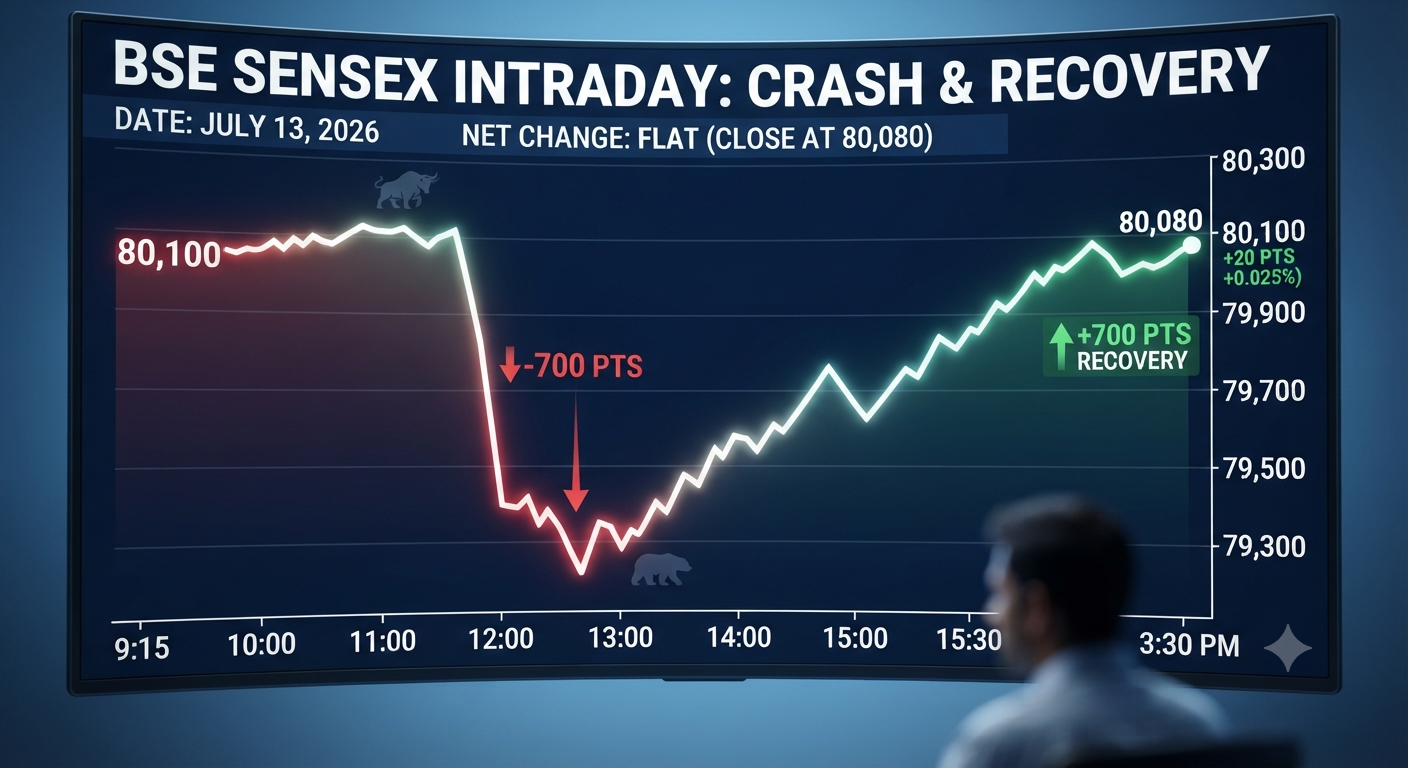
Quick Answer: On July 13, 2026, Indian benchmark indices Sensex and Nifty recovered sharply from steep intraday losses — Sensex had plunged over 700 points — to close nearly flat, driven by a 3%+ surge in IT stocks including TCS, HCL Tech, Infosys, and Wipro. The recovery signals underlying resilience in India’s technology sector even amid global headwinds.
Introduction: The Market That Refused to Stay Down
There’s a particular kind of relief you feel when you refresh your portfolio screen and see green where there was panic red just hours earlier.
That’s exactly what happened to thousands of Indian investors today.
Monday morning opened like a horror scene. The BSE Sensex cratered more than 700 points in the first few minutes of trade, touching an intraday low of 76,857 — a gap-down opening triggered by US-Iran tensions and a sharp spike in crude oil prices. The kind of opening that makes you question your entire investment thesis.
But by closing bell? The story had flipped entirely.
The Sensex closed at 77,616 — up 47 points. The Nifty 50 settled at 24,211, gaining 4 points. And the hero of the turnaround? India’s IT sector, which didn’t just recover — it led.
In this post, we’ll break down exactly what happened, why IT stocks stepped up when the rest of the market faltered, what the broader market signals are telling us, and — most importantly — what this means for your investment decisions right now.
Whether you’re a seasoned portfolio manager or someone anxiously watching Zerodha on their lunch break, this analysis is for you.
What Actually Happened Today: The Full Picture
The Morning Crash (And Its Triggers)
Let’s not sugarcoat it. The morning session was brutal.
The Nifty opened with a gap-down at 24,039 — well below the previous close — as geopolitical anxiety swept through global markets. The catalyst was escalating US-Iran tensions around the Strait of Hormuz, a critical global oil shipping corridor.
The consequence? Brent crude surged more than 4%, trading around $77.33 per barrel. For India — which imports roughly 85% of its crude oil — that’s not just a commodity story. It’s a direct hit to the fiscal deficit, the currency, and corporate margins across dozens of sectors.
The Indian rupee felt it immediately, weakening to ₹95.60 against the US dollar. And the India VIX — the market’s “fear gauge” — climbed nearly 10%, signalling that volatility wasn’t going anywhere soon.
Broader market breadth was ugly in the morning. Banking stocks sold off. FMCG stocks declined over 1%. Metal stocks tumbled. Even usually resilient blue-chips were dragged down in the panic selling.
The Afternoon Recovery: IT to the Rescue
Then something interesting happened.
By midday, a cluster of technology stocks started reversing course. Not just stabilising — actually rallying. And because IT stocks carry enormous weight in both the Sensex and Nifty indices, their recovery pulled the entire market with them.
By the close, five of the top six Nifty gainers were technology stocks:
| Stock | Sector | Performance |
|---|---|---|
| TCS | IT Services | Strong gains |
| HCL Technologies | IT Services | Strong gains |
| Tech Mahindra | IT Services | Solid recovery |
| Infosys | IT Services | Positive close |
| Wipro | IT Services | Recovery from lows |
| LTIMindtree | IT Services | Advanced on positive commentary |
The Nifty IT index surged more than 3% — making it the single best-performing sector in an otherwise weak market day.
Why Did IT Stocks Lead the Recovery?
This is the question every investor should be asking. Because understanding why IT bounced tells you a great deal about where this sector is headed.
1. The Weak Rupee Is Actually Good News for IT Exporters
Here’s something counterintuitive for newer investors: when the rupee weakens, IT companies often benefit.
Why? Because India’s major IT firms — TCS, Infosys, HCL, Wipro — earn the bulk of their revenue in US dollars, euros, and British pounds. When those earnings are converted back to rupees, a weaker rupee means more rupees per dollar earned.
Today’s rupee slide to ₹95.60 per dollar was actually a earnings tailwind for these export-heavy technology firms. Analysts at multiple brokerages have flagged this as a key support factor for IT margins in Q1 FY27 results, even as wage hike cycles put pressure on costs.
2. TCS Q1 Results Provided a Confidence Anchor
Markets had been bracing for TCS’s Q1 FY27 results (announced July 9). The numbers came in broadly as expected — with near-flat sequential dollar revenue growth — but crucially, the company’s management commentary didn’t trigger the kind of severe guidance downgrade that markets feared.
For investors who had been selling IT stocks in anticipation of disaster, the “not-as-bad-as-feared” result became a buying signal. That’s a classic market dynamic: when sentiment overshoots to the downside, even neutral news becomes a catalyst for recovery.
3. Earnings Season Positioning — Ahead of Infosys and Others
Today’s buying wasn’t random. With Infosys, HCL Tech, Wipro, and others all set to report Q1 results in the coming days, institutional investors were rebuilding positions ahead of what could be a positive surprise — particularly from Infosys, which multiple analysts have flagged as the standout large-cap IT name for relative resilience this quarter.
As noted by analysts at BusinessToday, Infosys is increasingly being seen as best positioned to benefit from AI-led repositioning and its Optimum Healthcare acquisition, which could add to organic growth numbers.
4. Institutional and FII Buying Stabilised Sentiment
Foreign Institutional Investors (FIIs) continued to show selective buying interest in Indian IT stocks. This institutional participation is critical — when large investors start accumulating, it not only supports prices but signals to retail investors that the selloff may have been overdone.
The Broader Market Mosaic: What Else Moved
While IT grabbed the headlines, the full market story was more nuanced.
Banking Showed Resilience
The Nifty Bank index closed at 58,131, gaining 86 points. Private sector banks led this recovery, with Kotak Mahindra Bank and ICICI Bank each gaining between 1–2%. This is significant because banking stocks had been under pressure from concerns about credit growth slowdowns and the interest rate outlook.
Consumer Durables — An Unexpected Bright Spot
Air-conditioner stocks continued their surprising rally:
- Voltas jumped 5%
- Blue Star gained 3%
Summer heat and rising urbanisation are structural tailwinds for this segment. This sector’s continued strength suggests underlying domestic consumption hasn’t completely rolled over, even amid global uncertainties.
Jewellery on a Historic Run
Kalyan Jewellers extended its remarkable rally — the stock has surged nearly 50% over just four trading sessions. This kind of move reflects both short-term momentum trading and underlying demand for jewellery stocks ahead of the wedding and festive season.
The Laggards: FMCG, Metals, Real Estate
Not everything bounced. Nifty FMCG fell over 1% — a sector that’s been caught in the crossfire of slowing volume growth and margin pressure. Avenue Supermarts (DMart) declined 3% after quarterly results disappointed investors.
Indian Bank fell 3%, giving back part of Friday’s gains. Metal stocks also underperformed, with the Nifty Metal index closing in negative territory.
What Market Analysts Are Saying Right Now
Reading between the lines of analyst commentary reveals some important signals:
Vipin Dixena, market analyst, noted that the Nifty is “consolidating in a narrow range while holding above the 50 EMA, indicating the broader short-term trend remains positive.” He identified key support near 24,100 and immediate resistance at 24,250, with RSI hovering around 54 — suggesting neutral-to-positive momentum without overbought signals.
Riyank Arora, Associate Vice President at Hedged.in, called today’s movement “a healthy pause rather than a reversal,” advising traders to “adopt a buy-on-dips strategy while maintaining disciplined risk management.”
The technical picture, in plain English: the market is resting after a sharp recent upmove. As long as Nifty holds above 24,100, the short-term trend is intact. A decisive move above 24,250 could target 24,500–24,600 next.
The IT Sector’s Bigger Story: Opportunity or Value Trap?
Here’s where we need to be genuinely honest with you — because the short-term bounce doesn’t erase the medium-term complexity in India’s IT sector.
The Headwinds Are Real
Several credible institutions have raised flags:
- ICICI Securities has turned “negative” on large-cap IT (TCS, Infosys, HCL, Wipro), citing “protracted low-to-mid single-digit revenue growth” through FY28 and slashed price targets by up to 34%.
- JP Morgan downgraded HCL Tech and Wipro to “underweight,” saying consensus estimates still face 5–9% downside despite both stocks already falling 31–33% this year.
- GenAI pricing deflation is real: clients are increasingly demanding efficiency gains in pricing contracts, and AI is enabling IT firms to do more with fewer people — which paradoxically squeezes traditional revenue models.
- The combined market cap of India’s top 5 IT companies (TCS, Infosys, Wipro, HCL, Tech Mahindra) has fallen over 46% from peak levels in August 2024, dropping from ₹33.71 lakh crore to around ₹18.15 lakh crore as of July 2026.
But the Tailwinds Deserve Attention Too
This is not a one-sided story. For long-term investors:
- AI transition deals are growing: While AI deflation is hurting legacy revenue, it’s also creating a new category of transformation projects. Firms like Infosys, TCS, and Persistent are actively winning AI-implementation mandates.
- Deal pipelines remain healthy: Despite soft macro, deal wins (Total Contract Value) have held up better than quarterly revenue suggests.
- Rupee depreciation is a structural support for earnings in dollar terms.
- Tier-2 IT companies — Persistent Systems, Coforge, Mphasis — are actually growing faster than their larger peers and may offer better near-term returns.
Before vs. After: IT Sector Sentiment Shift
| Factor | 6 Months Ago | Today |
|---|---|---|
| FII stance on IT | Accumulating | Selectively buying |
| Valuation | Premium | Reasonable-to-cheap |
| Growth outlook | Moderate optimism | Cautious but stabilising |
| AI impact | Fear of disruption | Starting to monetise |
| Rupee impact | Neutral | Earnings tailwind |
| Deal wins | Strong | Holding up |
What Should Investors Do Now? A Practical Framework
From conversations with clients and portfolio analysis over the years, the biggest mistake investors make during sector recoveries is either panic-selling at the bottom or buying indiscriminately on the bounce. Here’s a more disciplined approach:
Step 1: Don’t Chase the Momentum Blindly
A 3% single-day IT rally is exciting. But it doesn’t erase the structural questions about the sector’s growth trajectory. Before adding IT exposure, make sure you understand the medium-term earnings picture — which, as multiple analysts note, is likely to remain muted through much of FY27.
Step 2: Think in Quality Tiers
Not all IT stocks are the same right now:
Higher Conviction (Near-Term):
- Infosys — Best positioned among large-caps, AI repositioning underway, acquisition-led growth
- TCS — Most conservative balance sheet, dividend reliability, marginal results beat
- Persistent Systems / Coforge — Tier-2 firms with faster growth profiles
More Cautious (Near-Term):
- Wipro — Patchy demand, EBIT margin pressure
- HCL Tech — Mixed business lines, JP Morgan downgrade
Step 3: Watch Earnings Commentary More Than Numbers
For Q1 FY27, the headline numbers are likely to be soft across the board. What matters more is management guidance and deal commentary. If Infosys or TCS leadership sounds even marginally more optimistic about H2 FY27, that will move stocks more than the quarterly EPS figure.
Step 4: Use Volatility as a Friend, Not an Enemy
Today’s swing — from a 700-point crash to a near-flat close — is a reminder that short-term market moves are often noise. For long-term investors with 3–5 year horizons, quality IT companies bought at today’s valuations look significantly more attractive than they did at 2024 peaks.
Step 5: Diversify Beyond IT
Today’s market also showed you that consumer durables, select banking stocks, and insurance names all held up. A well-diversified portfolio doesn’t need to make “sector bets” — it needs exposure to quality businesses across the economy.
Pros and Cons: Investing in IT Stocks Right Now
✅ Pros
- Valuations have corrected significantly from 2024 peaks
- Rupee weakness provides structural earnings support
- AI transition creating new revenue streams
- Strong dividend track records (TCS, HCL Tech)
- Improving deal TCV (Total Contract Value) pipelines
- Tier-2 companies showing faster growth
❌ Cons
- Near-term revenue growth expected to remain muted (FY27)
- GenAI pricing deflation is compressing margins
- Global macro uncertainty (Middle East tensions, US policy)
- Multiple brokerages have cut targets and turned negative
- Wage hike cycles in Q1 adding cost pressure
- AI may reduce headcount growth, affecting scale economics
5 Key Takeaways From Today’s Market Action
- IT sector resilience is real but selective — not all IT stocks are equal; quality differentiation matters more than ever.
- Rupee depreciation = IT earnings support — counterintuitive but important for every IT investor to understand.
- The market’s intraday recovery shows demand at lower levels — institutional investors are buying dips, which limits downside.
- Nifty’s 24,100 support is the line to watch — a break below signals trouble; holding above keeps the bull case alive.
- Q1 results season will be the real test — Infosys’s guidance update may be the single most important market catalyst in the next two weeks.
FAQ: Your Real Questions, Answered
Q1: Why did the Sensex fall so sharply in the morning today? The primary triggers were escalating US-Iran geopolitical tensions around the Strait of Hormuz and a consequent 4%+ surge in Brent crude oil prices. Since India imports the vast majority of its crude oil, higher prices hit both corporate margins and the fiscal deficit outlook, triggering broad selling pressure at market open.
Q2: Is today’s IT stock rally sustainable, or just a dead-cat bounce? It’s genuinely both possible, which is why context matters. The rally has fundamental support — rupee weakness, positioning ahead of earnings, and improving sentiment around Infosys specifically. But the broader IT sector still faces structural headwinds from AI-led pricing deflation and muted discretionary tech spending. Watch Infosys’s FY27 guidance update closely; that will tell you a lot about sustainability.
Q3: Should I buy IT stocks now given today’s rally? This depends entirely on your investment horizon. If you’re a long-term investor (3+ years), current valuations for high-quality IT companies like TCS and Infosys look significantly more attractive than they did at 2024 peaks, after a 46%+ market cap erosion. If you’re a short-term trader, be cautious about chasing momentum — disciplined buy-on-dips strategy near 24,100 Nifty support makes more sense than buying a spike.
Q4: What is the Nifty IT index and why does it matter for the broader market? The Nifty IT index tracks India’s leading information technology companies, including TCS, Infosys, HCL Technologies, Wipro, and Tech Mahindra. IT stocks carry significant weight in the broader Nifty 50 index, which means when IT moves sharply — up or down — it has an outsized effect on the headline index number that most investors track.
Q5: How does the US-Iran tension affect Indian stock markets? The primary channel is crude oil prices. When Middle East tensions rise, global oil supply fears push crude prices higher. For India, higher crude means a larger import bill, which widens the current account deficit, pressures the rupee, and increases inflationary risks. All of these reduce corporate earnings expectations and investor risk appetite, hence the sharp morning selloff.
Q6: Which IT stocks are analysts most positive on right now? Based on current brokerage research, analysts at JM Financial and JP Morgan prefer Infosys (buy rating, target ₹1,230), TCS (add rating, target ₹2,205), Mphasis, Tech Mahindra, and Persistent Systems in the IT space. Wipro and HCL Tech face more cautious stances from multiple brokerages. Always consult your financial advisor before making investment decisions.
Q7: What should I watch during the Q1 FY27 earnings season for IT stocks? Three things matter most: (1) Revenue growth — even marginal beats versus expectations can move stocks; (2) Operating margin trajectory — watch for the interplay between rupee tailwind and wage hike headwinds; (3) Management guidance and deal pipeline commentary — any upgrade to FY27 revenue guidance by Infosys or TCS would be a significant positive catalyst for the entire sector.
Q8: Is the Indian market safe to invest in given today’s volatility? Volatility is a feature of markets, not a bug. India’s long-term fundamentals — a growing middle class, digital adoption, infrastructure spending, and a young demographic — remain strong. Today’s ability of the market to recover from a 700+ point crash to nearly flat close actually demonstrates underlying demand and institutional confidence. That said, always invest according to your risk tolerance and time horizon, preferably with a financial advisor’s guidance.
Conclusion: Resilience Is the Market’s Message Today
Here’s the most important thing to take away from today’s trading session:
Markets don’t move in straight lines. They breathe, they overreact, they correct. Today’s 700-point crash was fear. Today’s afternoon recovery was reason reasserting itself.
The IT sector’s leadership in today’s bounce isn’t just a short-term story. It reflects something deeper — that India’s technology companies, despite real short-term pressures from AI disruption, global slowdowns, and geopolitical uncertainty, are still the backbone of India’s global economic identity. They earn in dollars, they hire India’s best talent, and they sit at the intersection of every digital transformation happening in banking, healthcare, retail, and manufacturing globally.
The path forward won’t be smooth. Expect more volatile mornings like today as Middle East tensions, crude oil movements, and quarterly earnings all jostle for market attention in the weeks ahead. The 24,100 Nifty support level is your anchor — above it, the medium-term uptrend is intact.
For patient investors, the message is clear: India’s quality businesses, including its best IT companies, are available at prices that would have seemed like extraordinary discounts just 18 months ago. Volatility is the price of admission. Patience is the strategy.
What’s your take on today’s IT-led recovery? Drop your thoughts in the comments below — we read every one.
📩 Subscribe to our weekly market intelligence newsletter for in-depth analysis, expert picks, and actionable insights delivered every Sunday morning. No spam, unsubscribe anytime.
📱 Found this useful? Share it with a fellow investor on WhatsApp or X (formerly Twitter) — you might just save someone from a panic sell.
Read More
Cupid Limited Joins BSE Group A: What This Milestone Means for Investors and India’s Healthcare Sector
Authoritative Sources
- BSE India — Official Sensex Data
- NSE India — Nifty 50 Live Data
- SEBI — Securities and Exchange Board of India
- BusinessToday — IT Sector Analysis
- Goodreturns — Q1 FY27 IT Earnings Preview
Disclaimer: This article is for informational and educational purposes only. It does not constitute financial advice. Stock market investments are subject to market risk. Please consult a SEBI-registered financial advisor before making any investment decisions.
Published: July 13, 2026 | Category: Market Analysis, IT Sector, Indian Stock Market

