

Meta Description: What is an accredited investor in 2025? Learn the income, net worth, and knowledge thresholds — plus how to qualify, verify, and invest smarter.
The Direct Answer
An accredited investor is an individual or entity that meets specific financial or professional thresholds set by the U.S. Securities and Exchange Commission (SEC), granting them access to private, unregistered investment opportunities — such as hedge funds, venture capital, private equity, and private placements like pre-IPO shares. In 2025, the primary thresholds are:
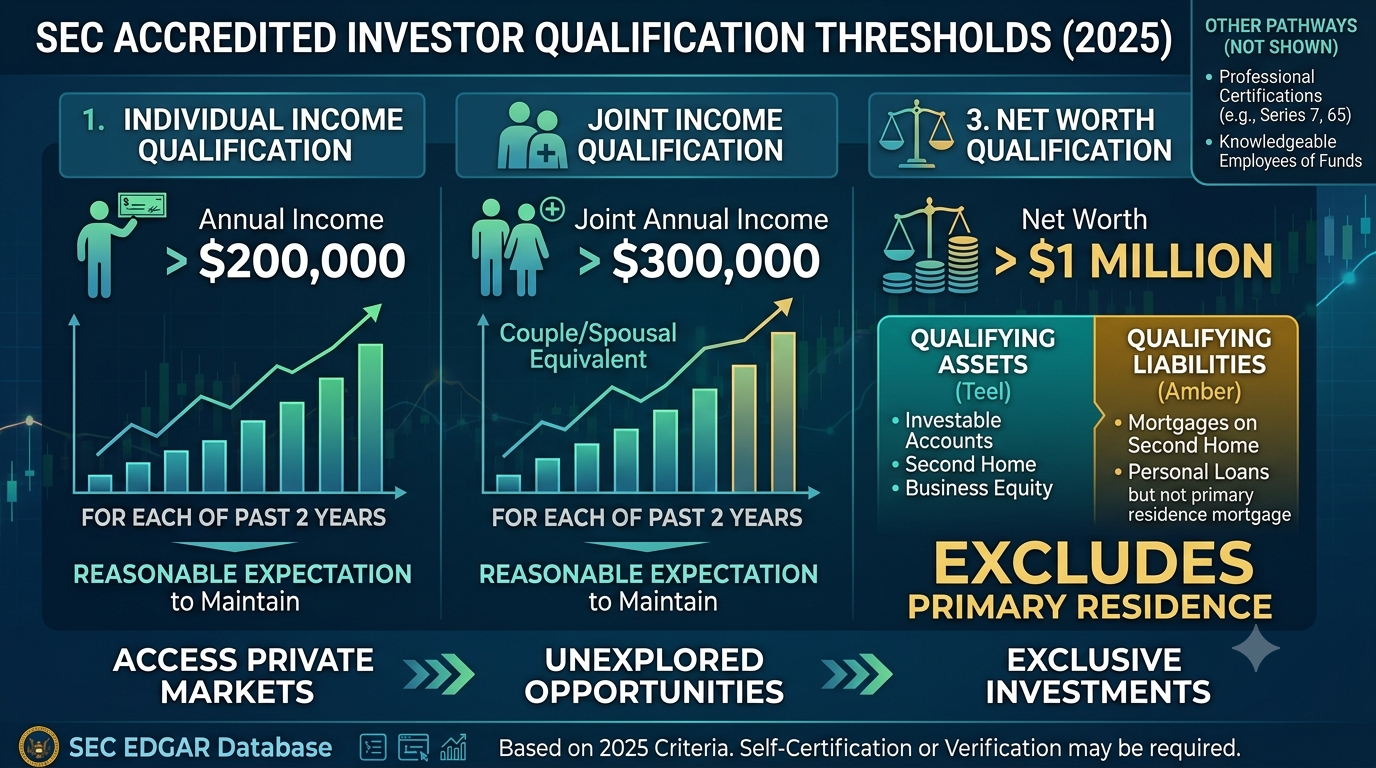
- Income: $200,000+ annually (or $300,000 combined with a spouse/partner) for the last two years, with expectation of the same going forward
- Net Worth: $1,000,000+ excluding primary residence
- Professional Credentials: Holding a FINRA Series 7, 65, or 82 license in good standing
If you’ve ever wondered why some people seem to get access to investment deals you never hear about — this is why.
Introduction: The Velvet Rope of Investing
Imagine walking up to an exclusive investment opportunity — pre-IPO shares in a company like SpaceX, a stake in a high-performing hedge fund, or equity in a private real estate syndication — only to be told: “Sorry. You’re not on the list.”
That’s what it feels like to not be an accredited investor.
The accredited investor designation is essentially Wall Street’s velvet rope. It divides the investing world into two groups: those who can access high-risk, high-reward private market deals, and those who are legally restricted from doing so.
Is that fair? That’s a debate worth having. But right now, understanding the rules is more valuable than arguing about them — because once you know what qualifies you, you can work toward it strategically.
This complete 2025 guide covers everything you need to know: what the accredited investor definition means, how the rules changed recently, how to verify your status, what investments you unlock, and — critically — whether pursuing accredited status is actually worth it for your financial situation.
Let’s get into it.
Why the SEC Created the Accredited Investor Standard
Before we get into the numbers, it helps to understand why this category exists.
The logic is consumer protection. When companies raise money through public offerings, they’re required by the Securities Act of 1933 to register those securities with the SEC and provide detailed disclosure documents (prospectuses, audited financials, risk factors). All of that disclosure is designed to protect everyday investors from fraud and information asymmetry.
Private offerings — think SpaceX secondary shares, venture capital funds, or private real estate deals — don’t go through that registration process. They’re exempt. And because they lack those disclosures and protections, the SEC restricts participation to investors who are presumed to be able to:
- Absorb the financial risk of losing their entire investment
- Conduct their own due diligence without SEC-mandated disclosures
- Withstand illiquidity — not needing to exit positions quickly
The accredited investor standard is the SEC’s way of drawing that line. It’s imperfect — wealth doesn’t equal sophistication — but it’s the framework we’re working with in 2025.
The 2025 Accredited Investor Requirements: Full Breakdown
For Individuals
Income Test
You qualify if you earned $200,000 or more in each of the two most recent calendar years — and reasonably expect to earn the same in the current year. If you’re married or have a spousal equivalent (a term the SEC broadened in 2020), the combined threshold is $300,000 per year.
Important nuances:
- The income must be consistent — a single high-earning year doesn’t qualify you
- Spousal equivalent now includes domestic partners and long-term committed partners in many jurisdictions
- Investment income counts toward the threshold
Net Worth Test
You qualify if your individual or joint net worth exceeds $1,000,000, excluding the value of your primary residence.
Key details:
- Primary residence equity is explicitly excluded — you can’t count your home’s value
- Liabilities secured by your primary residence (like a home equity loan) may reduce your net worth calculation
- All other assets count: brokerage accounts, retirement accounts, second properties, business interests, jewelry, art, vehicles, etc.
Professional Credentials Test (Added in 2020)
The SEC expanded the accredited investor definition in 2020 to include individuals with certain professional financial licenses, regardless of income or net worth:
| License | Issuing Body | What It Covers |
|---|---|---|
| Series 7 | FINRA | General Securities Representative |
| Series 65 | FINRA/State | Investment Adviser Representative |
| Series 82 | FINRA | Private Securities Offerings Representative |
This was a significant and long-overdue update. A 25-year-old licensed securities professional who earns $80,000/year now has the same access as a millionaire — because knowledge, the SEC reasoned, is as valid a qualifier as wealth.
“Knowledgeable Employee” Status
If you’re an employee of a private fund (a hedge fund, VC firm, or private equity fund), you may qualify as a “knowledgeable employee” — giving you access to invest in that specific fund regardless of income or net worth thresholds.
For Entities
It’s not just individuals — many types of entities can qualify as accredited investors:
| Entity Type | Qualification |
|---|---|
| Corporations, LLCs, Partnerships | $5 million+ in assets, not formed specifically to invest |
| Trusts | $5 million+ in assets, directed by sophisticated person |
| Banks, Insurance Companies | Automatically qualify |
| Registered Investment Advisers | Automatically qualify |
| Family Offices | $5 million+ AUM |
| Venture Capital Funds | Automatically qualify under certain exemptions |
| All Equity Owners Are Accredited | Entity qualifies if every individual owner qualifies |
If you’re investing through a business entity, work with a securities attorney to confirm your specific structure qualifies before proceeding.
What Changed in 2020 — and What May Change in 2025
The 2020 SEC Expansion
The most meaningful update in decades came in August 2020, when the SEC amended its accredited investor definition to include:
- Professional credential holders (Series 7, 65, 82)
- Knowledgeable employees of private funds
- “Spousal equivalents” (expanding beyond legal spouses)
- Certain Native American tribes, governmental bodies, and entities
This was widely praised as a step toward making private markets more accessible to people with genuine knowledge, not just wealth.
What to Watch in 2025
As of 2025, there are ongoing discussions in financial policy circles about:
- Raising income/net worth thresholds for inflation adjustment (the $200K/$1M thresholds haven’t changed since 1982)
- Adding additional credential categories to the knowledge-based qualification path
- Potential indexing of thresholds to inflation, which could significantly reduce the number of currently qualifying individuals
Stay current with the SEC’s official investor resources for the most up-to-date regulatory changes.
How to Verify Your Accredited Investor Status
This is where many investors get confused. You don’t register with the SEC or receive a certificate. Accredited investor status is self-attested — but must be verified by the company or fund you’re investing with.
The Verification Process
When you invest in a private offering, the issuer (the company or fund) is responsible for taking “reasonable steps” to verify your accredited status. Here’s how that typically works:
Method 1: Self-Certification (Common for Smaller Deals)
The issuer sends you a questionnaire or checkbox asking you to confirm you meet the criteria. Simple, but it places the burden on you to be accurate. Providing false information is securities fraud.
Method 2: Third-Party Verification (Required for Rule 506(c) Offerings)
More rigorous offerings require independent verification through:
- Tax returns or W-2s from the past two years (income test)
- Bank/brokerage statements dated within 90 days (net worth test)
- CPA or attorney letter confirming your status
- Third-party verification services like Parallel Markets or VerifyInvestor.com
If you’re serious about participating in private markets, getting a verification letter from your CPA or attorney is the cleanest approach — and many platforms will accept it universally.
What Investments Does Accredited Status Unlock?
Here’s the honest answer: a lot. And some of it is genuinely excellent. But not all of it.
Private Placements (Rule 506(b) and 506(c))
Companies raising private capital can offer securities directly to accredited investors without SEC registration. This is how SpaceX secondary shares, early-stage startup equity, and private debt offerings are sold.
Hedge Funds
Most hedge funds are structured to accept only accredited investors (and often the higher bar of “qualified purchasers” — individuals with $5M+ in investments). Minimum investments typically range from $100,000 to $1,000,000+.
Venture Capital Funds
VC funds invest in early-stage startups. As an accredited investor, you may be able to invest through:
- Direct VC fund LPs (typically $250K+ minimum)
- Syndicates on platforms like AngelList (lower minimums, often $1,000–$10,000)
- Emerging manager funds focused on democratizing access
Private Equity
PE funds acquire and restructure private companies, typically targeting higher returns over a 5–10 year horizon. Minimums are high ($500K–$5M+), and capital is locked up for years.
Real Estate Syndications
Private real estate deals — apartment complexes, commercial properties, development projects — are commonly structured as private placements for accredited investors. Minimums typically range from $25,000 to $100,000.
Pre-IPO Shares
Through platforms like Forge Global, EquityZen, or Linqto, accredited investors can buy secondary market shares of private companies before they go public. This is how retail-adjacent investors access SpaceX, Stripe, and other unicorns.
Before vs. After Becoming an Accredited Investor
| Investment Access | Non-Accredited Investor | Accredited Investor |
|---|---|---|
| Public stocks & ETFs | ✅ Yes | ✅ Yes |
| Crowdfunding (Reg CF) | ✅ Limited | ✅ Unlimited |
| Hedge Funds | ❌ No | ✅ Yes |
| Venture Capital Funds | ❌ No | ✅ Yes |
| Private Equity | ❌ No | ✅ Yes |
| Pre-IPO Secondary Shares | ❌ No | ✅ Yes |
| Private Real Estate Syndications | ❌ No | ✅ Yes |
| Private Debt/Credit | ❌ No | ✅ Yes |
| SPACs (post-IPO) | ✅ Yes | ✅ Yes |
How to Become an Accredited Investor: A Realistic Roadmap
Let’s be practical. If you don’t currently qualify, here’s how to get there.
Path 1: Income Growth
- Build income through career advancement, side income, consulting, or entrepreneurship
- Track two consecutive years of $200K+ income before you can self-qualify
- Timeline: 2–5 years for most high-earners
Path 2: Net Worth Building
- Aggressively invest in public markets, real estate, or business equity
- Reach $1M in investable assets (excluding your home)
- Diversified index investing + real estate is the most common path
- Timeline: 5–15 years depending on income and savings rate
Path 3: Professional Credentials (Fastest Path)
- Study for and pass the Series 65 exam (Investment Adviser exam)
- No employer sponsorship required for the Series 65 — you can take it independently
- Pass rate is approximately 65–70%; dedicated study takes 60–100 hours
- Cost: approximately $187 exam fee + study materials
- Timeline: 3–6 months
Pro tip from working with clients: The Series 65 path is dramatically underused. Many motivated non-accredited investors who genuinely understand markets could qualify in months through this route — but very few know it exists. If you’re serious about private market access, this is worth investigating seriously.
Accredited Investor vs. Qualified Purchaser: What’s the Difference?
Many investors encounter “qualified purchaser” requirements and assume it’s the same as accredited investor. It’s not — and the bar is significantly higher.
| Standard | Threshold | Access |
|---|---|---|
| Accredited Investor | $200K income OR $1M net worth OR FINRA license | Private placements, most hedge funds, VC |
| Qualified Purchaser | $5M+ in investments | All accredited access + 3(c)(7) funds (larger hedge funds, elite PE) |
| Qualified Eligible Person (QEP) | $2M+ portfolio OR $200K+ margin | Commodity pools, certain futures funds |
If you’re targeting access to the most exclusive institutional investment vehicles, qualified purchaser status is the next milestone after accredited investor.
Is Becoming an Accredited Investor Actually Worth It?
Honest answer: it depends on your situation — and this is something the financial media rarely says clearly.
When Accredited Status Genuinely Adds Value:
- You have a diversified public market portfolio and are looking for uncorrelated returns
- You can tolerate 5–10 year illiquidity without needing that capital
- You have enough capital to diversify across multiple private deals (not just one)
- You have the time and knowledge to conduct due diligence on private offerings
When It May Not Be Worth Chasing:
- You haven’t maxed out tax-advantaged accounts (401k, IRA, HSA) yet
- Your emergency fund is underfunded
- You’d be investing in private markets primarily to “be part of the story” (FOMO)
- You can’t afford to lose the entire investment
As Vanguard’s research consistently shows, low-cost public index funds outperform the majority of actively managed private funds after fees over long time horizons. Accredited investor access isn’t automatically better investing — it’s just different investing, with different risk and liquidity profiles.
Common Mistakes Accredited Investors Make
Even after qualifying, many investors stumble. Watch out for:
- Concentrating too heavily in one private deal — diversification matters even more in illiquid markets
- Ignoring fee structures — many private funds charge 2% management + 20% carry (profits), which significantly erodes returns
- Not reading the PPM — the Private Placement Memorandum is the legal disclosure document; reading it carefully is non-negotiable
- Assuming accredited = guaranteed returns — private markets can and do produce losses
- Overlooking SPV structure risk — investing in SpaceX through an SPV means you own a piece of a vehicle that owns SpaceX shares, not SpaceX directly. Legal structure matters.
FAQ: Real Questions About Accredited Investor Status
Q1: Does my 401(k) or IRA count toward net worth for accredited investor purposes?
Yes — retirement accounts are included in your net worth calculation for accredited investor purposes. Only your primary residence equity is excluded.
Q2: I made $200K last year but only $150K the year before. Do I qualify?
No. The income test requires $200K (or $300K joint) in each of the two most recent years, with a reasonable expectation of the same in the current year. One qualifying year is not sufficient.
Q3: Can I qualify as an accredited investor through a business entity?
Yes. If your entity has $5 million+ in assets and was not formed specifically to make the investment, it may qualify. Or if all equity owners of the entity individually qualify as accredited investors, the entity qualifies as well.
Q4: Do I need to requalify as an accredited investor for each investment?
Yes, in practice. Each issuer will conduct its own verification process. You may need to provide documentation for each separate private investment you make.
Q5: Is my primary residence really completely excluded from net worth?
Yes, under the current SEC rules, your primary residence is excluded. Additionally, if you have a mortgage or home equity loan, the outstanding balance secured by your primary residence may be subtracted from your net worth calculation if it exceeds the fair market value of the home.
Q6: What happens if I lie about being an accredited investor?
Providing false information to qualify for a securities offering is a federal crime — securities fraud — punishable by significant fines and imprisonment. Beyond legal consequences, if the deal goes badly and fraud is discovered, your legal recourse against the issuer is severely compromised.
Q7: Can non-U.S. citizens qualify as accredited investors?
The accredited investor definition is a U.S. regulatory concept. Non-U.S. investors may participate in certain private offerings under different regulatory frameworks (Regulation S, for example). Consult a cross-border securities attorney for your specific situation.
Q8: Will the income thresholds increase due to inflation?
This is actively discussed in policy circles. The $200K/$300K income thresholds and $1M net worth threshold were set in 1982 and have never been adjusted for inflation. In 2024 dollars, $200K in 1982 is equivalent to roughly $650,000. If the SEC does adjust thresholds, many currently qualifying individuals could lose accredited status. No formal rule change has been adopted as of mid-2025.
Conclusion: The List Is Worth Getting On — But Only When You’re Ready
Being an accredited investor opens real doors. Pre-IPO shares, venture funds, private real estate, hedge funds — these are legitimate asset classes that can genuinely diversify a mature portfolio.
But here’s the truth most financial content won’t tell you: the designation itself doesn’t make you a better investor. Access to more deals means access to more bad deals alongside the good ones. The filter the SEC tried to create — ensuring only sophisticated, resilient investors participate — doesn’t automatically protect you from making poor choices within private markets.
The smartest approach is sequential:
- Build your financial foundation first (emergency fund, tax-advantaged accounts, low-cost public market portfolio)
- Pursue accredited status as a natural byproduct of financial growth — or through the Series 65 credential path if you’re genuinely knowledgeable
- Enter private markets slowly, diversified, and with capital you genuinely don’t need for 5+ years
- Read every PPM. Ask every hard question. Never invest based on a story alone.
The velvet rope will still be there when you’re ready. There’s no prize for rushing through it.
💬 Are you working toward accredited investor status? Or already there and wondering where to start? Leave a comment — we’d love to help you think through your next move.
📩 Subscribe to our weekly investing newsletter for clear, no-hype breakdowns of private markets, public equities, and everything in between.
📤 Know someone who keeps asking “what is an accredited investor?” — send them this guide.

