

Meta Description: China’s Three Red Lines policy reshaped real estate forever. Learn what the 3 thresholds are, why they triggered Evergrande’s collapse, and what they mean for investors.
Quick Answer: China’s “Three Red Lines” policy, introduced in August 2020, set three financial thresholds that property developers must meet to qualify for new bank loans. The rules cap liabilities-to-assets ratios, net gearing, and cash-to-debt levels. Evergrande failed all three — and its inability to borrow new money to repay old debt set off a chain reaction that became the world’s largest corporate debt crisis.
Introduction: One Policy Change That Rewrote the Rules of Chinese Real Estate
There’s a moment in every financial crisis where, in hindsight, you can point to the exact rule change that pulled the trigger.
For China’s property sector, that moment came on August 20, 2020 — when regulators from the People’s Bank of China and the Ministry of Housing quietly announced a new framework for managing developer debt. Three metrics. Three thresholds. One seismic consequence.
They called it the “Three Red Lines” (三道红线, sān dào hóng xiàn).
Within 18 months, the world’s most indebted property developer — China Evergrande Group — had defaulted on its offshore bonds. Within three years, the contagion had spread to Country Garden, Sunac, Kaisa, and dozens of other developers. China’s property sector, which had powered the country’s economic miracle for two decades, was on its knees.
But here’s what most explainers miss: the Three Red Lines didn’t cause the crisis. They simply exposed a crisis that was already there, hiding behind an endless cycle of borrowing and re-borrowing.
In this post, you’ll get a clear, no-jargon breakdown of what the Three Red Lines actually are, why Beijing introduced them, how developers responded, and what the policy’s legacy tells us about the future of Chinese real estate — and the global economy connected to it.
The Context: Why China Needed the Three Red Lines
Two Decades of “Borrow, Build, Sell, Repeat”
To understand why the Three Red Lines mattered so much, you first need to understand the business model they were designed to break.
For roughly twenty years, China’s property developers operated on a simple but extraordinarily risky flywheel:
- Borrow money from banks, bond markets, and shadow lenders
- Buy land from local governments at auction (often at inflated prices)
- Pre-sell apartments before construction began, collecting cash upfront
- Use that cash to service existing debt and fund new land purchases
- Repeat — at ever-larger scale
This model worked brilliantly as long as three conditions held: home prices kept rising, buyers kept pre-purchasing, and lenders kept lending. All three held — mostly — from the early 2000s right up until 2020.
The problem was the debt accumulation happening beneath the surface. According to data from S&P Global Ratings, the combined debt of China’s top 30 developers grew from approximately 1 trillion yuan in 2010 to over 6 trillion yuan by 2020 — a six-fold increase in a single decade.
Beijing watched this leverage balloon with growing alarm. The concern wasn’t just financial stability — it was political. If this bubble burst in an uncontrolled way, millions of ordinary Chinese families who had poured their life savings into property would be left with nothing. Social unrest was a real risk.
The Straw That Broke the Camel’s Back
By 2020, the government had tried various cooling measures — limiting home purchases, capping mortgage sizes, restricting land supply. None of them tackled the fundamental issue: developers had learned to circumvent regulations by moving debt off their balance sheets, into joint ventures, and through shadow banking channels.
The Three Red Lines were different. They went directly after the source of the problem: the developers’ ability to keep borrowing.
What Are the Three Red Lines? A Clear Breakdown
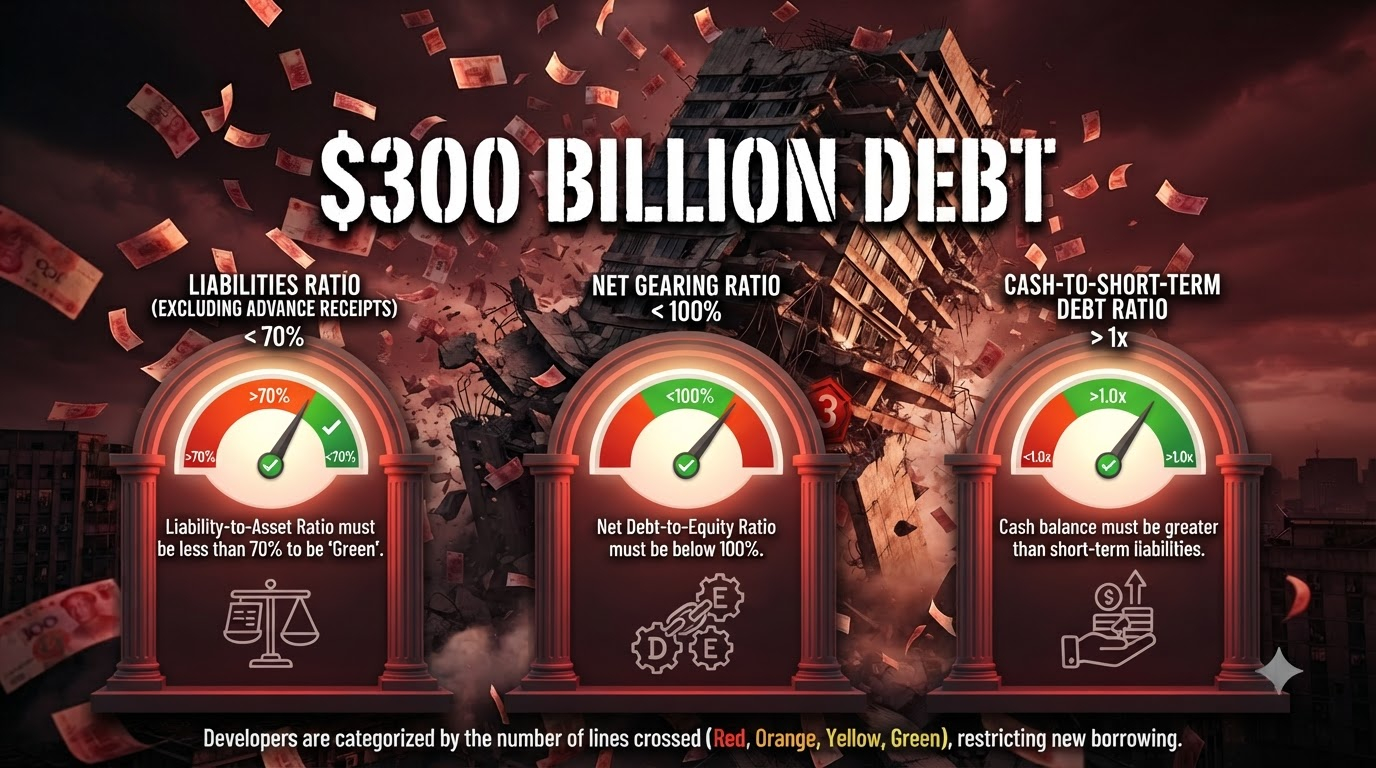
The Three Red Lines are three specific financial ratios that Chinese property developers must satisfy to qualify for new bank lending. Each “line” represents a ceiling or floor that must not be crossed.
Red Line 1: Liabilities-to-Assets Ratio Below 70%
What it measures: The proportion of a developer’s total assets that are funded by debt (excluding advance receipts from pre-sold homes).
Why it matters: A ratio above 70% means a company is overwhelmingly debt-financed — any significant drop in asset values could make it technically insolvent.
The Evergrande problem: At its peak, Evergrande’s liabilities-to-assets ratio exceeded 83%. It was, by this measure, dangerously over-leveraged.
Red Line 2: Net Gearing Ratio Below 100%
What it measures: Net debt (total debt minus cash) divided by total equity. It shows how much of a company’s net debt position exceeds its own equity base.
Why it matters: A net gearing ratio above 100% means a company owes more in net debt than its entire equity value — a precarious position if revenues slow.
The Evergrande problem: Evergrande’s net gearing ratio was estimated at over 177% in 2020 — nearly double the threshold.
Red Line 3: Cash-to-Short-Term Debt Ratio Above 1x
What it measures: Whether a company holds enough cash to cover all its debt maturing within the next 12 months.
Why it matters: This is the most immediate liquidity test. A ratio below 1x means a developer cannot pay its upcoming debt obligations without raising new funds. It’s the classic sign of a company on the edge of a liquidity crisis.
The Evergrande problem: Evergrande’s cash-to-short-term-debt ratio was consistently below 1x — meaning it was perpetually dependent on rolling over its debt to stay alive.
The Traffic Light System: How Borrowing Limits Were Set
Regulators created a tiered system based on how many red lines a developer crossed:
| Lines Crossed | Classification | Borrowing Limit |
|---|---|---|
| 0 Red Lines | Green | Debt can grow up to 15% annually |
| 1 Red Line | Yellow | Debt can grow up to 10% annually |
| 2 Red Lines | Orange | Debt can grow up to 5% annually |
| 3 Red Lines | Red | No increase in debt permitted |
Evergrande sat firmly in the Red category — meaning it could not take on a single yuan of new debt. For a company whose entire business model depended on constant new borrowing, this was effectively a death sentence.
Why August 2020? The Timing Was Deliberate
Reading Between the Political Lines
The Three Red Lines didn’t arrive in a vacuum. Several forces converged to make August 2020 the moment Beijing chose to act:
1. COVID-19 created a window
The pandemic had temporarily frozen China’s property market in early 2020. Home sales were down. Land auctions were paused. This gave regulators a rare moment when introducing tighter rules wouldn’t immediately cause a market crash — the market was already paused.
2. The leverage numbers had become impossible to ignore
Internal government modeling reportedly showed that a disorderly unwinding of developer debt — if left to accumulate further — could threaten the entire banking system. Better to act now, while there was still time to manage it.
3. Xi Jinping’s “common prosperity” agenda
President Xi had been increasingly vocal about the dangers of speculative real estate investment. The idea that housing was becoming a tool for wealth inequality — rather than a place to live — was politically toxic. The Three Red Lines fit neatly within a broader narrative of “houses are for living in, not for speculation” (房住不炒, fáng zhù bù chǎo), a slogan Xi had championed since 2016.
As The Financial Times noted at the time, the policy was as much a political signal as a financial regulation — Beijing was telling the market that the era of unlimited leverage was over.
Developer Responses: The Good, the Bad, and the Desperate
How Different Developers Adapted
Not every developer responded to the Three Red Lines the same way. The divergence in outcomes is instructive.
Developers who adapted well:
Companies like Vanke and Longfor Group had been running relatively conservative balance sheets for years. When the Three Red Lines landed, they were already close to compliance — or needed only modest adjustments. They slowed land buying, focused on completing existing projects, and emerged from the initial shock in reasonable shape.
Developers who tried to game the system:
Some developers attempted creative accounting to move debt off their balance sheets — into joint ventures, minority-owned subsidiaries, or supplier payment arrangements. Regulators tightened scrutiny of these workarounds, though enforcement was imperfect.
Developers who couldn’t adapt:
Evergrande, Sunac, Kaisa, and others found themselves trapped. They had borrowed too much, too fast, and too opaquely to fix their balance sheets quickly. When they could no longer roll over debt with fresh borrowing, their liquidity crises became public almost overnight.
The Unintended Consequences: What Beijing Didn’t Fully Anticipate
A Policy That Worked Too Well — and Too Fast
Policy design is one thing. Real-world implementation is another. The Three Red Lines, whatever their merits as a long-term structural reform, created several acute problems that regulators hadn’t fully stress-tested:
1. The presale model broke down
When word spread that developers like Evergrande were in financial trouble, homebuyers grew reluctant to put deposits on pre-sold apartments. This dried up the cash flow that developers needed to fund construction — creating a vicious cycle: less presale cash → slower construction → more buyer anxiety → even less presale cash.
2. Mortgage boycotts emerged
By mid-2022, an estimated 1.6 million homebuyers had paid for unfinished apartments. Their response — organized mortgage payment strikes across more than 100 cities — was unprecedented in modern Chinese history and forced an emergency policy rethink.
3. Local government finances collapsed
Local governments in China had long relied on land sales to property developers as a primary revenue source. As developers stopped buying land, that revenue vanished — stressing municipal budgets across the country and threatening funding for schools, hospitals, and infrastructure.
4. The banking system absorbed hidden losses
Chinese banks had extensive exposure to property developers through direct loans, construction financing, and wealth management products sold to retail clients. As developers defaulted, these losses — while managed — were real and ongoing.
According to the International Monetary Fund’s 2023 China Article IV Consultation, the property sector’s distress represented one of the key downside risks to China’s economic outlook.
Has the Policy Changed? The Evolution of the Three Red Lines
Softening at the Edges
Faced with the depth of the property downturn, Beijing has — without formally abandoning the Three Red Lines — introduced a series of complementary policies that effectively soften their impact:
- The “Whitelist” mechanism (2024): Qualifying real estate projects can receive designated bank financing for completion, bypassing the developer’s overall creditworthiness. This protects homebuyers without restoring the old borrowing free-for-all.
- Targeted support for state-owned developers: While private developers were left to restructure on their own, state-owned enterprises (SOEs) in real estate received implicit and explicit government backing — accelerating a market shift toward SOE dominance.
- Lower mortgage rates and down payment requirements: These demand-side measures aim to restore buyer confidence, though their effect has been modest in the face of broader confidence problems.
- 300 billion yuan relending facility (May 2024): The People’s Bank of China announced this facility to help local state-owned entities purchase unsold housing inventory from struggling developers — a direct attempt to reduce the stock of completed-but-unsold apartments dragging on the market.
The Three Red Lines themselves haven’t been repealed — and likely won’t be. They represent a structural commitment to lower developer leverage that Beijing considers essential for long-term financial stability. But the enforcement environment around them has become more nuanced, with regulators exercising more judgment about which developers and which projects receive emergency support.
Lessons for Global Investors: What the Three Red Lines Teach Us
Beyond China’s Borders
If you’re an investor, a policy analyst, or simply someone trying to understand how regulation shapes markets, the Three Red Lines story offers several transferable lessons:
Lesson 1: Regulatory cliffs are real
When regulators suddenly tighten access to capital after years of loose conditions, the adjustment isn’t gradual — it’s a cliff. Companies that had built business models on continuous access to cheap debt can’t restructure overnight. Watch for similar dynamics in any sector where credit conditions tighten rapidly.
Lesson 2: Off-balance-sheet risk always comes back on
Evergrande and its peers moved enormous amounts of debt into places regulators couldn’t easily see. This delayed the reckoning but made it worse when it came. In any market, assume that reported leverage understates true leverage.
Lesson 3: Presale models create systemic fragility
The Chinese property presale model — where buyers pay before apartments are built — created a fragile interdependence between developer cash flows and buyer confidence. When confidence broke, cash flows broke with it. Be cautious about business models where revenue depends on customers paying upfront for undelivered goods.
Lesson 4: Government policy can be the trigger, not just the response
In most financial crises, regulators respond to market events. The Three Red Lines is a case where regulation triggered the unwinding of hidden risk. Investors in any market need to model the risk of policy change — not just market risk.
Three Red Lines: Pros and Cons at a Glance
Was It the Right Policy?
| Pros | Cons |
|---|---|
| Addressed a genuine and growing systemic risk | Triggered a liquidity crisis faster than anticipated |
| Forced developers to confront hidden leverage | Damaged homebuyer confidence severely |
| Aligned with long-term financial stability goals | Caused cascading revenue losses for local governments |
| Reduced moral hazard for future developers | Created unemployment in a sector with millions of jobs |
| Signaled credible regulatory seriousness globally | Contributed to a deflationary spiral in property prices |
The consensus among economists is that the intent of the policy was sound — China’s developer leverage had become genuinely dangerous. The execution, however, was arguably too abrupt, without sufficient support mechanisms in place for the transition.
FAQ: China’s Three Red Lines Policy — Your Questions Answered
1. Are the Three Red Lines still in effect in 2024?
Yes — the Three Red Lines framework remains official policy. However, regulators have introduced complementary measures that provide relief to specific projects and developers, softening the practical impact without formally reversing the rules.
2. Which developers passed all three red lines?
Several major developers managed to stay “green” (crossing zero red lines), including Vanke, Longfor, and CR Land. These companies had maintained more conservative leverage ratios and were better positioned when tightening hit.
3. Did the Three Red Lines cause the Evergrande crisis?
They were the trigger that exposed it — not the cause. The underlying cause was Evergrande’s years of reckless borrowing. The Three Red Lines simply removed the ability to keep rolling that debt over, forcing the crisis into the open.
4. What is the “Three Red Lines” equivalent in other markets?
In Western banking, equivalent concepts include Basel III capital ratio requirements for banks and loan covenant restrictions in leveraged buyout financing. The principle is the same: regulators set quantitative thresholds to prevent excessive leverage before it becomes systemic.
5. Will China change the Three Red Lines policy?
A formal repeal is considered unlikely — it would send precisely the wrong signal about Beijing’s commitment to financial discipline. More probable is a continued evolution of supplementary policies that achieve flexibility without abandoning the core framework.
6. How do the Three Red Lines affect foreign investors?
Foreign investors who held offshore dollar bonds issued by Chinese developers (including Evergrande, Sunac, and Country Garden) face significant losses. The Three Red Lines effectively ended the era of high-yield Chinese property bonds as a reliable asset class, forcing a fundamental reassessment of risk in the Asian credit market.
7. What happens to developers that violate the Three Red Lines?
They are prohibited from increasing their total debt. This doesn’t mean immediate bankruptcy — but it does mean they must either sell assets, raise equity, or collect presales to fund operations and service existing debt. For highly leveraged developers, this constraint quickly becomes existential.
Conclusion: A Policy That Changed Everything — and Couldn’t Be Undone
China’s Three Red Lines policy will be studied in business schools and economics departments for decades. It represents one of the most consequential regulatory interventions in modern financial history — a deliberate, calculated attempt to deflate a leverage bubble that had been growing for twenty years.
The results have been painful, uneven, and — in some respects — worse in the short term than regulators intended. Millions of homebuyers have been caught in the fallout. Hundreds of billions in investor wealth have been lost. An entire generation of Chinese consumers has grown more cautious about property as a store of value.
But the underlying logic hasn’t changed: a property sector built on unlimited developer leverage was always going to end badly. The Three Red Lines forced that ending to happen on something closer to Beijing’s terms — rather than in an uncontrolled collapse that Beijing couldn’t manage.
Whether that trade-off was worth it — and whether China’s property sector can find a stable new equilibrium — remains one of the most important economic questions of our time.
The story isn’t over. But now you know exactly how it started.
📩 Want to stay ahead of the next big regulatory shift in global markets? Subscribe to our newsletter for clear, expert analysis of the policy moves that matter.
🔗 Read next: The Evergrande Collapse: What China’s $300 Billion Property Crisis Means for You | How to Assess Risk in Emerging Market Bonds |
💬 What’s your view — was the Three Red Lines policy the right call? Share your perspective in the comments.
- “The Evergrande Collapse: Full Story and Timeline” — core pillar article (already written)
- “Country Garden Crisis: What Happened Next” — developer contagion deep-dive
- “China’s Common Prosperity Policy: What It Means for Business” — political economy context
- “Emerging Market Bond Risk: An Investor’s Guide” — investor-focused companion piece
- “How China’s Property Slowdown Affects Global Commodity Markets” — macro impact article
Suggested Author Bio
[Aditi Rao] is a macroeconomic analyst and financial writer specializing in Asian markets and regulatory policy. With over a decade of experience analyzing credit markets across the Asia-Pacific region, they have contributed research and commentary to [Publication], [Publication], and [Think Tank Name]. They hold advanced qualifications in finance and economics from [University Name] and consult regularly with institutional investors on China market risk. Connect on [LinkedIn].

