

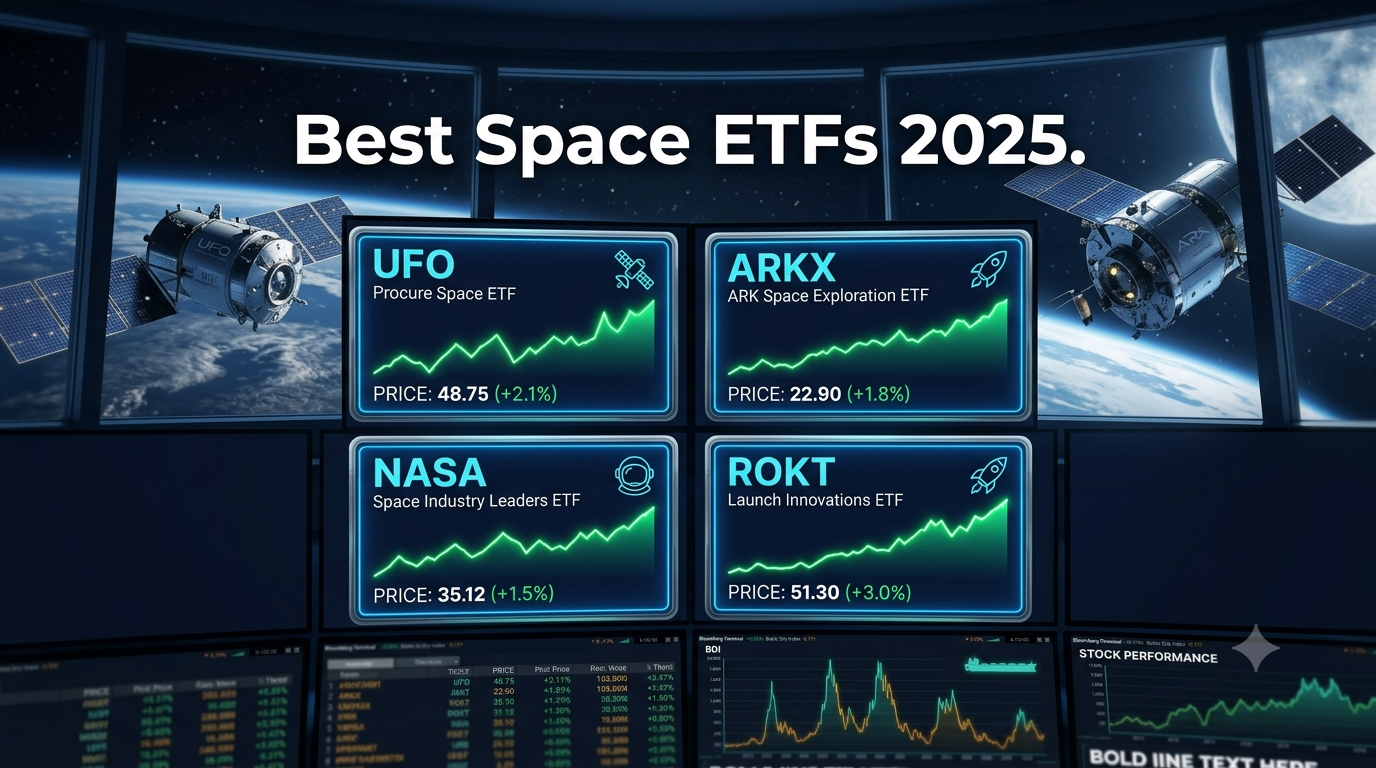
Meta Description: Looking for the best space ETFs in 2025? Compare UFO, ARKX, NASA, ROKT, ORBX & more — with real performance data, expense ratios, and which fits your goals.
Slug URL: best-space-etfs-2025-guide
The Direct Answer
The best space ETFs to watch in 2025 are:
- Procure Space ETF (UFO) — Best overall pure-play space exposure
- ARK Space & Defense Innovation ETF (ARKX) — Best for active, thematic management
- Tema Space Innovators ETF (NASA) — Best newcomer with SpaceX exposure via SPV
- SPDR S&P Kensho Final Frontiers ETF (ROKT) — Best mid-ground: space + reasonable expense ratio (0.45%)
- Global X Space Tech ETF (ORBX) — Best for strict pure-play rules-based exposure
- VanEck Space ETF (WARP) — Best emerging option for focused satellite/launch access
The right one for you depends on whether you want passive index tracking vs. active management, pure-play space vs. defense-adjacent exposure, and how much you’re willing to pay in fees.
Introduction: Why Space ETFs Are Suddenly Everywhere
For most of its existence, the space investing theme was a novelty. A curiosity. The kind of thing financial advisors politely nodded at before steering you back toward S&P 500 index funds.
Not anymore.
The numbers tell a clear story: as of mid-2025, space-themed ETFs collectively hold over $5.24 billion in assets under management — a figure that was virtually unimaginable just 18 months ago. One of the original space funds, the Procure Space ETF (UFO), had a mere $33 million in assets at the end of 2024. Today, it’s crossed $1 billion. That’s not momentum — that’s a category transformation.
What changed? A convergence of powerful forces: Starlink’s subscriber growth, the commercial viability of reusable launch systems, defense budgets accelerating toward space-based assets, and — above all — the looming prospect of a SpaceX IPO that has sent retail and institutional investors alike racing to find the best vehicle for space economy exposure.
Here’s the problem: not all space ETFs are created equal. Some are genuinely focused on the space economy. Others stretch the definition to include defense contractors, deep-sea technology companies, and AI firms with loose “space adjacency.” The fee structures vary. The liquidity varies. The risk profiles vary substantially.
This guide breaks it all down — clearly, honestly, and with real numbers — so you can make a decision based on facts, not headlines.
Why Invest in Space ETFs at All?
Before comparing specific funds, let’s address the fundamental question: why space ETFs instead of individual space stocks?
The Diversification Argument
Space is a genuine growth sector with multiple revenue streams — satellite communications, launch services, Earth observation, space tourism, defense contracts, and in-space manufacturing. But individual space companies carry enormous concentration risk. A single launch failure, a regulatory setback, or a contract loss can wipe out 20–40% of a company’s value overnight.
Space ETFs spread that risk across dozens of companies simultaneously, giving you exposure to the sector’s upside while cushioning against any single company’s bad week.
The SpaceX Problem
Here’s the uncomfortable truth that makes space ETFs particularly relevant right now: the most valuable space company in the world — SpaceX — is private. Most retail investors cannot buy SpaceX shares directly. ETFs that hold SpaceX through Special Purpose Vehicles (SPVs) or secondary markets offer one of the few accessible routes to that exposure.
The Macro Tailwind
The space economy is projected to reach $1.8 trillion by 2035, according to research from Morgan Stanley and other institutional analysts. Government space budgets — NASA, the Space Force, international agencies — continue to expand. Commercial satellite internet is scaling rapidly. These are structural, multi-decade growth drivers, not a short-term trade.
That said, this is still a high-risk, high-growth sector. Treat it as a satellite allocation (5–15% of portfolio), not a core holding.
The 2025 Space ETF Landscape at a Glance
The space ETF market has exploded in 2025. Where there were once only 3–4 options, there are now more than 10 funds vying for investor dollars. Here’s a quick overview before we go deep on each:
| ETF Ticker | Fund Name | Type | Expense Ratio | AUM (Mid-2025) | SpaceX Exposure |
|---|---|---|---|---|---|
| UFO | Procure Space ETF | Passive (Index) | 0.75% | ~$1.25B | Indirect/Minimal |
| ARKX | ARK Space & Defense Innovation ETF | Active | 0.75% | ~$1B+ | No |
| NASA | Tema Space Innovators ETF | Active | 0.87% | Growing rapidly | Yes (via SPV, ~10%) |
| ROKT | SPDR S&P Kensho Final Frontiers ETF | Passive (Index) | 0.45% | ~$237M | No |
| ORBX | Global X Space Tech ETF | Passive (Index) | 0.50% | Growing | No |
| WARP | VanEck Space ETF | Passive (Index) | TBD | Early stage | No |
| MARS | Roundhill Space & Technology ETF | Active | TBD | ~$76M | No |
Note: AUM figures reflect mid-2025 estimates. Always verify current data at ETF issuer websites before investing.
Deep Dive: The Top Space ETFs of 2025
1. Procure Space ETF (UFO) — The Pure-Play Pioneer
Ticker: UFO | Expense Ratio: 0.75% | AUM: ~$1.25B | Type: Passive, Index-Tracking
If there’s a flagship fund for space investing, UFO has earned that title by longevity alone. Launched in 2019, it spent years as a niche fund with barely enough assets to keep the lights on — just $33 million at the end of 2024. The SpaceX IPO narrative changed everything. It has since surged to over $1 billion in AUM, making it the largest dedicated space ETF.
What UFO actually holds: UFO tracks the S-Network Space Index, which requires that companies derive a majority of their revenues from space-related activities. Key holdings include Planet Labs (NYSE: PL), Rocket Lab (NASDAQ: RKLB), L3Harris Technologies, and Iridium Communications. The portfolio is approximately 80% pure-play space companies — one of the tightest definitions in this category.
Performance: UFO delivered approximately 30% year-to-date returns through mid-2025 — a dramatic reversal from years of underperformance. Since inception through the same period, it’s up around 26%.
Who it’s for: Investors who want the most direct, rules-based exposure to the space economy without active management discretion. If you believe the sector as a whole will grow and want to track it cleanly, UFO is the benchmark fund.
The honest caveat: UFO does not currently hold SpaceX directly, which remains its most glaring gap given SpaceX’s dominance of the commercial launch market. The 0.75% expense ratio is on the higher end for a passive fund — though arguably justified by the niche market access.
2. ARK Space & Defense Innovation ETF (ARKX) — The Active Manager’s Bet
Ticker: ARKX | Expense Ratio: 0.75% | AUM: ~$1B+ | Type: Active Management
ARK Invest built its reputation on early conviction in Tesla, genomics, and fintech. ARKX brings that same active, forward-looking philosophy to the space and defense sectors.
Unlike UFO’s rules-based index approach, ARKX is actively managed — meaning ARK’s research team makes discretionary decisions about which companies belong in the portfolio. This creates both opportunity and risk.
What ARKX actually holds: The fund typically holds 35–55 companies and includes not just pure-play space firms but also companies ARK identifies as critical enablers — advanced robotics, AI, 3D printing, energy storage, and defense technology. Key holdings include Rocket Lab (~8%), Kratos Defense (~7%), and Advanced Micro Devices, reflecting a mix of aerospace and defense innovation.
Performance: ARKX posted a 1-year return of approximately 48% through mid-2025, outperforming the S&P 500 over that period. Since inception through the same stretch, it’s up around 19% — trailing NASA but ahead of ROKT.
Who it’s for: Investors who believe ARK’s thematic research has genuine edge in identifying the space economy’s key enablers — including companies that don’t show up in traditional aerospace indexes. If you want active management and are comfortable with a broader, more adaptive definition of “space,” ARKX is compelling.
The honest caveat: ARK’s active management has been a double-edged sword historically. ARKX’s broader definition of “space” means holdings can drift far from the sector. It does not hold SpaceX. And the 0.75% expense ratio for an active fund is reasonable but not cheap.
3. Tema Space Innovators ETF (NASA) — The Exciting Newcomer
Ticker: NASA | Expense Ratio: 0.87% | AUM: Rapidly growing | Type: Active Management
NASA is the most interesting new entry in the space ETF landscape — and the one generating the most buzz in 2025. Launched in late March 2025, it has already demonstrated performance that turns heads.
The SpaceX differentiator: NASA is currently the only space-themed ETF that holds SpaceX — approximately 10.3% of the fund, accessed through a Special Purpose Vehicle, just behind its top holding, Rocket Lab, at 10.5%. This is the fund’s single biggest differentiator and the primary driver of investor interest.
Performance: Since inception, NASA is up approximately 37% — well ahead of UFO (26%), ROKT (20%), and ARKX (19%) over the same stretch. Whether that outperformance is attributable to SpaceX exposure, portfolio construction, or simply being launched at the right moment remains to be seen.
Other key holdings: Planet Labs, Intuitive Machines, Firefly Aerospace, and other pure-play space operators round out a portfolio focused on companies generating at least half their revenue from space-related activities.
Who it’s for: Investors who specifically want SpaceX exposure as part of their space ETF allocation — and are willing to pay a slightly higher expense ratio (0.87%) and accept a shorter performance track record for it.
The honest caveat: NASA is a young fund with a limited track record. The SpaceX SPV holding introduces structural complexity — you’re not holding SpaceX equity directly, but a vehicle that holds it. The highest expense ratio in the non-leveraged space ETF group is a real cost to weigh against the SpaceX exposure benefit.
4. SPDR S&P Kensho Final Frontiers ETF (ROKT) — The Value Play
Ticker: ROKT | Expense Ratio: 0.45% | AUM: ~$237M | Type: Passive (Index)
ROKT is the budget-conscious space investor’s best friend — and it’s criminally underappreciated. It tracks the S&P Kensho Final Frontiers Index, which covers companies driving the exploration of space and the deep seas (though in practice, it’s predominantly a space fund).
What ROKT actually holds: Key holdings include Rocket Lab, Planet Labs, Intuitive Machines, Northrop Grumman, and L3Harris Technologies. The fund has approximately 98% U.S. company exposure and leans heavily toward Industrials (64%+) and Technology sectors.
Why the expense ratio matters: At 0.45%, ROKT charges nearly half the fee of UFO and ARKX. Over a 10-year holding period, that difference compounds significantly. For investors who believe in passive, low-cost indexing as a philosophy, ROKT is the most consistent choice in the space category.
Performance: ROKT has delivered approximately 20% since the same inception-comparison period used above — trailing NASA and UFO but doing so at a meaningfully lower cost. Strong holdings like Moog and L3Harris have driven returns, while some smaller names like Intuitive Machines have been more volatile.
Who it’s for: Cost-conscious investors who want diversified space exposure through a reputable passive index from State Street (one of the world’s largest asset managers) at the lowest fee in the pure-play space category.
The honest caveat: The deep-sea mandate technically creates some portfolio drift, though in practice this is minimal. No SpaceX exposure. The 98% U.S. concentration is a geographic limitation for globally minded investors.
5. Global X Space Tech ETF (ORBX) — The Rules-Based Purist
Ticker: ORBX | Expense Ratio: 0.50% | AUM: Growing | Type: Passive (Index)
ORBX is one of the newer entrants in the space ETF category but comes from a credible thematic ETF issuer in Global X (part of Mirae Asset). It tracks the Global X Space Tech Index with a strict 50% revenue gate — meaning holdings must derive at least half their revenue from qualifying space activities.
Portfolio characteristics: ORBX spans launch systems, satellite communications, space infrastructure, software, and data solutions. A 20% single-name ceiling prevents runaway concentration. The mandate is pure-play focused — no defense-adjacent filler.
Who it’s for: Investors who want a pure-play rules-based approach similar to UFO but with a lower expense ratio (0.50% vs. 0.75%) and a slightly different index construction methodology.
The honest caveat: ORBX is a newer fund with less AUM than UFO or ARKX, meaning liquidity is currently thinner. The non-diversified status and small/micro-cap holdings create volatility risk. Give it time to establish a meaningful track record before making it a large allocation.
6. VanEck Space ETF (WARP) — The One to Watch
Ticker: WARP | Expense Ratio: TBD | AUM: Early stage | Type: Passive (Index)
WARP is among the newest space ETFs, launched in 2025 from VanEck — a highly credible ETF issuer known for its thematic and sector funds. Early assets are modest, but VanEck’s track record in building durable thematic funds makes this one worth monitoring.
Focus: WARP leans toward satellite communications and launch providers, making it more tightly focused than some broader competitors. Holdings overlap significantly with UFO and ORBX but may offer a differentiated index methodology over time.
Who it’s for: Investors who want to watch a new fund establish itself before committing meaningful capital, or those who specifically want VanEck’s research infrastructure behind a space allocation.
The honest caveat: Too early to evaluate on performance. Thin AUM and trading volume create liquidity risk for now. Check back in 12–18 months for a meaningful track record.
Head-to-Head Comparison: Top 4 Space ETFs
| Feature | UFO | ARKX | NASA | ROKT |
|---|---|---|---|---|
| Type | Passive | Active | Active | Passive |
| Expense Ratio | 0.75% | 0.75% | 0.87% | 0.45% |
| SpaceX Exposure | No | No | Yes (~10%) | No |
| Pure-Play Focus | High (~80%) | Medium | High | Medium-High |
| AUM | ~$1.25B | ~$1B+ | Growing fast | ~$237M |
| Track Record | Since 2019 | Established | Since Mar 2025 | Established |
| Best For | Pure-play index | Active thematic | SpaceX access | Cost efficiency |
| Biggest Risk | No SpaceX | Fee + drift | Short history | Deep-sea dilution |
How to Choose the Right Space ETF for You
Not every investor has the same goals. Here’s a decision framework:
Choose UFO if:
- You want the broadest pure-play space exposure
- You prefer passive, rules-based index investing
- You want the most liquid, established space ETF
- You’re comfortable paying 0.75% for sector access
Choose ARKX if:
- You trust ARK’s active research and conviction-driven approach
- You want exposure to “space-adjacent” technology (AI, robotics, 3D printing)
- You want a fund that adapts as the space economy evolves
- You’re comfortable with active management variability
Choose NASA if:
- SpaceX exposure is your primary goal
- You’re willing to pay the highest expense ratio (0.87%) for it
- You can accept a short track record and higher structural complexity
- You believe early outperformance reflects genuine portfolio quality
Choose ROKT if:
- You’re fee-sensitive and want the lowest expense ratio in the category (0.45%)
- You believe in passive investing and long-term compounding
- You want State Street’s institutional credibility behind your space allocation
- You’re not specifically seeking SpaceX exposure
Consider combining:
Many investors building a serious space allocation combine 2–3 funds:
- Core (60%): UFO or ROKT for broad, low-cost index exposure
- Satellite (25%): NASA for SpaceX access and active management
- Tactical (15%): Individual space stocks (RKLB, PL, LUNR) for high-conviction bets
Risks Every Space ETF Investor Must Understand
Be honest with yourself about these before investing:
Sector Concentration Risk
Space ETFs are thematic, single-sector bets. If the space economy faces a macro headwind — a major launch failure, government budget cuts, regulatory crackdowns — every fund in this category will feel it simultaneously.
Government Dependency
Many of the top holdings across all space ETFs — Rocket Lab, L3Harris, Northrop Grumman, Kratos Defense — rely heavily on NASA, Space Force, and DoD contracts. Budget sequestration or shifting political priorities can ripple through an entire ETF’s portfolio.
Expense Ratio Drag
Space ETFs are expensive by passive investing standards. UFO, ARKX, and NASA all charge 0.75–0.87% annually — compared to 0.03% for a Vanguard S&P 500 fund. Over 20 years, that fee difference compounds into meaningful real money.
Liquidity Risk in Newer Funds
Newer funds like ORBX, WARP, and MARS have thin trading volumes. This means bid-ask spreads can be wide and large buy/sell orders can move the price. Stick to limit orders rather than market orders for these funds.
The SpaceX Valuation Wildcard
Even funds with SpaceX exposure (like NASA) hold it through SPVs at private market valuations that may or may not be accurate. If SpaceX’s IPO pricing disappoints relative to SPV entry prices, that holding could underperform expectations.
Pros and Cons of Space ETFs
| Pros | Cons |
|---|---|
| Diversified sector exposure in one trade | High expense ratios vs. broad market ETFs |
| Accessible way to benefit from space economy growth | No direct SpaceX access in most funds |
| Liquid, exchange-traded — buy/sell anytime | Heavy sector concentration risk |
| Multiple strategy options (active/passive) | Most funds have short track records |
| Lower minimum than private market investments | Government budget dependency of holdings |
FAQ: Space ETF Investing Questions Answered
Q1: Can space ETFs give me SpaceX exposure?
Only one current space ETF — the Tema Space Innovators ETF (NASA) — holds SpaceX, doing so through a Special Purpose Vehicle at approximately 10% of the portfolio. Other funds like UFO and ROKT hold SpaceX competitors but not SpaceX itself. If a SpaceX IPO materializes, most major space ETFs would be expected to add it to their holdings once it’s publicly listed.
Q2: Are space ETFs a good long-term investment?
They can be — but as a supplemental allocation, not a core holding. The space economy has genuine structural growth drivers over the next decade and beyond. However, the sector is volatile, expense ratios are high, and many individual holdings are pre-profit companies with execution risk. Keep space ETF exposure to 5–15% of your total portfolio.
Q3: What is the cheapest space ETF by expense ratio?
The SPDR S&P Kensho Final Frontiers ETF (ROKT) currently has the lowest expense ratio among established space-focused ETFs at 0.45%. The iShares Aerospace & Defense ETF (ITA) and SPDR Aerospace & Defense ETF (XAR) are cheaper (0.38–0.40%) but include heavy defense contractor exposure that dilutes pure-play space exposure significantly.
Q4: How is UFO different from ARKX?
UFO (Procure Space ETF) tracks a passive index focused on companies deriving most of their revenue from space activities — it’s rules-based and narrow. ARKX (ARK Space & Defense Innovation ETF) is actively managed by ARK Invest and takes a broader, thematic view — including defense innovation and “enabling” technologies like AI, robotics, and 3D printing. UFO is more focused; ARKX is more adaptive and opinionated.
Q5: Should I invest in a space ETF or individual space stocks?
Most investors are better served by ETFs, which spread single-company risk across the sector. Individual space stocks like Rocket Lab (RKLB), Planet Labs (PL), or AST SpaceMobile (ASTS) can deliver higher returns if you pick well — but they can also lose 50%+ on a single bad quarter. A core space ETF allocation with a small tactical position in 1–2 individual stocks is a common approach for sophisticated investors.
Q6: What happens to space ETFs if SpaceX goes public?
A SpaceX IPO would likely be a watershed moment for the entire space ETF category. Most index-tracking funds (UFO, ROKT, ORBX) would be expected to add SpaceX once it meets index eligibility requirements. Inflows into space ETFs would likely surge dramatically. The NASA fund, which already holds SpaceX via SPV, could see its SPV position converted to publicly traded equity — simplifying its structure and potentially reducing holding cost.
Q7: Are there leveraged space ETFs?
Yes — the Defiance Pure Space Daily 2X Strategy ETF (SPCL) offers 2x daily leveraged exposure to space stocks. Leveraged ETFs are designed for short-term traders, not long-term investors. Compounding decay means that holding a 2x leveraged ETF over months or years typically produces returns significantly below 2x the underlying index. Approach leveraged space ETFs with extreme caution.
Q8: How much of my portfolio should be in space ETFs?
Financial planners generally recommend limiting thematic/sector ETF exposure to 5–15% of a total investment portfolio for most investors. Space is an exciting, high-potential sector — but it’s also volatile, expensive to hold in fee terms, and highly correlated within the fund category. Make sure your foundation of diversified, low-cost broad market exposure is solid before adding thematic overlays.
Before vs. After Adding a Space ETF to Your Portfolio
| Portfolio Characteristic | Without Space ETF | With Space ETF (5–10% allocation) |
|---|---|---|
| Sector diversification | Broad market only | Adds dedicated space/aerospace exposure |
| SpaceX access | None (for most investors) | Partial (via NASA fund’s SPV) |
| Volatility | Lower | Slightly higher |
| Growth potential | Market rate | Potential sector outperformance |
| Annual fee drag | 0.03–0.20% (if index-heavy) | Adds 0.45–0.87% on allocated portion |
| Complexity | Low | Low-to-medium |
Conclusion: The Right Space ETF Is the One That Fits Your Strategy
The space economy is real, it’s growing, and 2025 is shaping up to be one of the most consequential years in its investment history. The ETF options available to investors today are better than they’ve ever been — more focused, more competitively priced, and more strategically distinct.
But “best space ETF” isn’t a universal answer. It’s a personal one.
If you want pure-play passive exposure, UFO is still the benchmark. If you want active management with space-defense overlap, ARKX has the track record. If you want SpaceX exposure specifically, NASA is the only game in town. If you want the lowest fees, ROKT is the rational choice.
What you shouldn’t do is pick a space ETF because of a headline, a Elon Musk tweet, or FOMO from missing early Rocket Lab. Build your allocation deliberately, size it appropriately (5–15% of portfolio), combine it with a strong core of diversified broad market funds, and revisit the thesis annually as the sector evolves.
The universe is a big place. There’s no need to rush.
Your action checklist:
- ✅ Confirm space ETFs fit your broader portfolio allocation strategy
- ✅ Decide: passive (UFO, ROKT, ORBX) or active (ARKX, NASA)?
- ✅ Decide: SpaceX exposure priority (NASA) or cost priority (ROKT)?
- ✅ Limit space ETF allocation to 5–15% of total portfolio
- ✅ Use limit orders (not market orders) for newer, thinner funds
- ✅ Revisit your allocation after any major SpaceX IPO news
💬 Which space ETF are you watching most closely in 2025? Drop your pick in the comments — and tell us why.
📩 Subscribe to our weekly investor newsletter for no-hype analysis on thematic ETFs, private markets, and growth investing opportunities.
📤 Know someone trying to decide between space ETFs? Share this comparison guide with them.

