

Meta Description: Sensex surged 1,695 pts & Nifty hit 23,623 on June 12, 2026. Here’s what drove the mega-rally, which stocks won big, and what you should do next.
The Short Answer: What Happened on June 12, 2026?
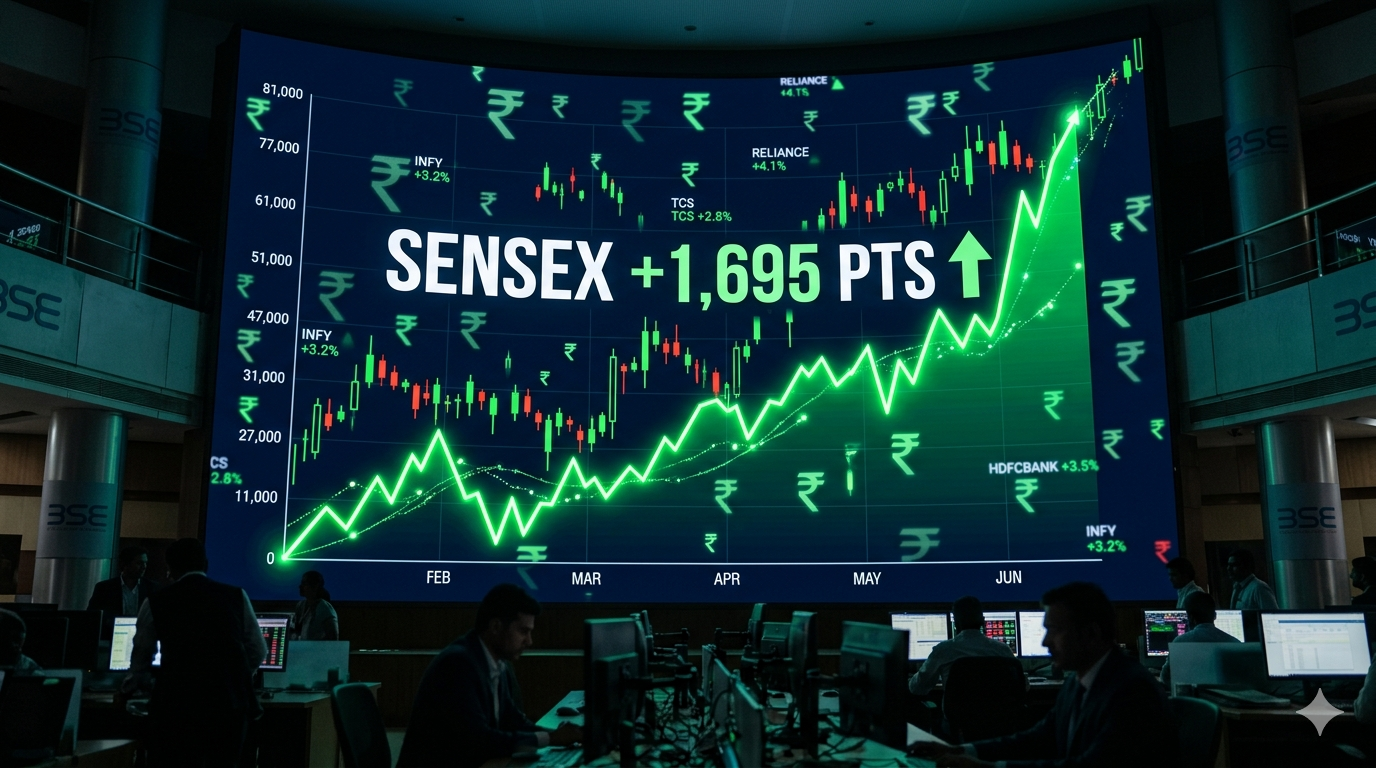
On Friday, June 12, 2026, India’s stock markets staged one of their most powerful single-day recoveries of the year. The BSE Sensex surged 1,695 points (2.3%) to close at 75,527, while the Nifty50 jumped 461 points (1.99%) to settle at 23,622.90. The catalysts? A landmark draft peace deal between the US and Iran — and a resulting crash in global crude oil prices. Investor wealth on BSE-listed firms swelled by roughly ₹7 lakh crore in a single session, pushing total market capitalisation to nearly ₹460 lakh crore.
If you’ve been nervously watching your portfolio over the past few months — wondering when the geopolitical storm would pass — Friday, June 12 gave you the first real breath of fresh air.
Let’s break down exactly what happened, why it matters to you, and what smart investors are doing about it.
Why Did the Market Rally So Sharply? The Big Picture
The US–Iran Peace Deal: The Spark That Lit the Fire
The afternoon session on June 12 saw the Nifty and Sensex accelerate after reports emerged that the United States and Iran had agreed on a draft 14-point memorandum of understanding (MoU). The key terms, according to media reports cited by multiple exchanges and news agencies, included:
- Iran agreeing to reopen the Strait of Hormuz within 30 days
- The lifting of oil sanctions against Iran
- The release of frozen Iranian funds
- The withdrawal of US military forces from the region
- Iran committing to no nuclear weapon ambitions
This is hugely significant. The Strait of Hormuz is the world’s most critical oil chokepoint — roughly 20% of global crude shipments pass through it. When military conflict between the US and Iran effectively shut it down beginning in late February 2026, crude oil prices rocketed from around $61/barrel in January to highs above $118/barrel by the end of Q1 2026, according to U.S. Energy Information Administration (EIA) data. That spike triggered inflation fears, earnings downgrades, and a punishing bear run across emerging markets.
Friday’s deal prospects reversed that narrative in a matter of hours.
US President Donald Trump publicly confirmed progress, telling reporters that Washington had “reached a great settlement with Iran” and that only the final document remained. Bloomberg separately reported that the two nations were nearing an agreement around the G7 meeting week. That double confirmation was enough to send every major global equity market — and the Indian rupee — surging.
Crude Oil’s Sharp Fall: A Gift for India
Why Lower Oil Is Such a Big Deal for Indian Markets
India imports around 85% of its crude oil needs, which makes it acutely vulnerable to energy price spikes. When oil rises, so do:
- Inflation (fuel, transport, manufacturing costs all climb)
- India’s current account deficit (more dollars flow out for oil imports)
- Rupee pressure (more dollar outflows weaken the currency)
- Profit margins for aviation, paints, chemicals, tyres, and logistics companies
When oil falls? The exact opposite happens — and investors reprice all of that very quickly.
On June 12, 2026:
| Benchmark | Price | Change |
|---|---|---|
| Brent Crude | ~$87/barrel | ↓ ~4% |
| WTI Crude | ~$84/barrel | ↓ ~3.9% |
Brent had been trading above $105/barrel just weeks prior. According to Trading Economics, Brent fell toward its lowest level since early March, erasing months of geopolitical premium in a single session. The EIA’s June Short-Term Energy Outlook had estimated Brent would average $105/barrel in June and July — so this move was a significant downside surprise driven entirely by the peace deal optimism.
For India, cheaper oil is almost like a de facto tax cut — it eases headline inflation, improves the current account, and allows the RBI more room to cut interest rates. All of that is positive for corporate earnings.
How Indian Markets Reacted: The Numbers
Index Performance — June 12, 2026 Close
| Index | Close | Change (Points) | Change (%) |
|---|---|---|---|
| BSE Sensex | 75,527.95 | +1,695.40 | +2.30% |
| Nifty50 | 23,622.90 | +461.30 | +1.99% |
| Nifty Midcap 100 | — | — | +2.43% |
| Nifty Smallcap 100 | — | — | +2.80% |
| Nifty Bank | — | — | +3.00% |
One important detail worth noting: the rally was broad-based from the opening bell. Smallcaps and midcaps actually outperformed large-caps, which signals genuine risk-on appetite rather than just index-level rebalancing. That’s a healthier kind of rally.
The market opened sharply higher — Sensex gapped up nearly 992 points at open — before consolidating in the mid-session and then surging again in the afternoon after the Iran MoU reports crystallised.
Top Gainers on Sensex & Nifty
The rally had clear winners, with financials, aviation, and consumption stocks leading:
- Bajaj Finance — up ~5.6% (financials rallied on rate-cut expectations)
- Larsen & Toubro (L&T) — up ~4.8% (infrastructure play on normalising supply chains)
- IndiGo (InterGlobe Aviation) — up ~4.5% (direct beneficiary of lower jet fuel costs)
- Tata Motors PV — up ~4%
- Titan — up ~3.8%
- Eternal & HDFC Bank — up ~3.7% each
- Shriram Finance — led the percentage gains at +8.1%
- Tata Steel, SBI, Tech Mahindra — each up roughly 3%
All 30 Sensex stocks closed in the green — a rare show of unanimous bullishness.
Notable exception: The IT index traded largely flat to slightly negative. This makes sense — IT companies earn in dollars, and a stronger rupee actually reduces the rupee value of their overseas revenues. When geopolitical fear eases and the rupee strengthens, IT stocks often underperform the broader market.
The Rupee’s Comeback
The Indian rupee appreciated by 60 paise to 85.25 against the US dollar, supported by the dual tailwind of falling crude oil import costs and improved global risk appetite. A stronger rupee reduces the cost of oil imports further — creating a positive feedback loop for the broader economy.
What Happened Globally? India Wasn’t Alone
The June 12 rally wasn’t just a Dalal Street story. It was a global risk-on day:
| Market | Performance |
|---|---|
| Japan’s Nikkei | +~3% |
| South Korea’s Kospi | +~8% |
| Hong Kong’s Hang Seng | +~2% |
| China’s Shanghai Composite | +~2% |
| Taiwan Benchmark | +~2.5% |
| Wall Street (prior session) | Rally that triggered Asian follow-through |
South Korea’s 8% surge is particularly striking — Korean markets are highly sensitive to global trade and energy stability, and the Kospi’s move reflects just how dramatically the mood shifted.
Interestingly, India’s gains, while impressive, were more moderate than Korea’s — which suggests there may still be room for further catch-up if the deal is finalised.
Sectoral Analysis: Who Benefits the Most?
Big Winners If the US–Iran Deal Holds
Aviation: IndiGo and other carriers have suffered enormously from high Aviation Turbine Fuel (ATF) costs over the past several months. Every $10 drop in crude oil significantly boosts airline margins. If oil stabilises below $90/barrel, IndiGo’s earnings estimates could see meaningful upgrades.
Banking & Financial Services: Easing oil prices reduce inflation expectations, which gives the Reserve Bank of India (RBI) room to cut interest rates. Lower rates are a tailwind for loan growth and net interest margins for banks. Bajaj Finance’s 5.6% jump reflects this repricing.
Auto: Tata Motors and others benefit from lower input costs (plastics, rubber, steel) and the prospect of EMIs becoming more affordable if rates fall.
Real Estate: Lower interest rates reduce home loan EMIs, improving affordability and demand. Real estate stocks were among the stronger sectors on the day.
Oil & Gas (Mixed): Companies like ONGC are actually hurt by lower crude prices since their realisation per barrel falls. Watch this space.
IT (Cautious): As mentioned, a stronger rupee is a mild headwind for IT exporters. Nothing dramatic, but worth monitoring.
Before vs. After: How the Market Sentiment Shifted
| Factor | Before June 12 | After June 12 |
|---|---|---|
| Crude Oil (Brent) | ~$91–95/barrel | ~$87/barrel (falling) |
| Geopolitical Risk | High (Strait of Hormuz closed) | Easing (deal on table) |
| Indian Rupee | ~85.85 vs USD | ~85.25 vs USD (+60 paise) |
| Investor Sentiment | Risk-off, cautious | Risk-on, broad buying |
| Nifty Trend | Below 23,200 | Reclaimed 23,600 |
| Market Cap (BSE) | ~₹453 lakh crore | ~₹460 lakh crore |
What Should You Do Now? Practical Investor Guidance
Disclaimer: This is not financial advice. Please consult a SEBI-registered investment advisor before making decisions.
Working with long-term investors, the most common mistake made after a big rally day is one of two extremes: panic-selling on the assumption that the rally is a “dead cat bounce,” or FOMO-buying everything in sight. Neither is ideal.
Here’s a more measured approach:
✅ If You Were Already Invested
Don’t overreact. One strong session, however dramatic, doesn’t change your long-term investment thesis. Review your asset allocation, not your daily P&L. If a position has become oversized due to the rally, consider rebalancing — not panic-trimming.
✅ If You’re Sitting on Sideline Cash
Don’t rush in all at once. The Iran deal still requires formal approval from Iranian authorities. Markets could remain volatile if the deal faces last-minute hurdles. Use a Systematic Transfer Plan (STP) or staggered deployment approach — deploy capital in 3–4 tranches over the next few weeks.
✅ Sectors to Watch Closely
- Aviation (IndiGo, Air India if listed)
- NBFC/Banking (Bajaj Finance, HDFC Bank, SBI)
- Auto (Tata Motors, Maruti)
- Infrastructure/Capital Goods (L&T)
- Consumer Discretionary (Titan, Eternal)
✅ Risk Factors to Keep Monitoring
- Formal confirmation of the US-Iran deal — markets have priced in hope, not certainty
- Strait of Hormuz reopening — Iran has said “within 30 days,” but implementation risks remain
- US domestic politics — deals like this can shift with election cycles and Congressional pressure
- India’s FII flows — continued foreign institutional investor buying will be key for sustaining gains
- RBI policy stance — watch for any rate signals at the next Monetary Policy Committee (MPC) meeting
The Bigger Context: Where Indian Markets Stand in 2026
It’s worth stepping back. The Sensex had begun 2026 around the 78,000–80,000 range before the February military action in the Middle East sent crude oil soaring past $100/barrel — and equity markets tumbling. The June 12 close at 75,527 still leaves the index below its year-start levels.
That said, Friday’s move is meaningful. The EIA had estimated that the Brent crude spot price averaged $107/barrel in May. A drop to $87 represents a nearly 19% decline from May’s average. If sustained, that is an enormous macro relief for India — a country whose trade balance, inflation, and RBI policy are all deeply linked to the price of a barrel of oil.
India’s equity market, despite the volatility, has demonstrated resilience. Mid and small caps have recovered faster than large caps in many sessions, suggesting domestic investors have used dips to accumulate quality positions.
3 Surprising Insights Most Investors Are Missing
1. South Korea’s 8% surge is the real signal. Korea’s export-driven economy is extremely sensitive to global trade normalisation. A single-day Kospi jump of 8% is historically rare and suggests institutional investors globally are making a massive geopolitical repricing bet — not just a technical bounce.
2. The rupee’s move matters as much as the Nifty’s. A stronger rupee reduces the cost of oil imports, controls inflation, reduces pressure on RBI to keep rates high, and attracts FII flows. The 60-paise appreciation on June 12 is actually one of the most bullish data points of the day for long-term India watchers.
3. IT being flat is a warning, not a signal to avoid. IT’s underperformance reflects currency logic, not business deterioration. For long-term IT investors, a stronger rupee provides an entry opportunity — you’re effectively buying the same business at a small discount because of FX optics.
Read More
Liotech Industries IPO: Everything You Need to Know Before Investing in This BSE SME Listing
Frequently Asked Questions (FAQ)
1. Why did the Sensex rise so much on June 12, 2026?
The primary trigger was news of a draft peace deal between the US and Iran. The deal, which reportedly includes Iran reopening the Strait of Hormuz and halting nuclear weapons development, dramatically reduced geopolitical risk in global energy markets. This, combined with a sharp fall in crude oil prices, sent global equities — including Indian markets — surging.
2. Which stocks gained the most on June 12, 2026?
Shriram Finance (+8.1%), Bajaj Finance (+5.6%), L&T (+4.8%), IndiGo (+4.5%), Tata Motors PV (+4%), Titan (+3.8%), Eternal (+3.7%), and HDFC Bank (+3.7%) were among the top performers. All 30 Sensex stocks closed in positive territory.
3. Is the US-Iran peace deal confirmed?
As of June 12, 2026, the deal is a draft MoU — it requires formal approval from Iranian authorities. President Trump confirmed significant progress and suggested the deal could be signed over the weekend. However, until it is formally signed and implemented, markets could remain volatile.
4. How does a fall in crude oil prices help India?
India imports about 85% of its crude oil. When oil prices fall: import bills shrink, the current account deficit narrows, inflation eases, the rupee strengthens, and the RBI has more room to cut interest rates. All of this is positive for corporate earnings and equity valuations.
5. What happened to the Indian rupee on June 12?
The rupee appreciated by approximately 60 paise against the US dollar, trading around 85.25 per dollar. The stronger rupee reflects lower dollar demand for oil imports and improved global risk sentiment favouring emerging market currencies.
6. Should I buy stocks now after this rally?
That depends entirely on your financial goals, risk profile, and time horizon. Generally, it is not advisable to make large lump-sum investments immediately after a 2%+ single-day rally. A staggered or STP approach is more prudent. Consult a SEBI-registered financial advisor for personalised guidance.
7. Which sectors are best positioned if oil prices stay low?
Aviation, banking/NBFCs, auto, real estate, paints, and consumer discretionary sectors tend to benefit most from sustained low oil prices. IT and oil-producing companies (like ONGC) may be less positively affected.
8. How does the global rally connect to India’s market?
Global institutional investors (FIIs) manage portfolios across multiple markets. When geopolitical risk eases globally — as with the Iran deal — they increase exposure to higher-risk emerging markets like India. Strong performances in the Nikkei, Kospi, and Hang Seng on the same day confirm this was a coordinated global risk-on move.
Conclusion: A Turning Point — But Stay Alert
June 12, 2026, may well be remembered as a turning point for Indian equities in an otherwise turbulent year. The Sensex’s 1,695-point surge and the Nifty’s return above 23,600 are not just numbers — they represent a fundamental repricing of geopolitical risk that had been suffocating markets since February.
For you as an investor, the key takeaway is this: the macro environment is shifting, but it hasn’t fully cleared. The US-Iran deal is a draft. Crude oil prices have fallen significantly but remain elevated relative to January 2026 levels. The Strait of Hormuz hasn’t reopened yet.
What Friday’s session tells us is that the market is ready to run — as soon as the fog clears. That means the next few weeks of news flow around deal confirmation will be critical.
Stay informed. Stay diversified. Don’t let one big green day make your investment decisions for you.
Found this helpful? Subscribe to our weekly market newsletter for data-driven insights every Friday. Share this with a friend who’s been anxiously watching their portfolio. And drop your questions or thoughts in the comments below — we read every one.
Last updated: June 13, 2026 | Sources: Business Standard, Upstox, HDFC SKY, Trading Economics, U.S. Energy Information Administration (EIA), Fortune

