

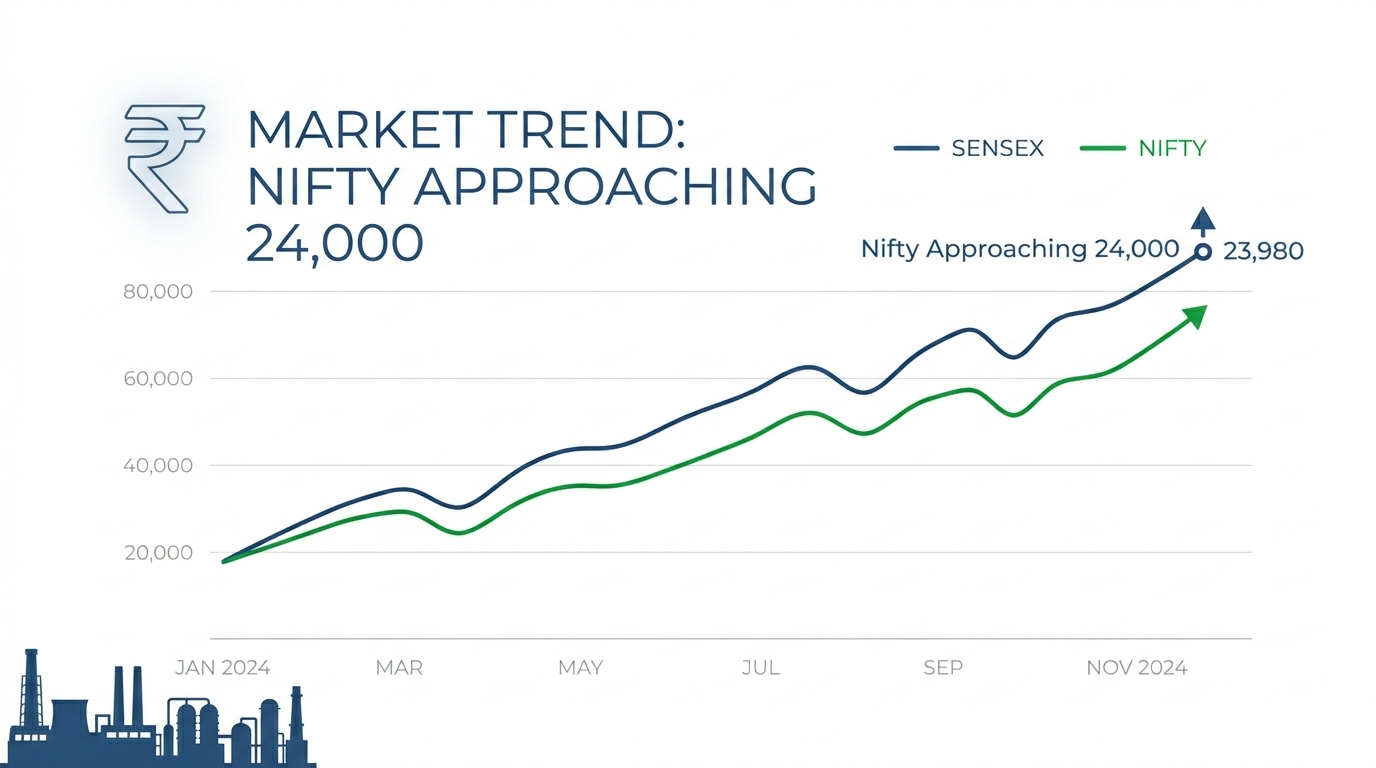
Meta Description: Nifty eyeing 24,000 amid a cautious recovery. Know the key levels, sectoral drivers, analyst targets, and what smart investors should do right now.
Quick Answer: As of mid-June 2026, the Nifty 50 is trading in the 23,100–23,350 range, recovering from recent lows near 23,000. Analysts broadly agree that 24,000 is the next meaningful upside target — but only if the index first clears and sustains above the 23,500–23,550 resistance zone. Geopolitical tensions in West Asia and FPI outflows remain the two biggest obstacles. Domestic institutional buying is providing a crucial floor.
The Number That Has Everyone’s Attention
Let’s be honest. When the Nifty hovers anywhere between 23,000 and 24,000, something interesting happens to investor psychology. Portfolios that looked fine a month ago suddenly feel uncertain. WhatsApp groups light up with screenshots of candlestick charts. And suddenly everyone — from the veteran trader to the first-time SIP investor — wants to know: Is 24,000 actually happening? And when?
The answer is nuanced. And that’s exactly what this post is about.
We’ll walk through where the Nifty stands right now, what levels matter, which sectors could drive the move, what top analysts are saying, and — most critically — what you as an investor should actually do with all of this.
No fluff. No vague optimism. Just honest, grounded analysis.
Where the Nifty Stands Today: A Clear-Eyed Picture
The Nifty 50 has had a turbulent ride through 2026. After touching a 52-week high above 26,000 in late 2025, the index has since corrected sharply — dragged down by an escalating geopolitical situation in West Asia, crude oil volatility, and aggressive foreign institutional selling.
According to 5paisa’s FY26 Market Report, FPI outflows in Indian equity markets exceeded ₹1.71 lakh crore since the start of calendar year 2026, with foreign investors being net sellers on every single trading day in March 2026 during peak West Asia tensions. That is a staggering number — and it explains why the Nifty bled from the mid-25,000s to the sub-23,500 range in a matter of weeks.
But here is the thing: the market has not collapsed. It has been absorbing this selling. And that tells you something important about the underlying strength of domestic participation.
As of the latest sessions, the Nifty has been consolidating around 23,100–23,350 — building a base, finding buyers at lower levels, and waiting for a meaningful trigger to break higher.
The Key Levels Every Investor Must Know
You don’t need to be a technical analyst to use market levels intelligently. Think of them as simple reference points: areas where buyers tend to show up (support) and areas where sellers tend to resist (resistance).
Here is where things stand right now:
Critical Support Zones
| Level | What It Means |
|---|---|
| 23,000 – 23,050 | The most important floor. Multiple sessions have seen buying emerge here. A decisive break below this would signal a significantly more bearish short-term outlook. |
| 22,900 – 22,950 | Secondary support; last line of defense for the bulls. |
| 23,100 – 23,150 | Immediate near-term cushion; important for day-to-day stability. |
Key Resistance Zones on the Way to 24,000
| Level | What It Means |
|---|---|
| 23,300 – 23,350 | First hurdle; needs to be crossed with volume and follow-through |
| 23,450 – 23,550 | The crucial breakout zone. A sustained close above here is the gateway to 24,000. |
| 23,975 – 24,025 | The psychological 24,000 band. Expect supply (selling pressure) here. |
| 24,200 – 24,325 | The next target zone once 24,000 is convincingly broken |
Enrich Money’s technical analysis puts it clearly: “The broader 23,450–23,550 zone, which had previously acted as a repeated rejection area, remains a crucial immediate resistance band. A sustained breakout above this zone could strengthen bullish sentiment and pave the way for a recovery towards 23,800, with further upside potential if momentum remains intact.”
The 24,000 target, in other words, is real — but it is a journey in stages, not a single leap.
What Could Push Nifty to 24,000?
1. Domestic Institutional Investors: The Unsung Heroes
The single most important development in Indian equity markets over the past two years has been the rise of domestic institutional capital as a counterbalance to FPI selling. When foreign investors panic and exit, Indian mutual funds, insurance companies, and pension funds are now large enough to absorb that selling and prevent a market freefall.
In a recent session where FIIs sold approximately ₹4,566 crore worth of Indian equities, DIIs bought ₹6,159 crore — net positive for the market despite the foreign exit. This DII cushion is structural, not temporary. As more Indians invest through SIPs every month (AMFI data shows SIP contributions running well above ₹26,000 crore monthly), this domestic firepower will only grow.
For the Nifty to reclaim 24,000, it does not necessarily need FPIs to return in a big way. It needs DII buying to continue alongside any improvement in global sentiment.
2. India’s Macro Story Remains Intact
Here is the broader context that often gets lost in the noise of daily market movements: India’s economic fundamentals are strong.
The RBI’s April 2026 Monetary Policy confirmed GDP growth for FY26 at 7.6% — one of the strongest rates among major global economies. For FY27, the RBI projects growth at 6.9%, supported by resilient domestic demand, healthy corporate and financial sector balance sheets, and the government’s continued push on capital expenditure.
The IMF raised its India growth forecast for FY26 by 0.7 percentage points to 7.3%, calling out India’s strong momentum even as global growth slows. This kind of macro credibility matters — it is what brings FPIs back to Indian equities when global risk appetite recovers.
A nation growing at 6.9–7.6% with a young population, rising middle class, and deepening capital markets is not a place where equity markets stay depressed for long.
3. Sectoral Rotation: Where the Next Rally Will Come From
Markets rarely rise in a straight line or with all sectors moving together. What typically happens is rotation — one sector leads, others follow. Here is how the sectoral picture looks right now:
Banking & Financials are showing resilience. Bank Nifty has demonstrated strong intraday recovery from lower levels, and with the RBI keeping the repo rate steady at 5.25% amid a neutral stance, banks benefit from stable net interest margins. Any future rate cut cycle — which markets are beginning to price in — would be a massive catalyst for banking stocks.
IT Stocks had a painful correction. But with global digital transformation spend still growing and AI-driven service demand rising, selective buying in large-cap IT is returning. A stabilisation in the rupee would add further tailwind.
Energy & FMCG are providing defensive ballast. When uncertainty rises, investors rotate into consumer staples and energy — sectors that generate reliable cash flows regardless of economic cycles.
Auto & Real Estate remain interest-rate sensitive and could see sharp upside moves if the RBI signals a more accommodative stance in future policy meetings.
4. Global Cues: The Wildcard
As Business Standard noted in its H2 2025 outlook, “any escalation in West Asia could push oil prices higher, disrupting the global inflation cycle and rattling stock markets — though the impact of oil price shocks during conflicts has been diminishing.”
Any de-escalation in the Iran situation, or a softening in US Federal Reserve language around interest rates, could trigger a rapid return of FPI flows into Indian equities and accelerate the Nifty’s path toward 24,000 faster than most expect.
What Could Delay or Derail the 24,000 Target?
Being genuinely helpful means being honest about downside risks too.
Risk 1 — West Asia Escalation India imports nearly 85% of its crude oil. Any disruption to shipping lanes through the Strait of Hormuz directly impacts fuel prices, the current account deficit, the rupee, and — by extension — corporate margins across multiple sectors. The RBI’s April 2026 policy explicitly cited “global oil shocks and Strait of Hormuz disruptions” as primary threats to FY27 growth.
Risk 2 — Sustained FPI Outflows While DII buying has been a lifeline, it has limits. If FPI selling intensifies beyond the ₹1.71 lakh crore already seen in 2026, even robust domestic buying may struggle to lift the index toward 24,000 without a breather.
Risk 3 — Earnings Disappointment Markets trade on future expectations, not past performance. If Q1 FY27 earnings (July–August reporting season) disappoint — especially in banking, IT, or consumer sectors — the Nifty could see a fresh de-rating that keeps it below 24,000 for longer.
Risk 4 — US Rate Uncertainty As Angel One’s senior analyst Vaqarjaved Khan noted, “if inflation remains sticky, the US Federal Reserve could delay or scale back rate cuts, which would impact global liquidity” — and consequently, FPI flows into emerging markets like India.
What Analysts Are Saying: The Honest View
The broker and analyst community is cautiously constructive. Here is a consolidated read:
- Near-term range: 23,000 – 24,000
- Breakout trigger: Sustained close above 23,550 with volume
- First upside target post-breakout: 23,800 – 24,025
- Extended target if 24,000 holds: 24,275 – 24,325
- Critical stop-loss for bulls: 22,900 (a break here flips the bias to bearish)
Multiple brokerage firms have forecast the Nifty 50 to reach between 24,000 and 26,000 over 2025-26, driven by India’s strong economic fundamentals — though global uncertainties around oil, inflation, and geopolitics are expected to cause short-term pressure along the way.
The key word from every credible analyst right now: patience. The levels are there. The macro story supports the upside. But the timing depends on variables outside anyone’s control — particularly geopolitics.
Investor Strategy: What Should You Actually Do?
If You Are a Long-Term SIP Investor (Horizon: 5+ Years)
Stop obsessing over 24,000. Seriously.
If you are investing monthly through SIPs in diversified equity mutual funds, current Nifty levels (23,000–23,500) are actually an opportunity, not a threat. Every dip means your SIP buys more units. When the market eventually recovers — and historically, it always has — those extra units generate outsized returns.
India’s real GDP grew 7.6% in FY26, and is projected to grow at 6.9% in FY27. In an economy growing at that pace, equity markets have a structural tailwind. Stay invested, stay disciplined, and consider a step-up SIP (increasing your SIP amount by 10% annually) to accelerate wealth creation.
Suggested action: Do not stop or pause SIPs due to short-term market uncertainty. If you have idle lumpsum funds and a 3+ year view, current levels have historically been rewarding entry points.
If You Are an Active Trader (Horizon: Days to Weeks)
The trading setup is fairly well-defined by technical levels:
- Buy zone: 23,200 – 23,300 with a stop-loss at 22,900
- First target: 23,500 – 23,550 (the breakout level)
- Confirm breakout: Only enter aggressively above 23,550 on a closing basis with good volume
- Extended target: 24,000 – 24,025 on momentum continuation
Never risk more than 1–2% of your total trading capital on a single position. And always remember: the stop-loss is not optional.
If You Are a Mutual Fund Investor Building Wealth
Consider adding allocation to:
- Flexicap or multicap funds — For diversification across market caps
- Banking and financial sector funds — If you believe in the rate cut thesis
- International funds — For geographic diversification away from India-specific risks
Consult a SEBI-registered investment advisor before making allocation changes. The above is directional guidance, not personalized advice.
Quick Reference: Nifty 24,000 Scenarios at a Glance
| Scenario | Trigger | Probability | Investor Action |
|---|---|---|---|
| Bulls break 24,000 | West Asia calm + FPI return + earnings beat | Moderate | Ride the trend; book partial profits at resistance |
| Nifty consolidates 23,000–23,500 | Uncertainty persists; no clear catalyst | High (near term) | Accumulate quality stocks in dips; continue SIPs |
| Bearish breakdown below 23,000 | Escalation in conflict + crude spike + sustained FPI selling | Low-Moderate | Hold cash; wait for re-entry signals; do not panic-sell SIPs |
FAQ: The Questions Real Investors Are Asking
Q1. Will Nifty definitely reach 24,000?
No one can say “definitely” about short-term market moves. What analysts say is that 24,000 is the next logical upside target if 23,550 is crossed and held. Treat it as a conditional target, not a promise.
Q2. Should I invest a lumpsum now or wait for a dip to 22,500?
Timing the market perfectly is nearly impossible. If your investment horizon is 3+ years, investing in tranches at current levels (rather than waiting for a hypothetical lower level that may not come) is a more practical strategy.
Q3. Why is DII buying so important?
Domestic institutional investors (mutual funds, insurance, pension funds) now have the scale to absorb FPI selling without triggering market crashes. Their sustained buying is what has held the Nifty above 23,000 despite massive FPI outflows. This is a structural change that makes Indian markets more resilient than they were five years ago.
Q4. How is the RBI’s policy affecting the Nifty?
The RBI has held its repo rate at 5.25% with a neutral stance. Stable rates support corporate earnings and consumer spending. If the RBI signals a rate cut in future meetings, banking, auto, and real estate sectors — which are heavily weighted in the Nifty — could see sharp upside moves.
Q5. What is the biggest risk to the 24,000 target?
A worsening of the West Asia conflict that pushes crude oil above $90/barrel would be the single biggest near-term risk. It would spike inflation, pressure the rupee, widen the fiscal deficit, and accelerate FPI outflows simultaneously.
Q6. At what level should I book profits if I’m a trader?
Partial profit booking at 23,975–24,025 (first target) and again at 24,200–24,275 (extended target) is a sensible approach. Never exit your entire position at one level — stagger the exits.
Q7. How long has Nifty taken to recover from similar corrections historically?
Past corrections of 10–20% on the Nifty (similar to what we have seen from the 26,000 peak) have typically taken 3–9 months to recover fully, depending on the trigger and global environment. There is no guarantee this time will follow the same script — but the historical base rate is constructive.
Q8. Where should I follow reliable Nifty analysis?
Stick to official and regulated sources: NSE India, BSE India, SEBI, AMFI, and reputable financial publications like Business Standard and Economic Times Markets. Be cautious of unverified Telegram/WhatsApp tips and influencer “calls.”
The Long View: Why India’s Bull Market Is Still Alive
Step back from the daily noise for a moment.
The Nifty 50 was at 1,000 in 1995. It crossed 10,000 in 2017, 20,000 in 2023, and 26,000 in 2024. Every single one of those milestones was surrounded by articles questioning whether the levels were sustainable. Every single time, long-term patient investors were rewarded.
India’s real GDP grew 7.6% in FY26, tying for the sharpest expansion since FY2022. Private expenditure grew 7.7%. Gross fixed capital formation accelerated. The government maintained elevated public spending. These are not the signs of a structurally broken economy.
The current pullback from 26,000+ to sub-24,000 is painful in the short term. But viewed through a 5–10 year lens, it is likely to be seen as exactly what every long-term investor should have wanted: a chance to buy a world-class economy’s equity market at a meaningful discount.
Conclusion: The 24,000 Target Is Real — But Patience Is the Edge
The Nifty 24,000 target is not wishful thinking. It is supported by technical analysis, India’s macro fundamentals, growing domestic institutional participation, and the simple fact that markets tend to recover from corrections in growing economies.
What nobody can tell you is the exact date it will happen. And anyone who claims otherwise is selling you something.
What you can control is your own behaviour: staying invested through the volatility, not making panic-driven decisions at the worst times, and understanding the difference between short-term noise and long-term signal.
The 24,000 target is real. India’s growth story is real. The question is simply whether you will still be invested when it gets there.
Subscribe to our weekly newsletter for Nifty level updates, sectoral rotation insights, and actionable market analysis — delivered every Sunday before markets open.
Have a question or a view on where Nifty is headed? Drop it in the comments below. And if this article helped clarify the picture for you, share it with a fellow investor who needs to read it.
⚠️ Disclaimer: This article is for educational and informational purposes only. It does not constitute investment advice or a solicitation to buy or sell securities. All investment decisions should be taken after consulting a SEBI-registered investment advisor. Investments in equity markets are subject to market risk. Past performance is not indicative of future results.

