

Meta Description: Nifty crashed 1.5% on May 29 amid MSCI rebalancing and FII sell-off. Here’s your complete Opening Bell June 1 market guide — global cues, FII/DII data, crude, gold & key levels.
🔔 The Short Answer First (For Skimmers & Google SGE)
Indian equity markets are expected to open cautiously positive on June 1, 2026. GIFT Nifty futures were trading up 0.23% at 23,744, suggesting a mild recovery gap-up after Thursday’s brutal 1.5% sell-off. The MSCI rebalancing-triggered FII dump of ₹21,105 crore — the largest single-day outflow in at least two years — is now behind us. Asian cues are mostly supportive, though rising crude oil prices and Middle East tensions demand your attention before you place any trade today.
Introduction: The Hangover After a Historic Sell-Off
If you watched your portfolio bleed on May 29, you’re not alone.
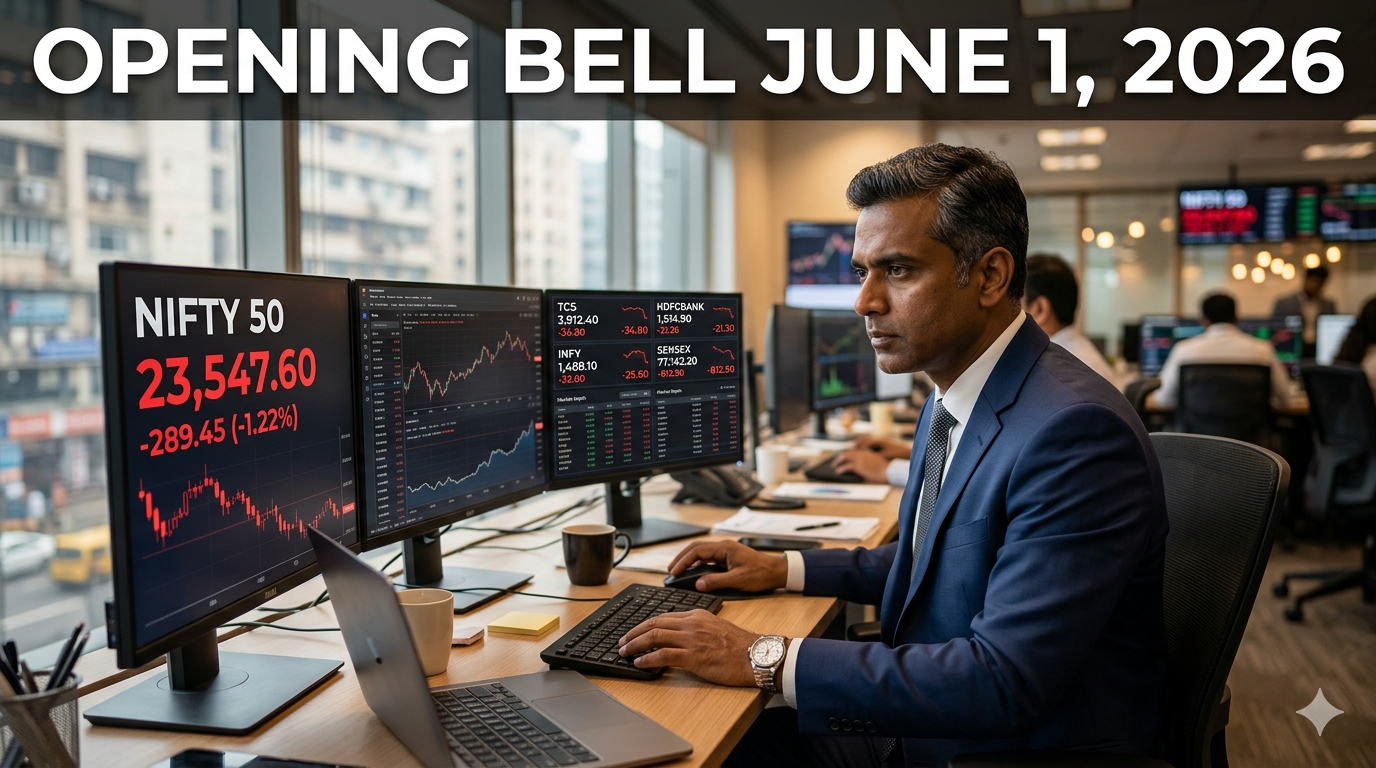
The last trading session of May 2026 was, to put it plainly, a gut-punch. The Sensex cratered over 1,092 points from its intraday high. The Nifty50, which had briefly kissed 24,002 during the session, slammed shut at 23,547.75. Thousands of retail investors watched their gains evaporate in the final 60 minutes of trading — a sharp, algorithm-driven sell-off that left many wondering: “What just happened? And should I panic?”
The answer? You shouldn’t panic. But you absolutely should understand why this happened — and what it means for your money as markets ring the Opening Bell on June 1.
In this guide, we break down every moving piece: the MSCI rebalancing chaos, FII vs DII tug-of-war, Asian market signals, crude oil’s worrying climb, gold’s pullback, and most importantly — what smart investors are watching today.
Let’s get into it.
H2: What Exactly Happened on May 29? The 6-Factor Crash Explained
Before we look ahead to June 1, we need to understand what happened on Thursday. Because context isn’t just helpful here — it’s everything.
H3: 1. The MSCI Rebalancing Bomb
The biggest trigger was one that seasoned market watchers knew was coming, but its magnitude still surprised many.
The MSCI Global Standard Index semi-annual rebalancing came into effect at the close of May 29, 2026. Four Indian stocks — Federal Bank, MCX, NALCO, and Indian Bank — were added to the index, while RVNL, Hyundai Motor India, Kalyan Jewellers, and Jubilant FoodWorks were removed.
Here’s the part most people miss: when stocks exit a major global index, the passive funds tracking that index are forced to sell those stocks. There’s no discretion. No timing. They must sell by close of the rebalancing day. India’s equity market saw a record net sell-off of over ₹21,100 crore by foreign institutional investors in the cash market on May 29 — the highest single-day outflow in at least two years — as passive global funds and ETFs shifted their portfolios in response to the MSCI rebalancing.
To put ₹21,105 crore in perspective: that’s roughly $2.5 billion leaving Indian equities in a single afternoon. No wonder the last hour was carnage.
H3: 2. Monsoon Downgrade by IMD
Adding fuel to the fire, the India Meteorological Department (IMD) revised its monsoon forecast downward during the session. A final-hour crash was triggered by MSCI rebalancing, an IMD monsoon downgrade, and lingering US-Iran peace deal uncertainty. A weaker monsoon directly threatens agricultural output, rural consumption, and inflation expectations — all of which feed into corporate earnings and RBI’s rate decisions.
H3: 3. Stalled US-Iran Peace Talks
West Asia tensions remain a live wire. The day’s trading on May 29, 2026 reflected the convergence of six simultaneous headwinds including stalled US-Iran peace talks, Brent crude above $104, MSCI rebalancing passive selling, FII outflows from financials, monthly F&O expiry pressure, and rupee depreciation anxiety.
H3: 4. Monthly F&O Expiry Pressure
May 29 was also the monthly Futures & Options expiry day — a day when positions are squared off and volatility structurally spikes. This compounded the institutional sell-off with retail stop-losses being triggered in cascading fashion.
H3: 5. Rising Crude Oil & a Weak Rupee
Brent crude spiking above $93/barrel (more on this below) is bad news for India — one of the world’s largest oil importers. Higher crude = higher import bill = wider current account deficit = rupee pressure. A record-low rupee against the dollar was also adding to anxiety.
H3: 6. Broad Sectoral Weakness
Weak monsoon concerns, continued FII outflows, fears of drought-like conditions, and MSCI index rebalancing-triggered selling in the final hour dragged benchmark indices sharply lower. Realty, auto, and metal stocks led the declines.
H2: Opening Bell June 1 — Your Complete Pre-Market Checklist
Here’s everything you need to know before markets open this morning.
H3: 📊 Indian Indices Snapshot
| Index | May 29 Close | Change | GIFT Nifty (Pre-market) |
|---|---|---|---|
| Nifty 50 | 23,547.75 | -1.50% | ~23,744 (+0.23%) |
| Sensex | 74,775.74 | -1.44% | Recovery expected |
| Bank Nifty | 53,537.00 | -0.32% | Watch PSU banks |
The GIFT Nifty is your single best early signal for how Dalal Street will open. A reading of 23,744 — roughly 196 points above Thursday’s Nifty close — suggests markets will open in the green. But don’t read this as a full recovery signal. The broader trend remains cautious.
Key Nifty Levels to Watch Today:
- Support zones: 23,362 and 23,184
- Resistance zones: 23,938 and 24,116
- RSI reading: Below 50 — indicating cautious, not bullish, momentum
From years of tracking Indian equity markets, one pattern stands out clearly: the session immediately after a large MSCI rebalancing event almost always sees a relief bounce, simply because the forced selling pressure is now exhausted. June 1 could follow that pattern — but macro headwinds mean you shouldn’t chase the gap-up blindly.
H3: 🌏 Global & Asian Market Cues for June 1
One of the most important rules of opening bell analysis: never look at the domestic market in isolation. Here’s what overnight and morning global cues are telling us.
| Market | Performance |
|---|---|
| Japan Nikkei 225 | ▲ +1.01% |
| Hong Kong Hang Seng | ▲ +0.72% |
| Singapore FTSE | ▲ +0.98% |
| China Shanghai Composite | ▼ -0.25% |
Asian markets are broadly supportive, with three of four major indices in the green. Japan’s outperformance is notable, though rising Japanese bond yields — a structural theme of 2026 — continue to create some unease for global risk appetite.
China’s slight decline is worth watching. As India’s largest trading partner and a massive player in global commodity pricing, any sustained weakness in Chinese equities can ripple into emerging markets including India.
West Asia tensions remain the wildcard. Any escalation near the Strait of Hormuz can instantly spike crude oil and trigger a risk-off mood across global markets.
H3: 💸 FII & DII: The ₹37,000 Crore Tug-of-War
This is where the story of Indian markets in May 2026 is most dramatically told.
Foreign portfolio investors sold equities worth ₹21,105.86 crore on May 29 alone, with gross sales exceeding ₹1.11 lakh crore against gross purchases of ₹89,733.64 crore.
To be clear about the full May picture: FPIs sold a net ₹29,484 crore worth of Indian equities across the entire month of May 2026. That’s a significant capital outflow by any measure.
But here’s what gives Indian markets their resilience: Domestic Institutional Investors (DIIs).
On May 29, domestic investors bought ₹16,764 crore worth of equities — soaking up a large portion of the FII dump. This is the SIP-powered, mutual-fund-fuelled domestic institutional base doing what it does best: buying on dips. Over the past 3 years, this DII cushion has repeatedly prevented crashes from turning into routs.
What to watch on June 1:
- Will FIIs turn net buyers now that the MSCI rebalancing is complete?
- Can DIIs maintain buying momentum?
- Watch for provisional exchange data around 6 PM for confirmation.
H3: 🛢️ Crude Oil: The Elephant in the Room
This is the data point that deserves the most attention from Indian investors today.
Brent crude: $93.41/barrel (+2.5%) WTI crude: $89.81/barrel (+2.8%)
Rising oil prices are arguably the single biggest structural headwind for India right now. Here’s why:
- India imports over 85% of its crude oil needs
- Every $10/barrel rise in Brent adds approximately ₹1 lakh crore to India’s annual import bill
- Higher crude directly impacts OMC (Oil Marketing Company) stocks like BPCL, HPCL, and IOC
- It widens the current account deficit, weakens the rupee, and stokes inflation
With Brent above $93 and West Asia tensions unresolved, the crude story is far from over. If prices breach $100 again, the RBI’s rate-cutting cycle — already tentative — could be paused entirely.
Sectors most impacted by rising crude:
- ❌ Airlines (IndiGo, Air India — higher ATF costs)
- ❌ Paint companies (raw material costs rise)
- ❌ Tyres (rubber and feedstock costs)
- ✅ OMCs (if government allows price hike pass-through)
- ✅ Upstream oil producers like ONGC and Oil India
H3: 🥇 Gold: The Dollar Takes the Crown
COMEX Gold: $4,563.30/oz (-0.63%)
Gold pulled back modestly on a stronger US dollar, which makes dollar-denominated assets like gold more expensive for international buyers. However, gold remains structurally elevated in 2026 — central bank buying, geopolitical risks, and inflation hedging continue to support prices.
For Indian gold investors, the pullback is relatively minor in rupee terms given currency depreciation. Indian MCX gold prices should be watched in morning trade for cues.
Practical takeaway: Gold’s dip on June 1 is likely to be shallow. If West Asia tensions re-escalate or the US dollar weakens, gold could bounce quickly. Short-term traders should be cautious; long-term holders can stay put.
H2: Sector-by-Sector Outlook for June 1 Opening
Based on all the data above, here’s a quick sector-level breakdown for today’s opening:
✅ Likely Outperformers
IT Stocks: Buying interest in the previous session was led by TECHM (+4.39%), followed by INFY (+2.15%), and HCLTECH (+1.24%), and IT as a sector continues to benefit from a stronger dollar and demand recovery. Watch for continuation today.
Pharma: Defensively positioned and benefiting from rupee depreciation (export revenues rise). A sector to consider on dips.
Telecom: BHARTIARTL and similar large-cap telecom names have been resilient. ARPU growth stories remain intact.
❌ Likely Underperformers
PSU Banks: SBI (-2.38%), CANBK, and PNB were dragged lower in recent sessions. Bond yield sensitivity and government ownership discount continue to weigh.
Metal Stocks: TATASTEEL (-3.21%) emerged as a major laggard, and the sector remains vulnerable to China demand uncertainty and currency headwinds.
Auto: Rising crude indirectly squeezes demand sentiment. Maruti and M&M face near-term pressure.
H2: What Smart Investors Are Doing Right Now (And What You Should Do)
Let’s be real: if you’re reading this before 9:15 AM, you’re probably wondering whether to buy, hold, or protect your portfolio. Here’s the framework that actually works — not just today, but every time markets go through turbulent patches.
H3: The Three-Question Framework
Before placing any trade today, answer these three questions:
1. Is this a structural problem or an event-driven correction? Thursday’s crash was almost entirely event-driven — MSCI rebalancing, F&O expiry, and macro anxiety. The Indian economy’s fundamentals haven’t changed overnight. GDP growth remains robust, corporate earnings are broadly healthy, and domestic consumption is intact.
2. What’s my investment horizon? If you’re a long-term SIP investor (5+ years), Thursday’s crash is noise. Stay the course. If you’re a short-term trader, use technical levels (23,362 support, 23,938 resistance) to structure your entries and exits.
3. Am I concentrated in the wrong sectors? If your portfolio is heavily weighted toward PSU banks, metals, or small-cap stocks, today might be a good day to review diversification — not to panic-sell, but to rebalance thoughtfully.
H3: Actionable Steps for June 1
For Long-Term Investors:
- Don’t make portfolio changes based on one day’s data. The MSCI-driven FII selling was mechanical, not sentiment-driven.
- If you have cash available, today’s lower prices may represent a buying opportunity in quality large-cap names — particularly IT and pharma.
- Continue your SIPs without interruption. Volatility feeds SIP returns over time.
For Short-Term Traders:
- Watch the first 15-minute candle post-open for directional cues
- 23,362 is your critical support level; a break below intraday should be treated as a risk signal
- Keep position sizes smaller than usual until the trend stabilizes
For Options Traders:
- Implied volatility may remain elevated — consider credit strategies (selling expensive options) rather than buying premium
- The range for the week appears to be roughly 23,184–24,116 based on support/resistance data
H2: The Bigger Picture — What June 2026 Could Mean for Indian Markets
Zoom out for a moment. One bad day doesn’t define a month — and May 2026 had several strong sessions before the Thursday sell-off.
Here’s what to watch over the next 4 weeks:
| Factor | Bullish Scenario | Bearish Scenario |
|---|---|---|
| US-Iran peace talks | Deal progresses → crude falls → sentiment improves | Escalation → crude spikes → risk-off |
| Monsoon progress | Catch-up rains → rural sentiment improves | Weak monsoon → inflation fears, RBI on hold |
| FII flows | MSCI rebalancing done → FIIs return as net buyers | Strong dollar continues → EM outflows persist |
| RBI Policy | Rate cut signals in June policy → market positive | Hold + hawkish tone → yields up, bond markets weak |
| Q1 FY27 Earnings (July) | Strong corporate earnings → fresh bull leg | Margin pressure from crude → earnings downgrades |
The structural India growth story — young demographics, digital adoption, infrastructure spend, and a maturing equity culture — remains firmly intact. Short-term volatility is the price of admission for long-term wealth creation in Indian equities.
H2: Key Numbers to Bookmark for June 1, 2026
📌 Nifty 50 May 29 close: 23,547.75 📌 Sensex May 29 close: 74,775.74 📌 GIFT Nifty (pre-market): ~23,744 (+0.23%) 📌 Brent Crude: $93.41/bbl (+2.5%) 📌 WTI Crude: $89.81/bbl (+2.8%) 📌 COMEX Gold: $4,563.30/oz (-0.63%) 📌 FII net sell (May 29): ₹21,105 crore 📌 DII net buy (May 29): ₹16,764 crore 📌 FPI net sell (full May 2026): ₹29,484 crore 📌 Nifty support levels: 23,362 / 23,184 📌 Nifty resistance levels: 23,938 / 24,116
H2: FAQ — Your Top Opening Bell Questions Answered
❓ Q1: Why did the Indian market crash so badly on May 29, 2026?
The crash was primarily caused by MSCI Global Standard Index rebalancing, which forced global passive funds and ETFs to sell Indian stocks being removed from the index. This created a mechanical, non-sentiment-driven sell-off of over ₹21,105 crore by FIIs. Additional factors included monthly F&O expiry, a downward monsoon forecast revision, stalled US-Iran peace talks, and rising crude oil prices.
❓ Q2: What does GIFT Nifty up 0.23% mean for June 1 opening?
GIFT Nifty is the offshore futures contract for Nifty50, traded in Gujarat’s GIFT City. It serves as a real-time pre-market indicator for how Indian markets are likely to open. A reading of 23,744 — roughly 196 points above Thursday’s Nifty close of 23,547 — suggests a modest positive gap-up opening. However, the opening doesn’t always hold through the session.
❓ Q3: Should I buy the dip after Thursday’s crash?
It depends on your investment profile. Long-term investors with a 5+ year horizon can consider adding quality large-cap stocks (IT, pharma, private banks) at lower valuations. Short-term traders should wait for the first 15 minutes to assess whether the gap-up is sustainable. Don’t invest money you may need within 6–12 months during volatile phases.
❓ Q4: Why does MSCI rebalancing cause such large market swings in India?
When MSCI adds or removes stocks from its indices, passive funds worth trillions of dollars globally must adjust their portfolios to match the new index composition. This creates mandatory buying in included stocks and mandatory selling in excluded stocks — all concentrated into the rebalancing date’s close. India’s growing weight in global indices (around 12.3% of the MSCI Global Standard Index) means these events increasingly impact domestic markets.
❓ Q5: How does rising crude oil affect Indian stocks specifically?
India imports over 85% of its crude needs, so rising oil prices have cascading effects: they widen the current account deficit, put downward pressure on the rupee, raise input costs for airlines, paint, tyre, and chemical companies, and potentially force the RBI to delay interest rate cuts. Airlines, auto ancillaries, and paint stocks are the most directly impacted on the negative side; ONGC and Oil India benefit.
❓ Q6: What is the Nifty’s key support level to watch on June 1?
Based on technical analysis, the critical near-term support levels are 23,362 and 23,184. If Nifty sustains above 23,362 in intraday trade, the recovery bias remains intact. A close below 23,184 would be a more serious bearish signal. On the upside, 23,938 and 24,116 are the key resistance zones.
❓ Q7: Are FIIs likely to come back after the MSCI rebalancing is done?
Historically, FII selling around MSCI rebalancing events is temporary and mechanical. Once the index adjustment is complete (which it is, as of May 29 close), the forced selling pressure eases. Whether FIIs return as net buyers in June depends on global factors — particularly the US dollar’s direction, US interest rate outlook, and emerging market risk sentiment. India’s domestic growth story and still-reasonable valuations (post-correction) could attract FII interest in June.
❓ Q8: What sectors should I watch most carefully on June 1?
Top sectors to monitor: IT (key recovery candidates after the MSCI-driven sell-off), OMCs (crude price sensitivity), PSU Banks (continued pressure from bond yields and FII selling), Pharma (defensive safe haven), and Metals (China demand and global risk sentiment). The broader market breadth — number of advancing vs declining stocks — will also tell you if today’s recovery is broad-based or narrow.
Conclusion: Don’t Let One Bad Day Define Your Investment Journey
Here’s what I want you to take away from all of this.
May 29, 2026 was painful. Watching ₹6 lakh crore in market capitalisation evaporate in a single session is not fun. But before you make any knee-jerk decisions with your portfolio, remember:
The MSCI rebalancing is done. The forced selling is over.
Asian markets are broadly positive heading into June 1. GIFT Nifty is pointing to a gap-up opening. DIIs demonstrated exactly the kind of institutional resilience that India’s domestic investor base has developed over the past decade — absorbing ₹16,764 crore of selling in a single day is no small feat.
The medium-term risks — crude oil, monsoon, West Asia tensions, FII flows — are real and warrant careful monitoring. But they are known risks, being closely tracked by markets. Unknown shocks are what cause sustained bear markets; event-driven corrections like Thursday’s are typically followed by recovery.
If you’re a long-term investor: stay invested, stay diversified, and keep your SIPs running. If you’re a trader: respect the technical levels, manage your position size, and let the market show its hand in the first 15 minutes before committing.
And if you’re still figuring out how to read the Opening Bell the right way — you’ve come to the right place.
👉 Subscribe to our daily pre-market newsletter for Opening Bell data, technical levels, and key events delivered to your inbox before 8 AM every trading day.
👉 Share this article with a fellow investor who might be confused about what’s happening in markets right now.
👉 Drop your questions or thoughts in the comments below — our community of investors discusses the market every morning.
Read More
NSE Extends Trading Hours: What Every Equity and F&O Trader Needs to Know Before August 2026
📝 Suggested Author Bio
[Author Name] is a SEBI-registered investment analyst and financial market commentator with over 10 years of experience covering Indian equity markets, global macro trends, and retail investment strategy. A graduate of [University], they have contributed to leading financial publications and regularly appear on business news channels to discuss market trends. Their research focuses on making complex market events accessible and actionable for everyday Indian investors.
Disclaimer: This article is for educational and informational purposes only and does not constitute investment advice. Please consult a SEBI-registered financial advisor before making investment decisions. Investments in securities markets are subject to market risk.

