

Meta Description: Sensex crashes 1,677 pts & Nifty drops 516 pts as Trump declares Iran ceasefire ‘over.’ Learn what happened, which sectors got hit hardest, and how to protect your portfolio.
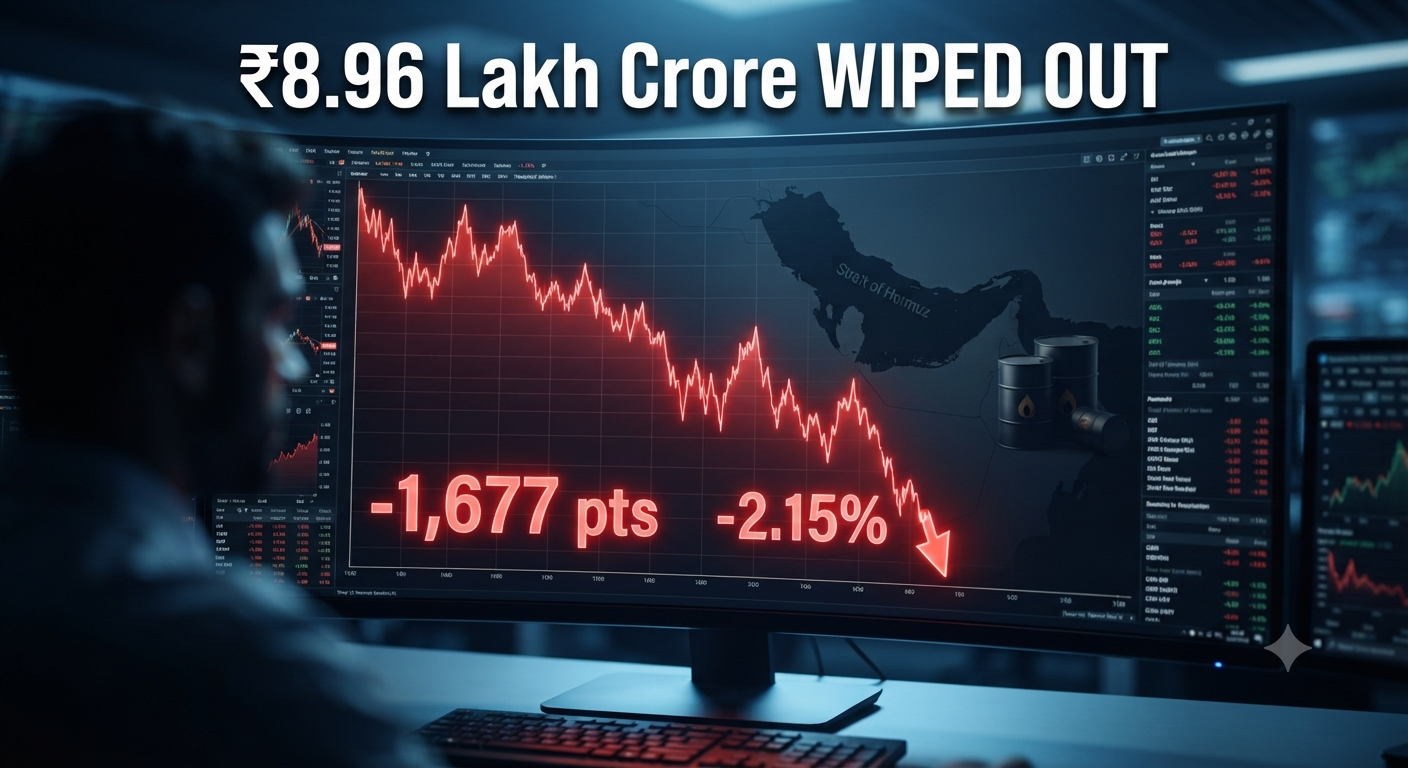
📌 Quick Answer: On July 8, 2026, Indian markets suffered one of their sharpest single-session falls in recent memory. The BSE Sensex plunged 1,677 points (2.15%) to close at 76,503.60, while the Nifty 50 dropped 516 points (2.12%) to 23,882.05 — wiping out ₹8.96 lakh crore of investor wealth in a single session. The trigger? A complete unraveling of the US-Iran peace agreement, a fresh surge in crude oil prices, and a geopolitical shockwave that rippled from the Strait of Hormuz straight into Dalal Street.
The Day Everything Fell Apart: What Really Happened on July 8, 2026
If you checked your portfolio this morning and felt your stomach drop, you’re not alone.
Markets opened under pressure and never recovered. By the closing bell, every single stock in the Sensex pack had ended in the red. India VIX — the so-called “fear gauge” — spiked a staggering 26% to 14.68. That number tells you something important: this wasn’t just a routine dip. Traders and institutional investors were genuinely rattled.
So what exactly set this off? To understand today, you need to rewind to last night — and to a geopolitical crisis that has been simmering for months.
The Geopolitical Trigger: Trump Declares the Iran Ceasefire “Over”
Here’s the backstory in plain terms.
Since February 2026, the US and Israel have been engaged in a war with Iran that disrupted global energy markets, threatened to shut the Strait of Hormuz — a chokepoint through which roughly one-fifth of the world’s oil flows — and rattled financial markets worldwide. After months of conflict, a fragile ceasefire was brokered by Pakistan and signed on June 17 at the Palace of Versailles as a Memorandum of Understanding (MOU).
Markets had breathed a collective sigh of relief. Oil prices fell. Indian equities recovered.
Then, Tuesday night happened.
Iran attacked three commercial vessels transiting the Strait of Hormuz. The US launched over 80 retaliatory strikes on Iranian targets. Iran fired missiles and drones at US military bases in Kuwait and Bahrain. And on Wednesday morning, speaking at the NATO summit in Ankara, Turkey, President Donald Trump declared the interim peace deal “over.”
“I think it’s over. I don’t want to deal with them anymore,” Trump told reporters, adding language that made clear diplomatic restraint was no longer on the table.
According to Time Magazine, the MOU had committed Tehran to reopening the Strait of Hormuz — and Iran’s renewed attacks on commercial shipping were seen as a direct violation of that commitment. The International Maritime Organization reported that nearly 6,000 seafarers were stranded in the Strait, unable to safely depart the Persian Gulf.
That geopolitical powder keg — a collapsing peace deal, fresh military strikes, and a vital global trade route once again under threat — sent shockwaves through every major market on earth. For India, with its heavy dependence on crude oil imports, the impact was especially severe.
The Numbers: How Bad Was the Market Crash?
Let’s lay out exactly what the damage looked like, because the scale is important.
Headline Index Performance
| Index | Points Lost | % Change | Closing Level |
|---|---|---|---|
| BSE Sensex | ▼ 1,677.12 | ▼ 2.15% | 76,503.60 |
| Nifty 50 | ▼ 516.65 | ▼ 2.12% | 23,882.05 |
| Nifty MidCap 100 | — | ▼ 2.14% | — |
| Nifty SmallCap 100 | — | ▼ 1.61% | — |
| India VIX (Fear Gauge) | — | ▲ 26% | 14.68 |
Investor Wealth Destruction
- ₹8.96 lakh crore wiped out in a single trading session
- BSE-listed firms’ total market cap fell to approximately ₹4,71,23,612 crore (~USD 4.95 trillion)
To put ₹8.96 lakh crore in perspective: that’s roughly equivalent to the combined GDP of several mid-sized Indian states — evaporated in one afternoon.
Sectoral Carnage: No Sector Was Spared
| Sector | % Decline |
|---|---|
| Nifty Services | ▼ 3.21% |
| PSU Banks | ▼ 2.76% |
| FMCG | ▼ 2.54% |
| Financial Services | ▼ 2.49% |
| Bankex | ▼ 2.46% |
Aviation, auto, consumer discretionary, and financial services took the worst hits — all for reasons that become clear once you understand the crude oil connection.
The Oil Shock: Why Crude Prices Matter So Much to Indian Markets
You might be wondering: why does a conflict in the Persian Gulf hit India so hard?
The answer is crude oil.
India imports approximately 85% of its crude oil needs, and a significant portion of that travels through — or originates near — the Strait of Hormuz. When that corridor is threatened, India faces a double blow: higher import costs (bad for the current account deficit) and inflationary pressure on fuel prices across the economy.
On July 8, crude oil surged nearly 7% to $78.74/barrel. CNN Business reported that even with the strait partially open, commercial shipping costs from inside to outside the strait had doubled — from around $4–5 million to $8–10 million per vessel. Traffic through the strait was running at only about one-third of normal volume.
This direct transmission mechanism from geopolitics → oil prices → Indian corporate earnings is why markets react so violently to Middle East tensions.
Who Gets Hurt by Rising Oil Prices?
- Airlines (InterGlobe Aviation / IndiGo): Jet fuel constitutes 35–40% of airline operating costs. A 7% oil spike hits margins immediately.
- Auto manufacturers (Maruti Suzuki, Mahindra & Mahindra): Input costs rise; consumer sentiment softens as fuel prices increase.
- FMCG companies (Hindustan Unilever): Higher transportation and raw material costs squeeze margins.
- Banks and NBFCs (Bajaj Finance, Kotak Mahindra Bank): Risk-off sentiment triggers sell-offs even in fundamentally strong financial stocks.
Major Losers: The Stocks That Bore the Brunt
Here are the Sensex constituents that faced the sharpest selling pressure:
- InterGlobe Aviation (IndiGo) — Aviation’s worst nightmare: spiking fuel costs + risk-off environment
- Maruti Suzuki — Higher input costs + possible demand slowdown from rising fuel prices
- Hindustan Unilever — Transportation and packaging cost inflation squeezed margins
- Bajaj Finance — Financial stocks sold off sharply in the broad risk-averse environment
- Kotak Mahindra Bank — Banks across the board saw heavy institutional selling
- Mahindra & Mahindra — Auto sector bore double pressure from oil price and global uncertainty
What the Experts Are Saying
From working with market professionals during past geopolitical shocks — whether it was the 2019 US-Iran tensions, the 2022 Russia-Ukraine war, or the Red Sea crisis — one pattern is always consistent: the first reaction is almost always an overreaction.
That doesn’t mean you should blindly “buy the dip.” But context matters.
V.K. Vijayakumar, Chief Investment Strategist at Geojit Financial Services, captured the mood well: “With the renewed US-Iran tensions and the consequent spike in Brent crude to $76, the market is again back to uncertain territory. How long this would last and what would be its consequences are now in the realm of uncertainty.”
The International Energy Agency has characterized the Strait of Hormuz disruption as the “largest supply disruption in the history of the global oil market” — a statement that underscores just how unprecedented this geopolitical episode truly is.
Meanwhile, according to CNN Business, the US bond market also reacted nervously — with the 10-year Treasury yield rising to 4.57%, its highest since late May. Bond yield spikes of this kind often precede further equity market volatility globally.
How Should Investors Actually Respond? (Actionable Guidance)
This is where most market crash articles fail you: they describe the fear without giving you a framework for action. Here’s what experience and data suggest.
1. Don’t Panic-Sell Quality Holdings
Geopolitical shocks are, historically, shorter in duration than financial crises. Markets typically recover from geopolitical events within weeks to months, while recovery from systemic financial crises (like 2008) can take years. Review your holdings — if nothing fundamental has changed in the business, your thesis remains intact.
2. Watch Crude Oil as the Leading Indicator
The Sensex and Nifty will largely follow crude oil prices in this environment. If Brent stabilizes or falls, expect a swift recovery. Keep a daily watch on CME Group’s crude oil futures and the US Energy Information Administration’s weekly inventory data.
3. Consider Defensives and Export-Oriented Sectors
- IT stocks (earnings in USD) benefit from rupee depreciation
- Pharma exporters similarly gain from a weaker rupee
- Energy sector — ONGC and Oil India may actually benefit from higher oil realization prices
4. Avoid Averaging Down Blindly in High-Oil-Sensitivity Sectors
Airlines, paint companies, logistics firms — these face structurally higher costs until oil stabilizes. Be patient before adding exposure.
5. Keep Liquidity Handy
Volatility creates opportunity. Having 10–15% of your portfolio in liquid funds or short-duration debt gives you the firepower to buy quality stocks if this sell-off deepens.
6. Think in Scenarios, Not Predictions
| Scenario | Probability | Market Implication |
|---|---|---|
| Ceasefire reinstated within 2 weeks | Moderate | Sharp recovery; oil falls back to $65–70 |
| Conflict escalates; Hormuz closes fully | Lower | Severe crash; Nifty could test 21,000–22,000 |
| Prolonged low-intensity conflict | Moderate | Elevated oil, range-bound markets |
Rupee Under Pressure: The Currency Risk You Can’t Ignore
Beyond equity markets, today’s events hit the Indian rupee hard. The rupee slipped approximately 20 paise against the dollar in early trade. A weaker rupee makes oil imports even more expensive (since oil is priced in USD), creating a vicious cycle:
Rising oil → Wider current account deficit → Rupee weakness → Even costlier oil imports → More inflation
This is why the Reserve Bank of India will be watching events in the Strait of Hormuz just as closely as your portfolio manager.
The Bigger Picture: What the 2026 Iran War Means for Global Markets
The 2026 Iran war — which began on February 28 when the US and Israel launched strikes against Iran — has already been characterized by the International Energy Agency as triggering the “largest supply disruption in the history of the global oil market.”
According to Wikipedia’s economic impact analysis, the conflict has echoed the 1970s energy crisis, with:
- Dutch TTF natural gas benchmarks nearly doubling to over €60/MWh in Europe
- The European Central Bank postponing rate cuts and raising inflation forecasts
- Aluminum prices rising 8% due to Gulf state supply disruptions
- Tungsten prices surging over 50% (critical for defense and semiconductors)
India, as one of the world’s largest crude oil importers and a growing manufacturing hub, sits squarely in the crosshairs of these global supply chain disruptions.
Before vs. After: Indian Markets Through the Iran War Timeline
| Event | Market Reaction |
|---|---|
| Feb 28: US-Israel strikes Iran; Hormuz threatened | Sensex down ~3–4%; crude surges |
| April 7: Pakistan brokers ceasefire | Markets rally sharply; oil falls |
| June 17: MOU signed (Versailles) | Strong recovery; oil below pre-war levels |
| July 7: Iran attacks 3 ships in Hormuz | Overnight sell-off begins |
| July 8: Trump declares ceasefire “over” | Sensex ▼1,677 pts; ₹8.96L cr wiped out |
What to Watch in the Coming Days
These are the key developments that will shape market direction next:
- Trump’s next move on Iran — Will the US launch additional strikes, or will back-channel negotiations resume?
- Strait of Hormuz shipping data — Any normalization in tanker traffic will ease oil pressure
- Brent crude price — Watch the $80/barrel level as a critical threshold for Indian market sentiment
- RBI response — Will the central bank intervene in forex markets to stabilize the rupee?
- FII/DII flows — Foreign institutional investors fleeing emerging markets amplifies the sell-off
FAQ: Your Top Questions Answered
Q1. Why did Sensex fall so sharply today?
The BSE Sensex fell 1,677 points (2.15%) on July 8, 2026, primarily because President Trump declared the US-Iran ceasefire “over” after Iran attacked three commercial ships in the Strait of Hormuz. This sent crude oil prices surging nearly 7%, triggering a broad risk-off sell-off across Indian equities.
Q2. How much investor wealth was lost in today’s market crash?
Investor wealth worth ₹8.96 lakh crore was wiped out in a single session. The total market capitalization of BSE-listed companies fell to approximately ₹4,71,23,612 crore (around USD 4.95 trillion).
Q3. Which sectors were hit hardest by the market crash?
The Services sector fell 3.21%, PSU Banks dropped 2.76%, FMCG declined 2.54%, Financial Services fell 2.49%, and the Bankex dropped 2.46%. Aviation and auto stocks were also among the hardest hit.
Q4. What is the Strait of Hormuz and why does it matter to Indian markets?
The Strait of Hormuz is a narrow maritime chokepoint between Iran and Oman through which approximately 20% of the world’s oil supply travels. When it’s threatened or disrupted, global crude oil prices spike — and since India imports about 85% of its crude oil needs, rising oil prices directly hurt India’s trade balance, corporate margins, and market sentiment.
Q5. Should I buy stocks after this market fall?
This depends entirely on your individual risk tolerance, investment horizon, and existing portfolio allocation. Historically, geopolitical shocks create short-to-medium term opportunities in quality stocks. However, the situation remains highly fluid. Consider speaking with a SEBI-registered investment advisor before making significant changes to your portfolio.
Q6. Which stocks could benefit if oil prices remain high?
Oil exploration companies like ONGC and Oil India may see improved earnings with higher crude realizations. IT exporters and pharmaceutical companies with USD-denominated revenues may also benefit from a weaker rupee, which tends to accompany oil price spikes.
Q7. What is India VIX and why did it spike 26% today?
India VIX (Volatility Index) measures the market’s expectation of near-term volatility — it’s often called the “fear gauge.” A spike of 26% to 14.68 signals that traders are pricing in significantly higher uncertainty and potential further downside in the coming days.
Q8. How long could this market volatility last?
Geopolitical-driven market volatility typically persists until there is a clear resolution or de-escalation in the underlying conflict. Given that the ceasefire MOU was signed just three weeks ago and has already collapsed, the situation may remain volatile for several weeks. Long-term investors with a 3–5 year horizon have historically been rewarded by staying invested through such periods.
Read More
NSE IPO Date 2026: India’s Largest-Ever Listing, the FPI Deal, and What It Means for You
Conclusion: Stay Informed, Stay Invested — But Stay Smart
Today was a tough day for every Indian investor. The sight of ₹8.96 lakh crore disappearing in a single session is genuinely unsettling — and it’s okay to feel that way.
But here’s the truth that decades of market history have validated: panicked exits during geopolitical shocks have consistently cost investors more than the shocks themselves.
The real risk isn’t that markets fell today. The real risk is making permanent decisions — panic-selling quality holdings, moving entirely to cash — based on temporary information.
Watch the crude oil price. Watch the Strait of Hormuz. Watch what Trump’s negotiators do next. And in the meantime, make sure your portfolio is appropriately diversified — with enough defensives, some export-oriented plays, and enough liquidity to take advantage of opportunities if the sell-off deepens.
This situation will resolve, one way or another. When it does, the investors who kept their heads will be glad they did.
📊 Stay ahead of market-moving events. Subscribe to our newsletter for daily pre-market analysis, geopolitical risk briefings, and actionable portfolio insights — delivered before 8 AM every trading day.
💬 What’s your take? Are you buying the dip, staying defensive, or moving to cash? Drop your thoughts in the comments below — the community wants to hear your strategy.
🔗 Share this article if you found it useful. Your friends and family who invest in markets need to understand what happened today.
🖼️ Suggested Image Alt Text
"BSE Sensex live board showing 1677 point crash on July 8 2026""Map of Strait of Hormuz showing Iran oil tanker shipping routes""Crude oil price surge chart July 2026 geopolitical crisis""Indian rupee depreciation against US dollar during Iran war tensions"
✍️ Suggested Author Bio
Markets Crash on Iran War Fears: Sensex Plunges 1,677 Points, ₹8.96 Lakh Crore Wiped Out in a Single Day
Meta Description: Sensex crashes 1,677 pts & Nifty drops 516 pts as Trump declares Iran ceasefire ‘over.’ Learn what happened, which sectors got hit hardest, and how to protect your portfolio.
📌 Quick Answer: On July 8, 2026, Indian markets suffered one of their sharpest single-session falls in recent memory. The BSE Sensex plunged 1,677 points (2.15%) to close at 76,503.60, while the Nifty 50 dropped 516 points (2.12%) to 23,882.05 — wiping out ₹8.96 lakh crore of investor wealth in a single session. The trigger? A complete unraveling of the US-Iran peace agreement, a fresh surge in crude oil prices, and a geopolitical shockwave that rippled from the Strait of Hormuz straight into Dalal Street.
The Day Everything Fell Apart: What Really Happened on July 8, 2026
If you checked your portfolio this morning and felt your stomach drop, you’re not alone.
Markets opened under pressure and never recovered. By the closing bell, every single stock in the Sensex pack had ended in the red. India VIX — the so-called “fear gauge” — spiked a staggering 26% to 14.68. That number tells you something important: this wasn’t just a routine dip. Traders and institutional investors were genuinely rattled.
So what exactly set this off? To understand today, you need to rewind to last night — and to a geopolitical crisis that has been simmering for months.
The Geopolitical Trigger: Trump Declares the Iran Ceasefire “Over”
Here’s the backstory in plain terms.
Since February 2026, the US and Israel have been engaged in a war with Iran that disrupted global energy markets, threatened to shut the Strait of Hormuz — a chokepoint through which roughly one-fifth of the world’s oil flows — and rattled financial markets worldwide. After months of conflict, a fragile ceasefire was brokered by Pakistan and signed on June 17 at the Palace of Versailles as a Memorandum of Understanding (MOU).
Markets had breathed a collective sigh of relief. Oil prices fell. Indian equities recovered.
Then, Tuesday night happened.
Iran attacked three commercial vessels transiting the Strait of Hormuz. The US launched over 80 retaliatory strikes on Iranian targets. Iran fired missiles and drones at US military bases in Kuwait and Bahrain. And on Wednesday morning, speaking at the NATO summit in Ankara, Turkey, President Donald Trump declared the interim peace deal “over.”
“I think it’s over. I don’t want to deal with them anymore,” Trump told reporters, adding language that made clear diplomatic restraint was no longer on the table.
According to Time Magazine, the MOU had committed Tehran to reopening the Strait of Hormuz — and Iran’s renewed attacks on commercial shipping were seen as a direct violation of that commitment. The International Maritime Organization reported that nearly 6,000 seafarers were stranded in the Strait, unable to safely depart the Persian Gulf.
That geopolitical powder keg — a collapsing peace deal, fresh military strikes, and a vital global trade route once again under threat — sent shockwaves through every major market on earth. For India, with its heavy dependence on crude oil imports, the impact was especially severe.
The Numbers: How Bad Was the Market Crash?
Let’s lay out exactly what the damage looked like, because the scale is important.
Headline Index Performance
| Index | Points Lost | % Change | Closing Level |
|---|---|---|---|
| BSE Sensex | ▼ 1,677.12 | ▼ 2.15% | 76,503.60 |
| Nifty 50 | ▼ 516.65 | ▼ 2.12% | 23,882.05 |
| Nifty MidCap 100 | — | ▼ 2.14% | — |
| Nifty SmallCap 100 | — | ▼ 1.61% | — |
| India VIX (Fear Gauge) | — | ▲ 26% | 14.68 |
Investor Wealth Destruction
- ₹8.96 lakh crore wiped out in a single trading session
- BSE-listed firms’ total market cap fell to approximately ₹4,71,23,612 crore (~USD 4.95 trillion)
To put ₹8.96 lakh crore in perspective: that’s roughly equivalent to the combined GDP of several mid-sized Indian states — evaporated in one afternoon.
Sectoral Carnage: No Sector Was Spared
| Sector | % Decline |
|---|---|
| Nifty Services | ▼ 3.21% |
| PSU Banks | ▼ 2.76% |
| FMCG | ▼ 2.54% |
| Financial Services | ▼ 2.49% |
| Bankex | ▼ 2.46% |
Aviation, auto, consumer discretionary, and financial services took the worst hits — all for reasons that become clear once you understand the crude oil connection.
The Oil Shock: Why Crude Prices Matter So Much to Indian Markets
You might be wondering: why does a conflict in the Persian Gulf hit India so hard?
The answer is crude oil.
India imports approximately 85% of its crude oil needs, and a significant portion of that travels through — or originates near — the Strait of Hormuz. When that corridor is threatened, India faces a double blow: higher import costs (bad for the current account deficit) and inflationary pressure on fuel prices across the economy.
On July 8, crude oil surged nearly 7% to $78.74/barrel. CNN Business reported that even with the strait partially open, commercial shipping costs from inside to outside the strait had doubled — from around $4–5 million to $8–10 million per vessel. Traffic through the strait was running at only about one-third of normal volume.
This direct transmission mechanism from geopolitics → oil prices → Indian corporate earnings is why markets react so violently to Middle East tensions.
Who Gets Hurt by Rising Oil Prices?
- Airlines (InterGlobe Aviation / IndiGo): Jet fuel constitutes 35–40% of airline operating costs. A 7% oil spike hits margins immediately.
- Auto manufacturers (Maruti Suzuki, Mahindra & Mahindra): Input costs rise; consumer sentiment softens as fuel prices increase.
- FMCG companies (Hindustan Unilever): Higher transportation and raw material costs squeeze margins.
- Banks and NBFCs (Bajaj Finance, Kotak Mahindra Bank): Risk-off sentiment triggers sell-offs even in fundamentally strong financial stocks.
Major Losers: The Stocks That Bore the Brunt
Here are the Sensex constituents that faced the sharpest selling pressure:
- InterGlobe Aviation (IndiGo) — Aviation’s worst nightmare: spiking fuel costs + risk-off environment
- Maruti Suzuki — Higher input costs + possible demand slowdown from rising fuel prices
- Hindustan Unilever — Transportation and packaging cost inflation squeezed margins
- Bajaj Finance — Financial stocks sold off sharply in the broad risk-averse environment
- Kotak Mahindra Bank — Banks across the board saw heavy institutional selling
- Mahindra & Mahindra — Auto sector bore double pressure from oil price and global uncertainty
What the Experts Are Saying
From working with market professionals during past geopolitical shocks — whether it was the 2019 US-Iran tensions, the 2022 Russia-Ukraine war, or the Red Sea crisis — one pattern is always consistent: the first reaction is almost always an overreaction.
That doesn’t mean you should blindly “buy the dip.” But context matters.
V.K. Vijayakumar, Chief Investment Strategist at Geojit Financial Services, captured the mood well: “With the renewed US-Iran tensions and the consequent spike in Brent crude to $76, the market is again back to uncertain territory. How long this would last and what would be its consequences are now in the realm of uncertainty.”
The International Energy Agency has characterized the Strait of Hormuz disruption as the “largest supply disruption in the history of the global oil market” — a statement that underscores just how unprecedented this geopolitical episode truly is.
Meanwhile, according to CNN Business, the US bond market also reacted nervously — with the 10-year Treasury yield rising to 4.57%, its highest since late May. Bond yield spikes of this kind often precede further equity market volatility globally.
How Should Investors Actually Respond? (Actionable Guidance)
This is where most market crash articles fail you: they describe the fear without giving you a framework for action. Here’s what experience and data suggest.
1. Don’t Panic-Sell Quality Holdings
Geopolitical shocks are, historically, shorter in duration than financial crises. Markets typically recover from geopolitical events within weeks to months, while recovery from systemic financial crises (like 2008) can take years. Review your holdings — if nothing fundamental has changed in the business, your thesis remains intact.
2. Watch Crude Oil as the Leading Indicator
The Sensex and Nifty will largely follow crude oil prices in this environment. If Brent stabilizes or falls, expect a swift recovery. Keep a daily watch on CME Group’s crude oil futures and the US Energy Information Administration’s weekly inventory data.
3. Consider Defensives and Export-Oriented Sectors
- IT stocks (earnings in USD) benefit from rupee depreciation
- Pharma exporters similarly gain from a weaker rupee
- Energy sector — ONGC and Oil India may actually benefit from higher oil realization prices
4. Avoid Averaging Down Blindly in High-Oil-Sensitivity Sectors
Airlines, paint companies, logistics firms — these face structurally higher costs until oil stabilizes. Be patient before adding exposure.
5. Keep Liquidity Handy
Volatility creates opportunity. Having 10–15% of your portfolio in liquid funds or short-duration debt gives you the firepower to buy quality stocks if this sell-off deepens.
6. Think in Scenarios, Not Predictions
| Scenario | Probability | Market Implication |
|---|---|---|
| Ceasefire reinstated within 2 weeks | Moderate | Sharp recovery; oil falls back to $65–70 |
| Conflict escalates; Hormuz closes fully | Lower | Severe crash; Nifty could test 21,000–22,000 |
| Prolonged low-intensity conflict | Moderate | Elevated oil, range-bound markets |
Rupee Under Pressure: The Currency Risk You Can’t Ignore
Beyond equity markets, today’s events hit the Indian rupee hard. The rupee slipped approximately 20 paise against the dollar in early trade. A weaker rupee makes oil imports even more expensive (since oil is priced in USD), creating a vicious cycle:
Rising oil → Wider current account deficit → Rupee weakness → Even costlier oil imports → More inflation
This is why the Reserve Bank of India will be watching events in the Strait of Hormuz just as closely as your portfolio manager.
The Bigger Picture: What the 2026 Iran War Means for Global Markets
The 2026 Iran war — which began on February 28 when the US and Israel launched strikes against Iran — has already been characterized by the International Energy Agency as triggering the “largest supply disruption in the history of the global oil market.”
According to Wikipedia’s economic impact analysis, the conflict has echoed the 1970s energy crisis, with:
- Dutch TTF natural gas benchmarks nearly doubling to over €60/MWh in Europe
- The European Central Bank postponing rate cuts and raising inflation forecasts
- Aluminum prices rising 8% due to Gulf state supply disruptions
- Tungsten prices surging over 50% (critical for defense and semiconductors)
India, as one of the world’s largest crude oil importers and a growing manufacturing hub, sits squarely in the crosshairs of these global supply chain disruptions.
Before vs. After: Indian Markets Through the Iran War Timeline
| Event | Market Reaction |
|---|---|
| Feb 28: US-Israel strikes Iran; Hormuz threatened | Sensex down ~3–4%; crude surges |
| April 7: Pakistan brokers ceasefire | Markets rally sharply; oil falls |
| June 17: MOU signed (Versailles) | Strong recovery; oil below pre-war levels |
| July 7: Iran attacks 3 ships in Hormuz | Overnight sell-off begins |
| July 8: Trump declares ceasefire “over” | Sensex ▼1,677 pts; ₹8.96L cr wiped out |
What to Watch in the Coming Days
These are the key developments that will shape market direction next:
- Trump’s next move on Iran — Will the US launch additional strikes, or will back-channel negotiations resume?
- Strait of Hormuz shipping data — Any normalization in tanker traffic will ease oil pressure
- Brent crude price — Watch the $80/barrel level as a critical threshold for Indian market sentiment
- RBI response — Will the central bank intervene in forex markets to stabilize the rupee?
- FII/DII flows — Foreign institutional investors fleeing emerging markets amplifies the sell-off
FAQ: Your Top Questions Answered
Q1. Why did Sensex fall so sharply today?
The BSE Sensex fell 1,677 points (2.15%) on July 8, 2026, primarily because President Trump declared the US-Iran ceasefire “over” after Iran attacked three commercial ships in the Strait of Hormuz. This sent crude oil prices surging nearly 7%, triggering a broad risk-off sell-off across Indian equities.
Q2. How much investor wealth was lost in today’s market crash?
Investor wealth worth ₹8.96 lakh crore was wiped out in a single session. The total market capitalization of BSE-listed companies fell to approximately ₹4,71,23,612 crore (around USD 4.95 trillion).
Q3. Which sectors were hit hardest by the market crash?
The Services sector fell 3.21%, PSU Banks dropped 2.76%, FMCG declined 2.54%, Financial Services fell 2.49%, and the Bankex dropped 2.46%. Aviation and auto stocks were also among the hardest hit.
Q4. What is the Strait of Hormuz and why does it matter to Indian markets?
The Strait of Hormuz is a narrow maritime chokepoint between Iran and Oman through which approximately 20% of the world’s oil supply travels. When it’s threatened or disrupted, global crude oil prices spike — and since India imports about 85% of its crude oil needs, rising oil prices directly hurt India’s trade balance, corporate margins, and market sentiment.
Q5. Should I buy stocks after this market fall?
This depends entirely on your individual risk tolerance, investment horizon, and existing portfolio allocation. Historically, geopolitical shocks create short-to-medium term opportunities in quality stocks. However, the situation remains highly fluid. Consider speaking with a SEBI-registered investment advisor before making significant changes to your portfolio.
Q6. Which stocks could benefit if oil prices remain high?
Oil exploration companies like ONGC and Oil India may see improved earnings with higher crude realizations. IT exporters and pharmaceutical companies with USD-denominated revenues may also benefit from a weaker rupee, which tends to accompany oil price spikes.
Q7. What is India VIX and why did it spike 26% today?
India VIX (Volatility Index) measures the market’s expectation of near-term volatility — it’s often called the “fear gauge.” A spike of 26% to 14.68 signals that traders are pricing in significantly higher uncertainty and potential further downside in the coming days.
Q8. How long could this market volatility last?
Geopolitical-driven market volatility typically persists until there is a clear resolution or de-escalation in the underlying conflict. Given that the ceasefire MOU was signed just three weeks ago and has already collapsed, the situation may remain volatile for several weeks. Long-term investors with a 3–5 year horizon have historically been rewarded by staying invested through such periods.
Conclusion: Stay Informed, Stay Invested — But Stay Smart
Today was a tough day for every Indian investor. The sight of ₹8.96 lakh crore disappearing in a single session is genuinely unsettling — and it’s okay to feel that way.
But here’s the truth that decades of market history have validated: panicked exits during geopolitical shocks have consistently cost investors more than the shocks themselves.
The real risk isn’t that markets fell today. The real risk is making permanent decisions — panic-selling quality holdings, moving entirely to cash — based on temporary information.
Watch the crude oil price. Watch the Strait of Hormuz. Watch what Trump’s negotiators do next. And in the meantime, make sure your portfolio is appropriately diversified — with enough defensives, some export-oriented plays, and enough liquidity to take advantage of opportunities if the sell-off deepens.
This situation will resolve, one way or another. When it does, the investors who kept their heads will be glad they did.
📊 Stay ahead of market-moving events. Subscribe to our newsletter for daily pre-market analysis, geopolitical risk briefings, and actionable portfolio insights — delivered every trading day.
💬 What’s your take? Are you buying the dip, staying defensive, or moving to cash? Drop your thoughts in the comments below — the community wants to hear your strategy.
🔗 Share this article if you found it useful. Your friends and family who invest in markets need to understand what happened today.
✍️ Suggested Author Bio
About the Author: [Aditi Rao] is a SEBI-registered investment analyst and financial journalist with over 10 years of experience covering Indian equity markets, macroeconomics, and geopolitical risk. She has previously contributed to [Economic Times / Mint / Business Standard] and specializes in translating complex market events into actionable insights for retail investors. She holds a CFA charterholder designation and an MBA in Finance from [IIM/premier institution].
Disclaimer: This article is for informational purposes only and does not constitute investment advice. Please consult a SEBI-registered investment advisor before making any investment decisions. Past market behavior is not necessarily indicative of future results.
Disclaimer: This article is for informational purposes only and does not constitute investment advice. Please consult a SEBI-registered investment advisor before making any investment decisions. Past market behavior is not necessarily indicative of future results.

