

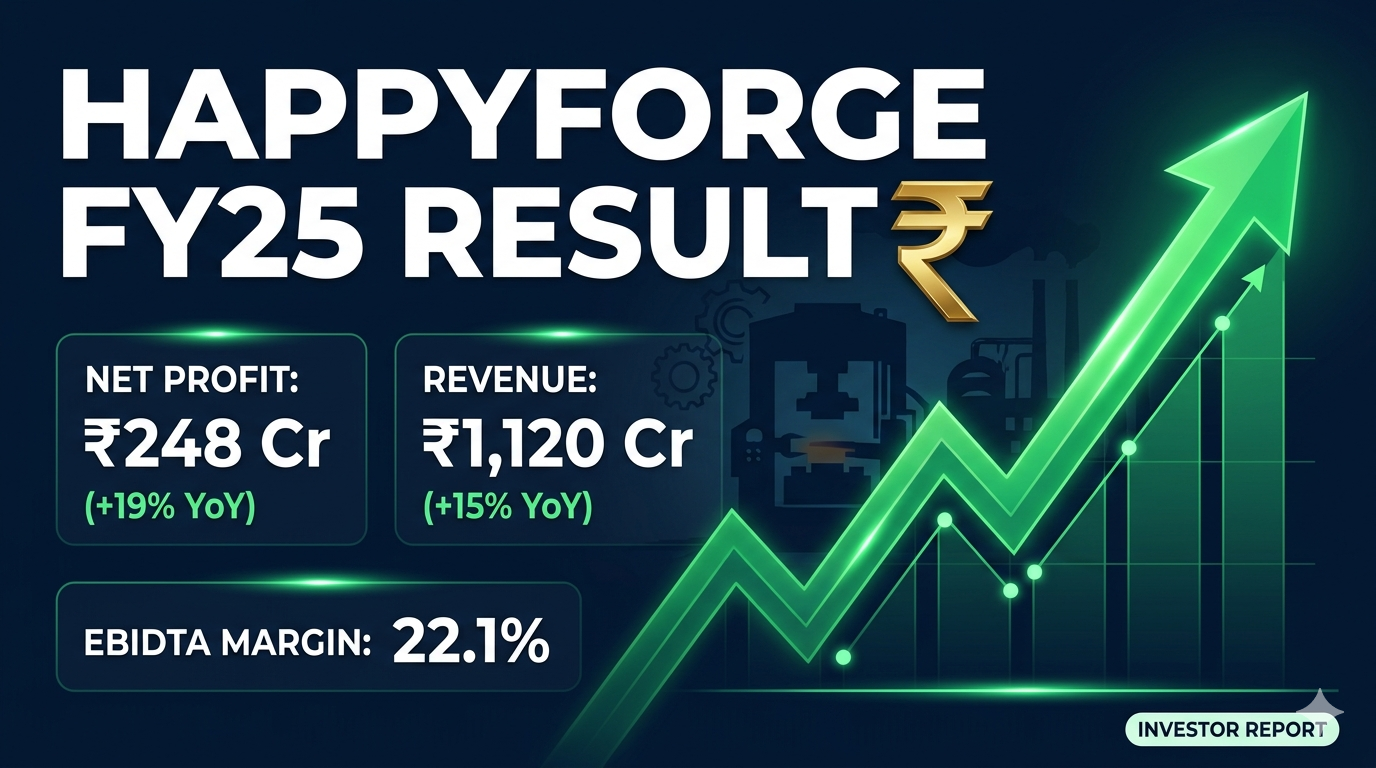
Meta Description: Happy Forgings (NSE: HAPPYFORGE) FY25 annual results decoded — revenue, profit margins, EPS, and what smart investors need to know right now.
The Quick Answer: How Did Happy Forgings Perform in FY25?
Happy Forgings Limited (NSE: HAPPYFORGE) delivered a solid, if not spectacular, FY2024–25. Here’s the snapshot:
| Metric | FY25 | FY24 | Change |
|---|---|---|---|
| Revenue | ₹1,408–1,546 Cr | ₹1,359 Cr | +3.7% YoY |
| Net Profit (PAT) | ₹267–301 Cr | ₹243 Cr | +10.1% YoY |
| Net Profit Margin | 19.0% | 17.9% | +110 bps |
| Operating Profit Margin | 28.9% | 28.5% | Marginal improvement |
| EPS | ₹28.39 | ₹26.78 | +6% |
| 5-Year Revenue CAGR | 25.1% | — | Strong long-term trend |
| 5-Year Profit CAGR | 32.6% | — | Exceptional compounding |
Revenue missed some analyst estimates by approximately 1.7%, but the profit story is genuinely impressive — and that distinction matters enormously for how you interpret this result.
📌 Source: Equitymaster FY25 Annual Report Analysis | Simply Wall St Full Year 2025 Earnings
Introduction: Why Happy Forgings Deserves Your Attention Right Now
If you’ve been following the Indian capital goods and precision manufacturing space, you’ve likely come across Happy Forgings Limited — a company that often flies just below the headline noise of the Nifty 50, but quietly compounds returns in a way that serious investors deeply respect.
When the FY25 annual results dropped in May 2025, market reaction was muted on the surface. Revenue growth came in at a modest 3.7% year-on-year — a number that, taken in isolation, might cause a casual investor to scroll past. But here’s the thing: this is a company that has grown its net profit at a CAGR of 32.6% over five years. That’s not luck. That’s operational discipline.
In this deep-dive, you’ll get a clear, honest breakdown of exactly what the FY25 results tell us — the wins, the cautionary notes, the context that most reports miss, and what investors watching HAPPYFORGE should be thinking about heading into FY26.
Whether you’re a seasoned investor in the capital goods sector or someone who recently discovered this Jalandhar-based forging powerhouse after its 2023 IPO, this post is for you.
Background: Who Is Happy Forgings Limited?
Before we dissect the numbers, a quick grounding for those newer to the stock.
Happy Forgings Limited (HFL) was incorporated in July 1979 in Jalandhar, Punjab. According to Screener.in, it stands today as the 4th largest manufacturer of complex, safety-critical, heavy-forged, and precision-machined components in India by forging capacity. The company serves several high-stakes industries:
- Commercial vehicles (trucks, buses)
- Farm equipment (tractors, agricultural machinery)
- Industrial equipment
- Wind turbines (pinion shaft manufacturing — a segment entered in 2019)
- Electric buses (front axle beams — commercialised in 2022)
HFL’s journey into electric mobility and wind energy isn’t just a press release strategy. These are real revenue streams that the company has been building for years, and they represent the optionality that long-term bulls point to when making the case for HAPPYFORGE.
The company went public through a ₹1,009 crore IPO in late 2023, combining ₹500 crore of fresh issue with an offer for sale — and the market has been recalibrating its expectations ever since. You can review all official company filings and disclosures directly on the NSE India company page for HAPPYFORGE and the Happy Forgings official website.
FY25 Annual Results: A Deeper Look Behind the Numbers
Revenue Growth: Modest on the Surface, Meaningful in Context
Operating income for FY25 came in at approximately ₹1,408–1,546 crore (figures vary slightly between standalone and consolidated, and across reporting sources), representing a 3.7% year-on-year increase.
This is slower than the company’s five-year CAGR of 25.1%, and it did miss some street estimates by 1.7%. But here’s the context that matters: FY24 was a high base. The commercial vehicle industry in India, which has been a significant revenue driver for HFL, started showing signs of moderation in late FY24 and into FY25. Macro headwinds — slower infrastructure ordering cycles, rural demand volatility — naturally created resistance.
What’s encouraging is that HFL managed to reduce raw material costs from ₹629.73 crore in FY24 to ₹602.78 crore in FY25 even while revenues grew. This is a sign of genuine operational efficiency — the company is getting leaner, not just bigger.
Profitability: The Real Story
This is where FY25 truly shines.
Net profit grew 10.1% to approximately ₹267–301 crore, up from ₹243 crore in FY24. More importantly, net profit margins expanded from 17.9% in FY24 to 19.0% in FY25 — a 110 basis point improvement. For a capital-intensive manufacturing business, that’s a meaningful shift.
Operating profit margins also ticked up slightly — from 28.5% to 28.9%. In a year when revenue growth slowed, holding and growing margins speaks to pricing power, product mix improvement, and cost discipline.
Finance costs dropped 36% year-on-year — a dramatic improvement that reflects both debt repayment using IPO proceeds and improved working capital management. For investors who track interest coverage ratios, this is a green flag.
Other income surged 180.4% YoY, which includes treasury income on cash raised from the IPO. While this inflates the profit picture somewhat, it’s not artificial — it’s a legitimate benefit of a well-capitalised balance sheet.
📌 Source: Equitymaster — Happy Forgings FY25 Annual Report Analysis
EPS and Shareholder Returns
Earnings per share for FY25 came in at ₹28.39, up from ₹26.78 in FY24, as reported by Simply Wall St. The company declared a final dividend of ₹3 per share, modest but consistent, reflecting a company that is ploughing the bulk of its earnings back into capacity building.
With a promoter holding of 78.5% per Screener.in, the founding family remains deeply committed — always a positive signal of long-term alignment with minority shareholders.
Balance Sheet: Building for the Future
One of the most important — and underappreciated — parts of the FY25 story is what HFL is doing with its balance sheet. Based on data from Equitymaster’s annual report analysis:
- Total assets grew to ₹22 billion in FY25, up from ₹19 billion in FY24 — a 17% increase.
- Fixed assets rose 13% — the company is actively investing in manufacturing infrastructure.
- Current assets rose 24% — liquidity is healthy.
- Cash flow from operations jumped 54.3% to ₹3 billion — this is significant. It means the business is generating real cash, not just accounting profits.
The capex picture tells a story of aggressive forward investment. Cash flow from investing activities was deeply negative (around ₹-3 billion) — which might sound alarming but is exactly what you’d expect from a company building out new forging press lines, precision machining capacity, and EV component capabilities.
HFL installed its first 14,000-ton forging press line in 2022, which is among the largest in India. This kind of infrastructure takes years to fully load, but once it runs at high utilization, margin expansion follows almost mechanically. You can track full historical cash flow data on Trendlyne’s financials page for HAPPYFORGE.
Share Price Performance: The Disconnect Investors Need to Understand
Here’s where the conversation gets genuinely interesting — and a little uncomfortable.
Over the past year, HAPPYFORGE shares fell approximately 23.7% (from around ₹1,270 to ₹969 at one point), while the broader S&P BSE Sensex gained 4.8% over the same period — a significant underperformance, per Equitymaster.
But as of mid-2025, the stock has recovered meaningfully — trading around ₹1,149–1,341 depending on the reference date — with a P/E ratio of approximately 39–43x, per Tickertape.
Why the earlier sell-off? A few reasons:
- Post-IPO euphoria correction — Many newly listed stocks trade at peak multiples post-IPO and then correct as the initial excitement settles.
- Revenue miss vs. expectations — The market priced in faster growth, and the 3.7% revenue expansion didn’t meet those expectations, with revenue missing analyst estimates by ~1.7% per Simply Wall St.
- Sector rotation — Capital goods saw some pressure as interest rate uncertainty persisted globally.
The 52-week range of ₹724–₹1,193 tells you this stock has been through meaningful volatility. For long-term investors, that kind of range often creates opportunity — provided the underlying business thesis remains intact. Live price data is available on NSE India and BSE India.
Competitive Position: What Makes HAPPYFORGE Different?
From research in the Indian capital goods sector, a few structural advantages stand out for HFL that rarely get enough attention in standard earnings commentary:
1. Safety-critical manufacturing moat.
Forgings used in crankshafts, axle beams, and gearboxes for commercial vehicles aren’t commodities. Customers qualify suppliers through rigorous testing processes. Once you’re a certified supplier to a major OEM, switching costs are very high. HFL’s customer relationships with large Indian CV makers represent a durable moat.
2. Wind energy positioning.
India has set an ambitious target of 500 GW of non-fossil fuel-based electricity capacity by 2030, per the Ministry of New and Renewable Energy. HFL’s wind turbine component business (pinion shafts) is a direct beneficiary of this megatrend.
3. EV component readiness.
The company entered EV bus axle manufacturing in 2022. As electric buses proliferate under government schemes like PM e-Bus Sewa, HFL is positioned to supply this growing market.
4. Scale and press capacity.
With multiple 8,000-ton and one 14,000-ton forging press line, HFL has industrial-grade scale that new entrants cannot replicate quickly or cheaply.
What Analysts Are Saying: Forward Outlook
Sell-side consensus on HAPPYFORGE for FY26 and beyond is cautiously optimistic, per Simply Wall St’s earnings coverage:
- Revenue is forecast to grow approximately 13% per annum over the next two years, in line with the broader Indian machinery sector outlook.
- Margin improvement is expected to continue as the newer press lines ramp up utilization.
- Debt reduction and lower interest costs will continue to support bottom-line growth even if revenue growth remains moderate.
The key risk flagged by analysts: customer concentration in the commercial vehicle segment. Investors should monitor CV wholesale volumes published monthly by SIAM (Society of Indian Automobile Manufacturers) — a reliable leading indicator of HFL’s revenue trajectory.
Key Takeaways: What Should Investors Do?
Let’s be honest — this post isn’t financial advice, and I’m not your fund manager. But here’s a clear-eyed summary of what the FY25 results tell us:
Reasons to be positive:
- Profit growth of 10.1% in a tough revenue environment shows operational quality
- Margin expansion is real and structurally driven
- Cash flow from operations surged 54% — the business is healthy
- 5-year profit CAGR of 32.6% is exceptional for a manufacturing business
- Balance sheet strengthening through debt reduction
Reasons to be watchful:
- Revenue growth slowed sharply from historical trends — needs to recover in FY26
- Revenue missed analyst estimates — the street expected more
- The stock trades at 39–43x earnings — a premium that requires consistent delivery
- CV cycle exposure is a concentration risk
The bottom line: Happy Forgings is a high-quality Indian manufacturing compounder going through a period of above-average capex investment and below-average revenue growth. For investors with a 3–5 year horizon, this combination has historically been a good setup — provided the business thesis (safety-critical forgings + EV + wind) plays out. For short-term traders, the premium valuation and revenue miss create near-term headwinds.
💡 For regulatory filings, shareholding patterns, and official financial disclosures, always refer to BSE India’s filings portal and NSE India as primary sources.
Comparison: Happy Forgings vs. Sector Peers
| Company | 5-Year Profit CAGR | Net Margin | P/E (approx.) | Reference |
|---|---|---|---|---|
| Happy Forgings (HAPPYFORGE) | 32.6% | 19.0% | 39–43x | Screener.in |
| Bharat Forge | ~15% | ~12% | 45–50x | Screener.in |
| Ramkrishna Forgings | ~20% | ~10% | 25–30x | Screener.in |
| Precision Castparts (global benchmark) | N/A | ~18% | 35x | Public filings |
Note: Peer figures are approximate and based on publicly available FY24–25 data. Always verify current figures before making investment decisions.
Happy Forgings compares favourably on profitability metrics versus domestic peers, though its valuation premium is not as extreme as Bharat Forge’s, which has a more diversified global footprint.
FAQ: Your Questions on Happy Forgings FY25 Results, Answered
Q1: What was Happy Forgings’ total revenue for FY2024-25?
Happy Forgings reported standalone revenue of approximately ₹1,546 crore for FY25 (consolidated figures were similar), representing a 3.7% year-on-year increase, per Whalesbook corporate news. While this was below some analyst estimates, the company’s five-year revenue CAGR of 25.1% reflects a strong long-term growth trajectory.
Q2: What was the net profit and EPS for Happy Forgings in FY25?
Net profit (PAT) for FY25 came in at approximately ₹267–301 crore (standalone basis), up about 10.1% from ₹243 crore in FY24. Earnings per share (EPS) improved to ₹28.39 from ₹26.78 in FY24, per Simply Wall St.
Q3: Why did Happy Forgings’ share price underperform in FY25 despite profit growth?
The share price fell approximately 23.7% over the past year primarily because revenue growth disappointed expectations (missing analyst estimates by ~1.7%), and the stock had run up significantly post-IPO. At 39–43x earnings, the market expected stronger top-line delivery. Profit growth was healthy, but the market punishes revenue misses at premium valuations.
Q4: Is Happy Forgings a good long-term investment?
This is a question only you can answer in the context of your own risk profile and portfolio. What the data shows is a company with exceptional profit compounding (32.6% 5-year CAGR), improving margins, strong cash generation, and positioning in EV and wind energy. However, CV cycle risk and premium valuations are genuine considerations. This is not financial advice — consult a SEBI-registered investment advisor before making decisions.
Q5: What dividend did Happy Forgings declare for FY25?
Happy Forgings declared a final dividend of ₹3 per share for FY25, with the record date set for July 2025, per HDFC Sky. This translates to a dividend yield of approximately 0.27–0.53% depending on the reference share price.
Q6: What is the promoter holding in Happy Forgings?
As of the latest filings, promoter holding stands at approximately 78.5% per Screener.in, indicating very high promoter commitment and alignment with minority shareholders.
Q7: What are the key risks for Happy Forgings going forward?
The primary risks are: (1) customer concentration in the commercial vehicle segment and sensitivity to CV cycles; (2) execution risk on large capex programs; (3) premium valuation leaving limited margin of safety if growth disappoints; (4) raw material price volatility (steel is a key input). Analysts have flagged at least one warning sign worth reviewing — see the detailed Simply Wall St risk analysis before investing.
Q8: What is the revenue growth forecast for Happy Forgings in FY26 and FY27?
Analyst consensus forecasts approximately 13% revenue growth per annum over the next two years, broadly in line with the Indian machinery sector, per Simply Wall St. EPS is expected to continue improving as interest costs decline and new press capacity loads up.
Conclusion: The Honest Summary Every Investor Needs
Happy Forgings FY25 annual results tell a nuanced story that rewards careful reading over reactive interpretation.
The company didn’t dazzle with revenue growth — 3.7% is modest by its own historical standards. But it proved something arguably more important: it can expand margins, generate strong operating cash flows, and compound profits even when the macro environment doesn’t cooperate.
For investors in the Indian capital goods space, HAPPYFORGE on NSE represents one of the more focused, operationally disciplined businesses available. Its five-year financial track record is genuinely exceptional. The questions going into FY26 are whether revenue growth can re-accelerate to the 10–15% range and whether new segments (EV, wind) begin contributing more meaningfully to the top line.
If you’re already a shareholder, the FY25 results provide reassurance, not alarm. If you’re evaluating entry, the stock’s move from 52-week lows represents a more reasonable starting point than the post-IPO peaks.
Either way, this is a company worth following closely — because when a high-quality compounder goes through a slow patch, it often sets the stage for the next leg of outperformance.
📩 Found this analysis useful? Subscribe to our newsletter for weekly deep-dives on Indian capital goods stocks, earnings breakdowns, and sector trends delivered straight to your inbox.
💬 Have a question or a different take on the HAPPYFORGE results? Drop it in the comments — we read and respond to every one.
📲 Share this post with someone who tracks Indian manufacturing stocks — they’ll thank you for it.
📚 External Sources & References
| Source | Description | Link |
|---|---|---|
| NSE India | Official HAPPYFORGE stock page | nseindia.com |
| BSE India | Official HAPPYFORGE filings | bseindia.com |
| Equitymaster | FY25 Annual Report Analysis | equitymaster.com |
| Simply Wall St | Full Year 2025 Earnings | simplywall.st |
| Screener.in | Company fundamentals & ratios | screener.in |
| Trendlyne | Annual results & financial history | trendlyne.com |
| Happy Forgings Official | Annual reports | happyforgingsltd.com |
| MNRE | India’s 500 GW renewable target | mnre.gov.in |
| SIAM | CV industry sales statistics | siam.in |
| SEBI | Find registered investment advisors | sebi.gov.in |
✍️ Suggested Post
Disclaimer: This article is for informational and educational purposes only. It does not constitute investment advice. Always consult a SEBI-registered investment advisor before making investment decisions. The author may or may not hold positions in the securities mentioned.

