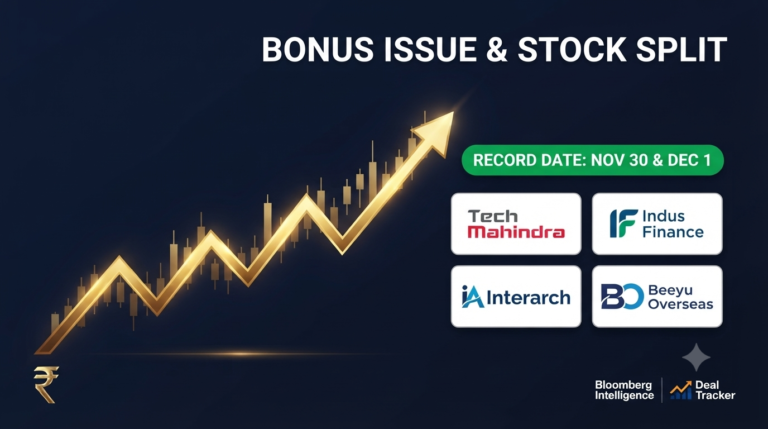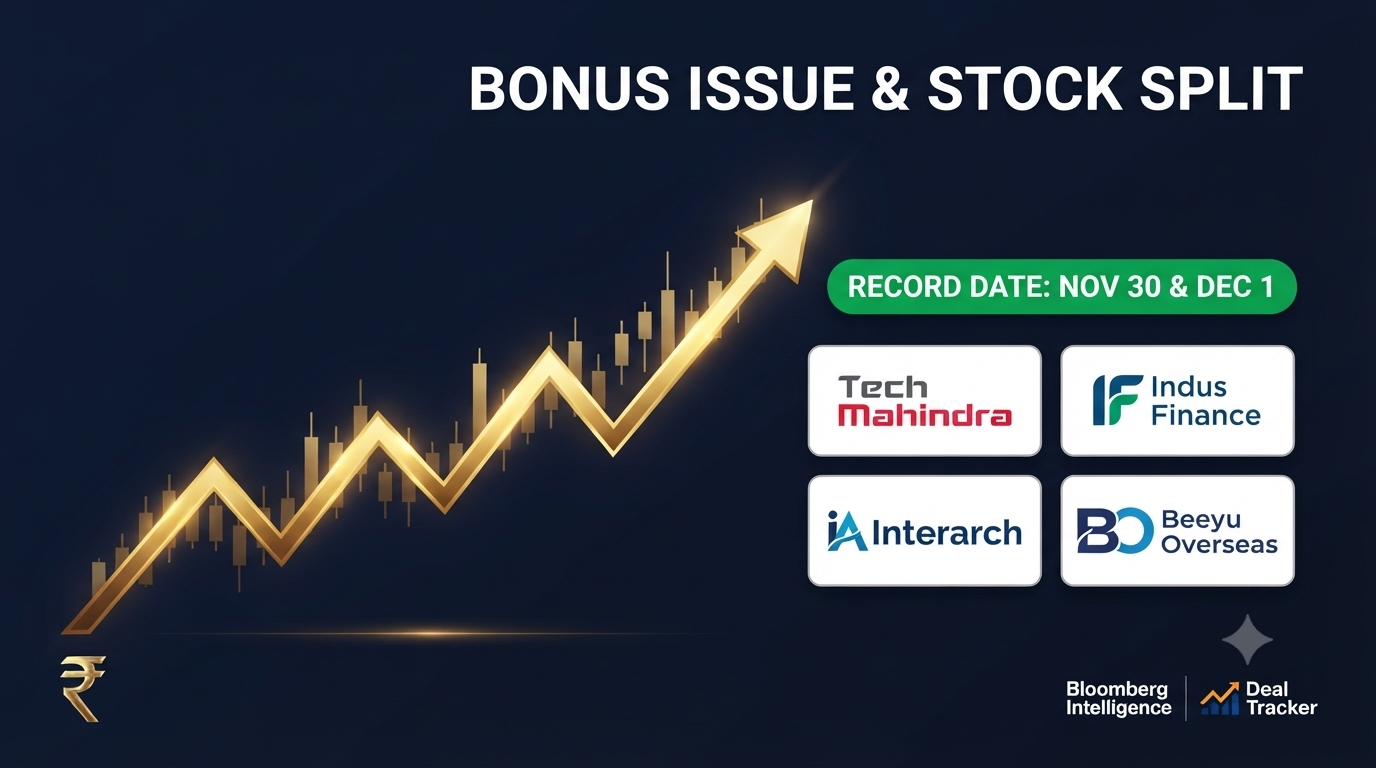
Tech Mahindra 1:1 bonus issue, Interarch 1:5 stock split, Indus Finance 5:9 bonus & Beeyu Overseas 99.41% capital reduction — record dates, eligibility & investor guide.
Introduction
If you’ve been tracking the Indian stock market lately, you’ve probably noticed a flurry of corporate action announcements — bonus issues, stock splits, and even a dramatic capital reduction. For long-term investors and active traders alike, these events aren’t just noise. They can directly affect your portfolio value, your tax obligations, and your eligibility to receive free shares.
But here’s the thing most investors get wrong: they fixate on the announcement date, not the record date — and that single oversight can mean missing out entirely on a bonus issue or stock split benefit.
In this guide, we’re breaking down everything you need to know about the upcoming stock split and bonus issue record dates for some of India’s most closely watched companies: Tech Mahindra, Indus Finance, Interarch Building Solutions, and Beeyu Overseas. You’ll also learn exactly how to check your eligibility, avoid the most common investor mistakes, and position yourself smartly ahead of these corporate actions.
Let’s get into it.
What Are Stock Splits and Bonus Issues? (Quick Answer)
Before diving into the specifics, let’s make sure we’re on the same page — because these two terms get confused constantly, even by experienced investors.
Stock Split: More Shares, Same Total Value
A stock split increases the number of shares in circulation by dividing existing shares into smaller units. The face value is reduced proportionally, so the total market capitalisation stays the same.
Example: If you hold 100 shares at ₹500 each (face value ₹10), and the company announces a 1:5 stock split (reducing face value to ₹2), you will now hold 500 shares at ₹100 each. Your total investment value remains ₹50,000 — but the stock becomes more accessible to smaller investors.
💡 According to the Securities and Exchange Board of India (SEBI), stock splits improve liquidity and retail investor participation without changing the fundamental value of a company.
Bonus Issue: Free Shares from a Company’s Reserves
A bonus issue (also called a scrip dividend) is when a company distributes additional shares to existing shareholders at no cost, funded from its accumulated reserves or free reserves.
Example: A 1:1 bonus issue means for every 1 share you hold on the record date, you receive 1 additional share free of charge.
Key difference from a stock split: In a bonus issue, the face value of shares remains unchanged. Only the number of shares increases.
| Feature | Stock Split | Bonus Issue |
|---|---|---|
| Face Value | Reduced | Unchanged |
| Shares Held | Increases | Increases |
| Market Cap Impact | Neutral | Neutral |
| Source of New Shares | Structural division | Company free reserves |
| Tax on Receipt | Generally nil | Generally nil |
| Future Cost Basis | Adjusted proportionally | New shares at ₹0 cost |
Why Record Dates Matter More Than You Think
Here is where most retail investors lose money they never needed to lose.
The record date is the specific date a company sets to determine which shareholders are eligible to receive benefits from a corporate action — be it a bonus issue, stock split, or dividend.
If you’re holding the shares on the record date at the close of trading, you qualify. If you bought on the record date itself, you likely do not qualify — because Indian stock markets operate on a T+1 settlement cycle (as of January 2023, per NSE’s settlement framework).
This means:
- Record Date: November 30, 2024 → You must have purchased the shares by November 29, 2024 to be credited as a holder on the record date.
- Ex-Date: The day before the record date is typically the ex-bonus or ex-split date. The stock price usually adjusts on this day to reflect the dilution.
📌 Pro tip from practice: Many first-time investors buy shares on the record date itself, thinking they’ll receive the bonus or split benefit. Under T+1 settlement, that purchase settles the next trading day — after the record date has already passed. Don’t make this mistake.
Tech Mahindra Bonus Issue: 1:1 Ratio Explained
Company: Tech Mahindra Limited (NSE: TECHM | BSE: 532755) Corporate Action: Bonus Issue Ratio: 1:1 (1 bonus share for every 1 share held) Record Date: November 30, 2024
Tech Mahindra, one of India’s leading IT services companies and a cornerstone of the Mahindra Group, has announced a 1:1 bonus share issue — arguably the most generous ratio possible. For every share you hold on the record date, you receive one additional share, effectively doubling your shareholding at no cost.
What Does This Mean Practically?
Suppose you hold 500 shares of Tech Mahindra at a hypothetical pre-bonus market price of ₹1,600 per share:
- Before bonus: 500 shares × ₹1,600 = ₹8,00,000 portfolio value
- After 1:1 bonus: 1,000 shares × ~₹800 (adjusted) = ₹8,00,000 portfolio value
The total market cap doesn’t change. But liquidity increases — the stock becomes more tradeable at a lower per-share price, often attracting more retail buyers and improving price discovery.
Why Is Tech Mahindra Doing This?
Bonus issues are typically a signal of corporate confidence. When a company dips into its free reserves to issue bonus shares, it’s essentially communicating: “We have more than enough reserves, and we want to reward long-term shareholders.”
According to publicly available exchange filings on BSE India, Tech Mahindra’s board approved this bonus in view of its strong reserve position and to increase retail participation in the stock. For a company in the competitive IT services space — alongside peers like Infosys, Wipro, and HCL Technologies — this move signals confidence in future earnings.
Tax Implications You Should Know
- At receipt: Bonus shares are not taxable at the time of allotment.
- At sale: The cost of acquisition for bonus shares is considered ₹0 for capital gains calculation.
- Holding period for LTCG: Counted from the date of allotment of bonus shares (not from when you bought the original shares).
- When you eventually sell these shares, your entire sale proceeds will be taxable as capital gains (short-term at 20% if held under 12 months; long-term at 12.5% above ₹1.25 lakh exemption if held 12+ months, as per Income Tax Act, Section 112A).
⚠️ Always consult a qualified CA or tax advisor before making decisions based on tax implications of corporate actions.
Indus Finance Bonus Issue: 5:9 Ratio — What It Means for You
Company: Indus Finance Corporation Limited Corporate Action: Bonus Issue Ratio: 5:9 (5 bonus shares for every 9 shares held) Record Date: December 1, 2024
If you haven’t heard of Indus Finance before, you’re not alone — it operates in the NBFC (Non-Banking Financial Company) space and is listed on Indian exchanges. What makes this announcement interesting is the 5:9 bonus ratio, an unusual, non-round number that often signals careful calibration of reserve utilisation by the board.
How the 5:9 Ratio Works — Concrete Examples
Let’s make this concrete with real numbers:
- If you hold 900 shares → You receive 500 bonus shares → Total: 1,400 shares
- If you hold 180 shares → You receive 100 bonus shares → Total: 280 shares
- If you hold 9 shares → You receive 5 bonus shares → Total: 14 shares
Fractional entitlements (if any) are typically rounded down or handled per company policy. It’s worth verifying with your broker or the company’s registrar and transfer agent (RTA).
Why the Unusual Ratio?
Companies choose specific ratios based on their distributable free reserves and total outstanding shares. A 5:9 ratio suggests Indus Finance has reserves that support distributing approximately 55.5% additional shares — a meaningful but carefully measured bonus.
For investors in small-cap NBFCs, this bonus issue, combined with the December 1 record date, makes the ex-bonus date approximately November 28–29 — confirm the exact date with your broker or directly on NSE India or BSE India.
📌 Small-cap NBFCs carry higher volatility around corporate action dates. Always position size responsibly and don’t chase stocks purely for bonus eligibility.
Interarch Building Solutions Stock Split: ₹10 to ₹2 Face Value
Company: Interarch Building Solutions Limited Corporate Action: Stock Split Split Ratio: 1:5 (1 share of ₹10 split into 5 shares of ₹2 face value) Record Date: December 1, 2024
Interarch Building Solutions is a prominent player in India’s pre-engineered steel buildings (PEB) space — a sector experiencing explosive growth as infrastructure spending in India scales up under government programmes like PM Gati Shakti and the National Infrastructure Pipeline.
Breaking Down the 1:5 Stock Split
This is a 1:5 stock split, meaning every 1 share with a face value of ₹10 is subdivided into 5 shares with a face value of ₹2 each.
Before the Split:
- Shares held: 100
- Face value: ₹10 per share
- Hypothetical market price: ₹2,000 per share
- Portfolio value: ₹2,00,000
After the Split:
- Shares held: 500
- Face value: ₹2 per share
- Adjusted market price (theoretical): ~₹400 per share
- Portfolio value: ₹2,00,000 (unchanged)
Why Interarch Is Splitting Its Stock
Interarch’s stock has been among the stronger performers in the infrastructure-linked small-cap segment. High per-share prices can act as a psychological barrier for retail investors — a 1:5 split brings the per-share price to a far more accessible range, potentially increasing trading volumes, improving market depth, and enabling SIP-style equity investing in the stock.
According to SEBI’s regulations on sub-division of shares, companies must obtain board approval and pass a shareholder resolution before executing a split — both of which Interarch has completed ahead of this announcement.
What Should Current Shareholders Do?
Absolutely nothing — that’s the beauty of a stock split. If you hold shares on the record date, the split happens automatically in your demat account. Your broker’s system handles all the adjustments, including:
- Updating share quantity and face value in your demat account (within 2–7 business days post record date)
- Adjusting your average cost basis proportionally in your trading account
- Automatically revising any open orders (GTT triggers, stop-losses) — but confirm with your broker
💡 Infrastructure sector insight: The PEB segment in India is projected to grow at a CAGR of 12–15% through 2028, driven by industrial and logistics infrastructure demand. Interarch’s stock split could be timed to increase retail participation ahead of this growth phase.
Beeyu Overseas Capital Reduction: The 99.41% Story
This one is fundamentally different from everything else on this list — and it deserves careful, deliberate attention.
Company: Beeyu Overseas Limited Corporate Action: Capital Reduction (not a bonus issue or stock split) Reduction Extent: 99.41% of equity capital Regulatory Approval: NCLT (National Company Law Tribunal) Record Date: November 30, 2024
What Is a Capital Reduction?
A capital reduction is a process by which a company formally reduces its paid-up share capital. Unlike a stock split or bonus issue — which are typically shareholder-friendly events — a capital reduction is a corporate restructuring instrument, often used for one of three reasons:
- Write off accumulated losses against the capital account, cleaning up the balance sheet
- Return surplus capital to shareholders (less common in India)
- Restructure ahead of a merger, acquisition, or fresh fund infusion
What Does a 99.41% Reduction Actually Mean?
This is an extraordinary figure that demands attention. A 99.41% capital reduction means the company is wiping out nearly all of its existing paid-up equity capital. If the company had paid-up capital of, say, ₹100 per shareholder’s proportional share, only ₹0.59 worth would remain post-reduction.
This level of reduction typically points to one of two scenarios:
- Scenario A — Massive accumulated losses: The company writes off these losses against share capital, essentially performing balance sheet surgery to restart on a healthier footing. This is known as a “loss absorption” capital reduction.
- Scenario B — Pre-restructuring action: Companies sometimes reduce capital before a fresh capital infusion from a new investor, as part of a court-approved scheme of arrangement or merger.
Beeyu Overseas obtained NCLT approval for this scheme, which is mandatory under Section 66 of the Companies Act, 2013. NCLT scrutiny means the tribunal has examined the scheme, heard objections, and found it compliant with Indian corporate law.
What Should Beeyu Shareholders Do?
If you hold shares in Beeyu Overseas, this is not the time to be passive. Capital reductions of this scale can fundamentally alter your investment value. Here’s your action checklist:
- Read the NCLT-approved scheme document — available on the company’s website and in BSE/NSE filings under the Corporate Actions section
- Understand your entitlement — are you receiving cash compensation for the cancelled capital? This varies by scheme structure
- Consult a SEBI-registered investment advisor — before the November 30 record date
- Monitor your demat account post-record date for any changes in share quantity and face value
- File the scheme document with your CA for tax purposes — capital reductions can have specific tax treatments under the Income Tax Act
⚠️ Important disclaimer: Capital reductions are complex legal-financial events with potentially significant impact on shareholder value. This post is for informational and educational purposes only. Please consult a qualified financial advisor and legal expert before making any investment decisions regarding Beeyu Overseas.
Corporate Actions Calendar: November–December Record Dates
Here’s your quick-reference master table for all the corporate actions covered in this guide:
| Company | Action Type | Ratio / Details | Record Date | Approx. Ex-Date |
|---|---|---|---|---|
| Tech Mahindra (TECHM) | Bonus Issue | 1:1 | November 30, 2024 | November 29, 2024 |
| Beeyu Overseas | Capital Reduction | 99.41% reduction | November 30, 2024 | November 29, 2024 |
| Indus Finance | Bonus Issue | 5:9 | December 1, 2024 | November 29/30, 2024 |
| Interarch Building Solutions | Stock Split | 1:5 (₹10 → ₹2 FV) | December 1, 2024 | November 29/30, 2024 |
📌 Important: Ex-dates should always be confirmed directly on NSE India’s Corporate Actions page or BSE India’s Corporate Actions section. Exchange-confirmed dates are always authoritative over third-party sources.
How to Check If You’re Eligible (Step-by-Step)
This is the section most investors skip — and then regret. Here’s exactly how to verify your eligibility for any of these corporate actions, step by step.
Step 1: Confirm the Record Date from Official Sources
Visit the NSE India Corporate Actions page or BSE India Corporate Actions section. Search by company name and verify the record date directly from exchange filings — not from social media, WhatsApp forwards, or unverified websites.
Step 2: Understand Your T+1 Buy Deadline
Under India’s T+1 settlement cycle (effective January 2023 per SEBI circular), shares purchased today settle tomorrow. If the record date is November 30, your last chance to buy and qualify is November 29.
Step 3: Verify Your Demat Holdings (Not Just Trading Account Balance)
Log in to your demat account via CDSL’s myEasiOnline or NSDL’s portal, or through your broker. Confirm shares are in your demat account — not as an unsettled purchase in your trading account. Settlement must be complete before the record date.
Step 4: Confirm No Pledge or Lien on Your Shares
If your shares are pledged (for a margin facility, for example), check with your broker whether pledged shares qualify for corporate benefits. In most cases, they do — but it’s worth confirming.
Step 5: Wait for Corporate Benefit Credit
After the record date, bonus shares or split shares are credited to your demat account within 2–15 business days, depending on the registrar and transfer agent (RTA) timeline set by the company.
Step 6: Verify the Credit and Update Records
Log back into your demat account after the expected credit date. Confirm the new shares are reflected. If not, contact your broker’s support team with your holdings proof and the corporate action reference. You can also raise a complaint via SEBI SCORES if the issue isn’t resolved.
Common Mistakes Investors Make Around Record Dates
From advising investors over the years, here are the most costly and avoidable mistakes made around record dates:
❌ Mistake 1: Buying on the Record Date Itself As detailed above, under T+1 settlement, buying on the record date means your shares settle the next trading day — after eligibility has been determined. You will not receive the benefit.
❌ Mistake 2: Relying on Unverified Social Media Information WhatsApp forwards and Twitter/X posts about record dates are frequently inaccurate or outdated. Always verify from NSE/BSE directly.
❌ Mistake 3: Confusing Announcement Date with Record Date Companies often announce corporate actions 2–6 weeks in advance. The benefit is determined on the record date, not the announcement date. Mark the right date in your calendar.
❌ Mistake 4: Ignoring Tax Implications Until Tax Season Bonus shares acquired at ₹0 cost can create large taxable events when sold — especially if the shares appreciate significantly. Many investors are surprised by their capital gains liability in the year they finally sell these shares. Plan proactively with your CA.
❌ Mistake 5: Chasing Stocks Purely for the Corporate Benefit Buying a stock solely to capture a bonus or split, then selling immediately after, is a strategy that rarely works as planned. The stock price adjusts on the ex-date, taxes apply on eventual sale, and transaction costs eat into any perceived gain. Invest in good businesses first; corporate actions are a bonus, not the thesis.
❌ Mistake 6: Not Updating Demat Account Details If your demat account has an outdated nominee, incorrect PAN linkage, or inactive KYC, corporate benefits may face processing delays. Use this period to audit your account with your broker or depository participant (DP).
Pros and Cons of Investing Around Corporate Actions
✅ Pros of Investing Around Corporate Actions
- Increased liquidity: Post-split or post-bonus, stocks often trade in higher volumes, improving price discovery and reducing bid-ask spreads.
- Psychological price accessibility: A lower per-share price post-split attracts more retail buyers and enables fractional-style participation.
- Confidence signal from management: Bonus issues signal strong reserves and management’s conviction in future performance.
- More shares without additional investment: Your portfolio grows in terms of share count without deploying fresh capital.
- Potential for price re-rating: High-quality stocks post-split sometimes see improved valuations as retail participation broadens the investor base.
❌ Cons and Risks to Consider
- No fundamental value change: More shares at a lower price equals the same total value. It is not “free money” — the market adjusts on the ex-date.
- Tax complexity: Bonus shares create a ₹0 cost basis, inflating future capital gains. This can create unexpected tax liabilities.
- Short-term volatility: Corporate actions attract speculative traders, increasing price volatility around ex-dates and in the days following.
- Capital reduction risk: As seen with Beeyu Overseas, not all corporate actions benefit shareholders. Capital reductions can significantly diminish investment value.
- Anchoring bias: Investors sometimes hold onto appreciated bonus shares too long because they “feel like free shares” — ignoring opportunity cost.
FAQ Section
Q1. What happens to my shares if I sell them on the ex-bonus date?
If you sell your shares on the ex-bonus date, you will still receive the bonus shares — because you were a registered holder before the ex-date cutoff. However, your buyer won’t receive the bonus. The stock price typically adjusts downward on the ex-date to reflect this. So you gain the bonus but sell at a lower price — the net effect is roughly neutral.
Q2. Do I need to apply for bonus shares or a stock split?
No. Both bonus issues and stock splits are completely automatic. If you’re the registered holder on the record date, the new shares are credited to your demat account without any action required from you. No application, no form, no opt-in.
Q3. Is a 1:1 bonus issue “better” than a 5:9 bonus issue?
In terms of additional shares, yes — a 1:1 ratio gives you 100% additional shares, while a 5:9 ratio gives approximately 55.5% additional shares. But what actually matters is the underlying fundamentals of the company issuing the bonus. A generous ratio from a struggling company is worth far less than a modest ratio from a fundamentally strong business.
Q4. What is the exact difference between ex-date and record date?
The record date is the official cut-off date to determine eligible shareholders. The ex-date is the first day you’re trading the stock without the right to receive the corporate benefit. Under T+1 settlement in India, the ex-date is typically 1 business day before the record date. If the record date is November 30, the ex-date is likely November 29.
Q5. How does a 1:5 stock split affect my stop-loss orders and GTT triggers?
Most brokers (Zerodha, Upstox, Angel One, Groww) automatically adjust open orders post-split. However, it is strongly recommended that you manually review and confirm all open orders after the split date. This prevents accidental triggering of orders at pre-split price levels.
Q6. Is the Beeyu Overseas capital reduction the same as a stock buyback?
No. A buyback involves a company purchasing its own shares from the open market or shareholders at a premium, reducing outstanding shares — typically value-accretive for remaining shareholders. A capital reduction under NCLT approval is a different legal process — often used to write off accumulated losses — and can significantly reduce shareholder value depending on the scheme’s terms.
Q7. Where can I find official record dates for all corporate actions?
The most reliable, authoritative sources are:
- NSE India – Corporate Filings & Actions
- BSE India – Corporate Actions
- The company’s official investor relations page
- Depository participant statements (CDSL/NSDL)
- SEBI SCORES for dispute resolution if benefits aren’t received
Q8. Are bonus shares included in LTCG (Long-Term Capital Gains) tax calculation?
Yes, with important nuances. Bonus shares are taxed when you sell them. The 12-month holding period for LTCG eligibility is counted from the date of allotment of bonus shares (not from when you originally bought the parent shares). The cost of acquisition is ₹0, so the entire sale proceeds form your taxable capital gain. For FY2024-25, LTCG on listed equity above ₹1.25 lakh is taxed at 12.5% (post the Union Budget 2024 revision). Consult your CA for precise calculation.
Conclusion
Corporate actions like bonus issues, stock splits, and capital reductions are among the most impactful events in an investor’s journey — and yet they’re consistently misunderstood, mistimed, or overlooked by retail investors.
Whether you’re eyeing the Tech Mahindra 1:1 bonus issue with its generous reward for loyal shareholders, tracking the Indus Finance 5:9 bonus, excited about the liquidity unlock that the Interarch Building Solutions 1:5 stock split promises, or carefully monitoring the dramatic Beeyu Overseas 99.41% capital reduction — the core principle remains constant:
Know your record date. Understand your T+1 eligibility window. Act before the ex-date. And invest in fundamentally sound businesses first.
The Indian equity market rewards those who do their homework. Use the resources linked throughout this post, verify everything from official exchange sources, and when in doubt — always consult a SEBI-registered investment advisor.
If you found this guide genuinely useful, here’s how you can take action right now:
- 📧 Subscribe to our free weekly corporate actions newsletter — never miss another record date
- 📲 Share this post with a fellow investor who needs it (you probably know at least one)
- 💬 Comment below — which of these corporate actions are you tracking and why? Let’s discuss.
- 🔖 Bookmark this page — we update it regularly with new record date additions
READ MORE
Why Are Jewellery Stocks Falling? Sky Gold, Titan, Kalyan & Senco Under Pressure — What Every Investor Must Know
📌 Coming up next: Q3 FY25 dividend record dates and ex-dividend calendar — stay tuned.
⚠️ Disclaimer: This article is for informational and educational purposes only. It does not constitute investment advice. Always conduct your own due diligence and consult a SEBI-registered investment advisor before making investment decisions.
This article was last reviewed and updated: November 2024