

Meta Description: Jewellery stocks like Sky Gold, Titan, Kalyan & Senco Gold are declining. Here’s what’s driving the fall — and what smart investors should do next.
🔎 Quick Answer (For Google SGE / AI Overviews)
Jewellery stocks including Sky Gold, Titan Company, Kalyan Jewellers, and Senco Gold have faced sharp selling pressure due to a combination of factors: a correction in gold and silver prices on MCX, profit-booking after a strong rally, a strengthening US dollar, rising bond yields, cautious Federal Reserve rate expectations, and policy-level concerns around gold demand in India. MCX gold has slipped over 2% and MCX silver over 3% in recent sessions, dragging jewellery sector stocks down with them. Investors should understand this as a multi-layered correction, not a structural collapse.
Introduction: When Gold Falters, Jewellery Stocks Feel the Burn
There’s something almost counterintuitive about the jewellery sector on Indian bourses. These are companies that sell aspiration — wedding sets, festive gold, heirloom silver. And yet, within hours of a policy speech, a Fed statement, or a bullion correction, their stocks can shed billions in market capitalisation.
If you’ve been watching your portfolio and wondering why Sky Gold is slumping 4%, why Titan is a top Nifty loser, or why Kalyan Jewellers is suddenly off by 2–3% when nothing seems obviously broken in their business — this article is written for you.
Over the past few months, working with retail investors and market observers who hold jewellery stocks as long-term bets on India’s consumption story, I’ve seen the same confusion play out repeatedly: “The company reported great quarterly numbers. Why is the stock falling?”
The answer, as always in markets, is layered. Let’s unpeel it — carefully, honestly, and with enough practical context to help you make a smarter decision than simply panic-selling or blindly averaging down.
The Big Picture: What’s Actually Happening to Jewellery Stocks Right Now
A Sector That Was Flying High — Until It Wasn’t
To understand the decline, you first have to appreciate the rally. Despite recent declines, in the past six months, the stock prices of major jewellery companies had outperformed the market by surging up to 39%, while the benchmark index was down 9% during the same period.
That’s an extraordinary run. When any sector moves that far, that fast, it creates a fragile setup where even modest negative catalysts can trigger disproportionate selling.
The sharp decline in jewellery stocks came despite strong quarterly earnings reported by some of the sector’s leading players, which tells you something important: this isn’t about fundamental business deterioration. It’s about sentiment, macro forces, and yes — the gold price.
The Primary Trigger: Gold and Silver Prices Are Correcting
MCX Gold and Silver Have Come Off Their Highs
The most direct link between bullion prices and jewellery stocks is straightforward: when gold gets cheaper, demand might rise, but investor sentiment around gold-linked businesses often falls first. When gold gets pricier, the inverse can also cause problems — higher input costs pressure margins.
But what we’re seeing right now is a correction from record highs, and markets are pricing in uncertainty before the dust settles.
MCX gold slipped approximately 2.31% to ₹1,18,167 per 10 grams in a recent session, while silver fell approximately 2.14% to ₹1,40,302 per kg.
For silver, the correction has been even sharper. Over a ten-day period, silver in India fell about 17% from its peak. When silver drops that aggressively, it signals something broader is happening in precious metals — not just gold.
In the international market, after soaring to an all-time high of US$4,381.52 an ounce earlier in 2025, gold prices fell as much as 6.3% in a single day, marking bullion’s biggest single-day decline since 2013. That kind of move leaves a mark on investor confidence — and on jewellery stocks.
The Macro Forces Behind the Decline
1. A Stronger US Dollar Is Pressuring Bullion
The US dollar’s recent strength has put downward pressure on bullion. The greenback has firmed ahead of Federal Reserve policy meetings and amid upbeat earnings from major US companies. Since a stronger dollar makes gold and silver more expensive for buyers using other currencies, global demand has softened.
This is a classic inverse relationship. When the dollar strengthens, gold — which is priced in dollars globally — becomes relatively pricier for buyers in India, Europe, and Asia. Demand softens. Prices correct. Jewellery stocks follow.
2. Federal Reserve Rate Expectations Are Shifting
The Federal Reserve’s monetary policy stance has raised the likelihood of sustained high interest rates in the US, which reduces the allure of non-yielding assets like gold and silver.
Here’s the logic in plain English: gold doesn’t pay dividends or interest. When US Treasury bonds are yielding 4–5%, holding gold becomes comparatively less attractive. Investors rotate out of bullion and into yield-bearing instruments, reducing demand for precious metals.
The Federal Reserve released its first 25 basis point rate cut of 2025 in line with market sentiment, but the policy direction for 2026 was less dovish, with markets now expecting just one possible rate cut next year. That hawkish forward guidance was enough to rattle gold bulls — and by extension, jewellery sector stocks.
3. Profit-Booking After a Powerful Rally
Gold and silver prices fell on the MCX as traders booked profits after the recent rally, even as investors continued to watch for signals from the US Federal Reserve ahead of its monetary policy meeting.
Profit-booking is entirely rational behaviour. If you held Sky Gold through a 39% run, some part of that trade has to close at some point. When enough participants do this simultaneously, the pressure cascades down. This isn’t panic — it’s the market digesting its gains.
4. Weakening Safe-Haven Demand
Gold prices extended their decline for a second consecutive week as improved global risk appetite, a strong dollar, and the US Federal Reserve’s cautious tone on further rate cuts dampened demand for safe-haven assets.
Safe-haven demand — the kind that sends gold surging during geopolitical crises — fades when global risk sentiment improves. As trade tensions ease and equity markets stabilize, the premium investors were paying for gold’s safety properties diminishes.
5. Rising Bond Yields
Higher bond yields in the US amplify the opportunity cost of holding gold. When 10-year US Treasuries yield significantly positive real returns, institutional money shifts away from non-yielding commodities. The decline in gold and silver was further supported by a stronger US dollar, rising US Treasury yields, and positive US inflation data.
Stock-Level Impact: Who Has Fallen and By How Much
The Sharp End of the Decline
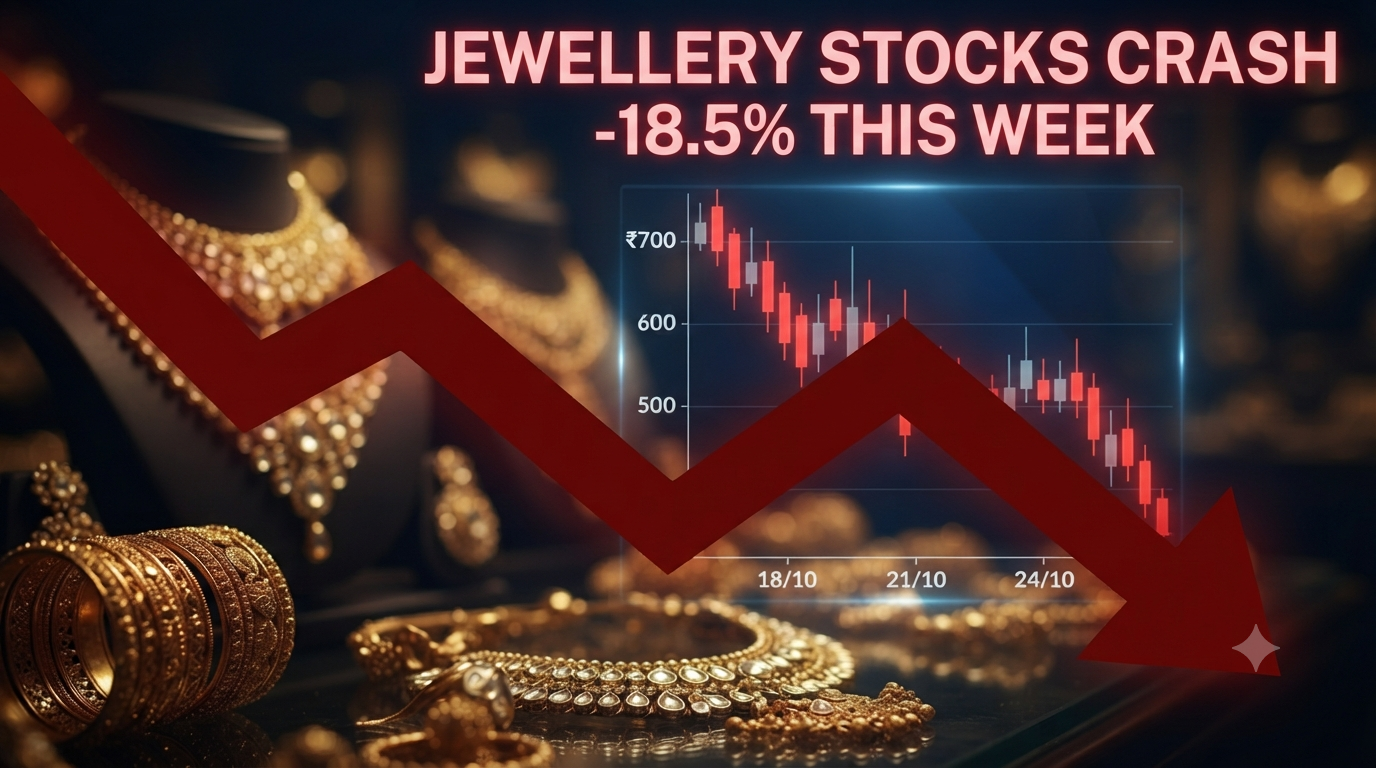
Sky Gold And Diamonds fell sharply by 12.24%, Senco Gold cracked 11%, Kalyan Jewellers tumbled 9.99%, Thangamayil Jewellery tanked 9.79%, Titan Company dived 8%.
That’s not a minor dip. Those are significant single-session moves. And they’ve occurred across the board — from large-cap Titan to mid-cap Sky Gold — suggesting this is a sector-wide repricing, not company-specific bad news.
Here’s a quick snapshot of the recent declines:
| Company | Approximate Decline | Note |
|---|---|---|
| Sky Gold & Diamonds | Up to 12.24% | Hardest hit mid-cap |
| Senco Gold | ~9–11% | Despite strong revenues |
| Kalyan Jewellers | ~8–10% | Despite Q4 profits doubling |
| Thangamayil Jewellery | ~9.79% | Regional player, sharp fall |
| Titan Company | ~6–8% | Top Nifty loser multiple sessions |
| Tribhovandas Bhimji Zaveri | ~6.83% | Legacy brand under pressure |
What makes this particularly striking is the disconnect with fundamentals. Kalyan Jewellers’ Q4 profit more than doubled (~118%). Senco Gold reported strong revenue and retail expansion. And yet both stocks saw double-digit percentage declines.
This is the market’s forward-looking mechanism at work. Investors aren’t reacting to what just happened — they’re pricing in what they fear might happen next.
The India-Specific Factor: Policy Concerns on Gold Demand
Beyond global macro pressures, Indian jewellery stocks faced an additional headwind from domestic policy signals in 2025 and 2026.
India’s gold imports rose 24% to a record $71.98 billion in 2025–26, contributing significantly to the country’s widening trade deficit. This ballooning import bill has created policy-level anxiety, with concerns that government interventions — whether in the form of import duty hikes, consumption curbs, or other regulatory measures — could dampen organised jewellery demand.
The government upped import tariffs on gold and silver to 15% from 6%, and analysts warned this could delay discretionary purchases, especially in the wedding and festive segments, impacting organised jewellery retailers such as Titan Company, Kalyan Jewellers, Senco Gold, and PC Jeweller.
Experts believe higher prices could delay discretionary purchases, especially in the wedding and festive segments. Until both gold price stability and policy clarity improve, the outlook for jewellery stocks is likely to remain subdued.
For anyone who understands India’s jewellery market — and I mean really understands it, not just the stock tickers — this is the core anxiety. India’s organised jewellery sector is built on weddings and festivals. Any signal that reduces gold buying in those contexts hits revenue at its deepest root.
Why Silver’s Decline Matters for Jewellery Stocks Too
Silver often gets overshadowed in the gold conversation, but its decline is worth understanding separately.
Industrial demand drops caused a steeper decline for silver compared to gold. Silver has a dual identity: it’s both a precious metal (a store of value like gold) and an industrial metal (used in solar panels, electronics, EVs). When industrial demand softens alongside macro pressure, silver gets hit from both directions.
This dual exposure explains why silver has seen steeper percentage losses in correction phases. For investors in jewellery companies that work significantly with silver (many mid-tier jewellers do), this adds another layer of margin and demand risk to monitor.
The Longer View: Is This a Structural Problem or a Cyclical Dip?
What the Data Suggests
After a powerful rally, both gold and silver have recently entered a correction phase. Gold and silver prices are highly sensitive to US Federal Reserve policy. When the Fed signals delayed rate cuts or a tighter stance, bond yields rise — making non-yielding assets like gold less attractive in the short run.
The key phrase there is short run. India’s RBI has also added to its gold reserves in recent years, reflecting confidence in the metal’s stability, and this long-term structural demand supports gold prices even during periods of short-term correction.
Despite the sharp recent falls, experts expect organised jewellery players to gain from industry formalisation over the medium term. The shift from unorganised to organised retail in Indian jewellery is a decade-long trend that isn’t reversed by a few weeks of stock pressure.
While short-term price swings are likely to continue, gold’s dual role as both a growth and defensive asset ensures that it remains one of 2025’s most resilient performers amid persistent global uncertainty.
What Should Investors Actually Do? (Practical Guidance)
This is the section that matters most. Market commentary that stops at explaining the fall without offering actionable guidance isn’t truly helpful. So let me be direct.
✅ If You’re a Long-Term Investor in Jewellery Stocks
Don’t conflate stock price with business quality. The fact that Kalyan Jewellers doubled its Q4 profit while the stock fell 10% is a data point that should give you confidence, not panic. Markets are noisy in the short run. Business fundamentals eventually reassert themselves.
Revisit your thesis. Ask yourself: “Why did I buy this stock originally?” If your answer was “India’s rising middle class, wedding demand, and organised retail growth” — has any of that changed? The duty hike and policy signals are headwinds, not obituaries.
Consider staggered accumulation. Experts recommend staggered investments to manage current volatility in precious metals. This applies equally to jewellery stocks. Rather than trying to time the bottom, buy in tranches over weeks or months. This averages your cost and reduces timing risk.
⚠️ If You’re a Short-Term Trader
This correction may have further to go before it stabilises. A 10–15% correction from peak was anticipated, which could bring prices closer to lower support levels before stabilising again. Until clarity emerges on Fed policy direction and domestic gold demand, momentum remains negative. Trade with tight stops and appropriate position sizes.
🔍 What to Watch Going Forward
- US Federal Reserve meetings — Any shift toward more dovish guidance will be a bullish catalyst for gold and jewellery stocks
- MCX gold price levels — Watch for stabilisation above key support levels (₹1.15–1.18 lakh range)
- Government policy signals — Duty adjustments, any relaxation of import curbs
- Quarterly earnings — Companies delivering consistent revenue growth validate the long-term story
- US CPI data and Federal Reserve guidance — These will be central to shaping short-term precious metals price movements
Pros and Cons: Investing in Jewellery Stocks During This Correction
| Pros of Buying Now | Cons / Risks |
|---|---|
| Stocks now cheaper than recent highs | Further correction possible if Fed stays hawkish |
| Strong underlying business fundamentals | Gold import duty hike could hurt demand |
| India’s organised jewellery growth story intact | Sentiment-driven selling can persist |
| Long-term gold demand from weddings, RBI reserves | Dollar strength may continue short-term |
| Some companies trading at better valuations | Silver’s industrial demand weakness adds risk |
A Note on Nifty Underperformance and Sector Rotation
Jewellery stocks don’t just move with gold — they also move with broader market sentiment. During periods when Nifty itself is under pressure or when institutional investors rotate from consumer discretionary to defensive sectors, jewellery stocks can underperform even the already-struggling index.
What you’re witnessing with the broader jewellery sector is what analysts call double jeopardy: a sector already sensitive to commodity prices getting hit simultaneously by macro headwinds and domestic policy uncertainty. That combination creates outsized moves — both up and down.
The implication for retail investors is clear: understand what you own and why. A jewellery stock is not simply a “gold proxy.” It’s a business bet on retail expansion, consumer spending habits, wedding culture, and organised trade growth. Those fundamentals remain compelling for India’s long-term growth story.
FAQ Section: Real Questions Investors Are Asking
Q1. Why are jewellery stocks falling even when gold prices are high?
Sometimes stocks fall in anticipation of future problems rather than reacting to current conditions. High gold prices can actually hurt jewellery companies by raising input costs and potentially dampening consumer demand — especially for discretionary and fashion jewellery. When gold surges dramatically and then corrects, investor uncertainty about the direction causes selling.
Q2. Is the decline in Sky Gold, Titan, Kalyan, and Senco Gold temporary or permanent?
Based on current analysis, this appears to be a cyclical correction driven by macro factors (US dollar strength, Fed rate expectations, profit-booking) rather than a structural breakdown in the businesses. Experts expect organised jewellery players to gain from industry formalisation over the medium term, suggesting the long-term story remains intact.
Q3. What is the connection between the US Federal Reserve and Indian jewellery stocks?
The Fed’s interest rate policy influences the US dollar and global gold prices. The Federal Reserve’s monetary policy stance raises the likelihood of sustained high interest rates in the US, which reduces the allure of non-yielding assets like gold and silver. Lower gold demand globally means lower prices, which impacts bullion sentiment in India and, by extension, jewellery sector stocks.
Q4. Should I buy the dip in jewellery stocks?
This depends entirely on your investment horizon and risk tolerance. For long-term investors with 3–5 year horizons who believe in India’s consumption growth story, the current dip may offer an accumulation opportunity. For short-term traders, the momentum is currently bearish, and patience may serve better than aggressive buying.
Q5. Why is silver falling more than gold during this correction?
Industrial demand drops caused a steeper decline for silver. Unlike gold, silver has significant industrial applications (solar energy, electronics, EVs). When global growth concerns arise, industrial demand for silver softens, adding selling pressure beyond what purely macro forces would cause for gold.
Q6. How does the import duty hike on gold affect jewellery companies?
The government raised import tariffs on gold and silver to 15% from 6%, and analysts warn higher gold prices may hurt demand. Higher import duties raise the domestic price of gold, potentially slowing discretionary purchases — especially in lower and middle market segments. Premium wedding jewellery may be more insulated, but the mid-market is at risk.
Q7. Which jewellery stock is most vulnerable and which is most resilient in this environment?
Larger, more diversified players like Titan Company tend to be more resilient due to their watches, eyewear, and accessories businesses alongside jewellery. Pure-play jewellery companies like Sky Gold or Senco Gold have more direct exposure to bullion price swings. That said, company-specific strengths in distribution, brand loyalty, and cost management matter enormously.
Q8. What is the staggered accumulation strategy for precious metals and jewellery stocks?
Experts recommend staggered investments to manage current volatility in precious metals. Applied to stocks, this means splitting your planned investment into 3–5 equal parts and deploying them at regular intervals (say, monthly) rather than committing all your capital at once. This strategy reduces the risk of buying at a local peak and smooths out your average cost over time.
Conclusion: The Dip You Should Understand Before You React
Here’s the core takeaway from everything we’ve explored: jewellery stocks are falling not because India stopped caring about gold, but because a convergence of global macro factors, policy headwinds, and rational profit-booking created a perfect storm of selling pressure.
The current gold–silver correction may feel unsettling, but the underlying fundamentals remain strong.
India is still the world’s second-largest gold consumer. Weddings remain a sacrosanct economic event. Organised retail in jewellery is still displacing informal traders. The RBI is still accumulating gold. None of that has changed.
What has changed is short-term sentiment. And sentiment, by definition, is temporary.
If you’re a long-term investor, use this period to review your positions with fresh eyes, not panicked ones. If you’re a first-time investor considering entry, do your homework on specific companies — their balance sheets, revenue growth, and market positioning matter more than the daily MCX ticker.
And if you’re simply watching from the sidelines trying to understand what’s happening? Now you do.
The jewellery sector’s story in India is far from over. It’s just taking a breath.
📌 Found this helpful? Share it with a fellow investor, drop your questions in the comments below, or subscribe to our newsletter for weekly market insights delivered straight to your inbox.
Read More
Gold & Silver Prices Fall Sharply — What Every Indian Investor Must Know Right Now
🔗 Authoritative Source Citations
- Business Standard — Jewellery Stocks and Gold Duty Hike Analysis
- Outlook Business — Jewellery Stocks Free Fall Analysis
- Outlook Money — Decoding the Gold and Silver Price Decline
- Moneylife — Gold Prices and Federal Reserve Rate Cuts Impact

