

Meta Description: Does the Fed control your mortgage rate? Not directly — but it powerfully shapes it. Here’s exactly how Fed rate decisions affect what you pay on your home loan in 2026.
The Question Every Homebuyer Is Asking Right Now
If you’ve been house hunting, refinancing, or just watching the news, you’ve probably heard some version of this: “The Fed held rates steady again — so mortgage rates might go up.” Or maybe the opposite: “The Fed cut rates — great news for homebuyers!”
Both statements are partly true and partly misleading. The Federal Reserve’s interest rate decisions do affect your mortgage — but not in the direct, one-to-one way most people assume. The actual relationship is more nuanced, more interesting, and once you understand it, significantly more useful for making smart financial decisions.
This guide breaks it all down — clearly, practically, and with the actual 2026 numbers you need.
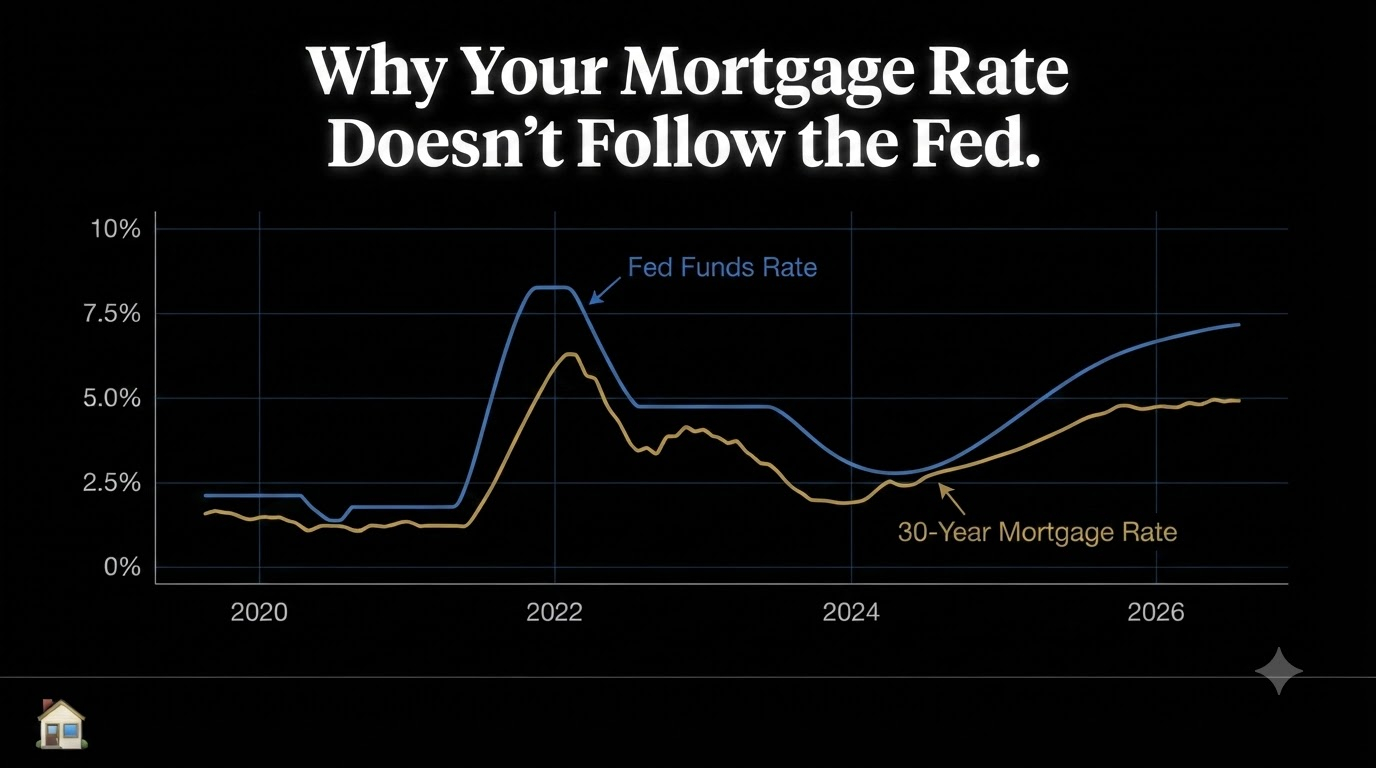
Here’s your direct answer upfront: The Fed does not set mortgage rates. But its policy decisions heavily influence the economic conditions that determine what lenders charge you. The link runs through Treasury yields, inflation expectations, and investor behavior — and once you understand that chain, you’ll never read a Fed headline the same way again.
🔗 New to the Fed? Start with our plain-English primer: What Is the Federal Reserve Act? How the Fed Works — And Why It Affects Your Money Every Day
First: What Does the Fed Actually Control?
Before we get to mortgages, it helps to be precise about what the Federal Reserve actually controls.
The Fed sets the federal funds rate — the interest rate that banks charge each other for overnight loans. As of July 29, 2026, the central bank left the federal funds rate unchanged at a range of 3.5% to 3.75%.
That’s it. One rate. One overnight lending rate between banks.
Yet this single number ripples outward across the entire economy — affecting credit cards, car loans, business borrowing, savings accounts, and yes, mortgages. But the path from the federal funds rate to your mortgage rate is indirect, and it runs through a different benchmark entirely.
The Real Driver of Mortgage Rates: The 10-Year Treasury Yield
Here’s the insight that most people miss, and that most financial news coverage buries:
Fixed-rate mortgages — the most popular type of home loan — don’t mirror the federal funds rate. They track the 10-year Treasury yield. When that goes up or down, fixed-rate mortgage rates do, too.
This is the single most important sentence in this entire article. Let it sink in.
When the Fed cuts its overnight rate, your 30-year fixed mortgage rate doesn’t automatically drop. What matters is what happens to the 10-year Treasury yield — and that is driven by a different set of forces: inflation expectations, economic growth forecasts, and global investor demand for U.S. government debt.
Why the 10-Year Treasury?
Since mortgages last longer than shorter-term lending options tied to the federal funds rate, they require a benchmark where the duration reflects the average mortgage. As Kiplinger explains, the 10-year Treasury yield is the right benchmark because it lasts about as long as the average homeowner actually holds a mortgage before selling or refinancing.
The “Spread” — The Gap Between Treasury Yields and Your Rate
Your mortgage rate isn’t exactly equal to the 10-year Treasury yield. It’s always higher — by what’s called a spread or margin. This spread compensates mortgage investors for the additional risks involved in holding mortgage-backed securities (MBS) instead of risk-free government bonds.
According to The Mortgage Reports, the historical relationship is remarkably stable: 30-year mortgage rates have averaged about 1.7 percentage points above the 10-year Treasury yield — compressing to 1.3% in calm markets and widening past 2.5% in stressful ones.
Bankrate confirms that typically the gap spans 1.5 to 2 percentage points — but for much of 2023 and 2024, the spread grew to 3 percentage points, making mortgages significantly more expensive than Treasury yields alone would suggest.
Think of it this way: Treasury yields are gravity for mortgage rates. Other forces can push rates around, but they can’t escape that gravitational pull for long.
How the Fed Influences Mortgage Rates (Indirectly)
So if the Fed doesn’t directly control mortgage rates, what exactly does it do?
The Fed shapes mortgage rates through three indirect channels:
Channel 1: Inflation Expectations
This is the most powerful channel. The Fed raises rates to fight inflation. When investors believe inflation will stay low — partly because the Fed is credibly fighting it — they accept lower yields on Treasury bonds. Lower Treasury yields → lower mortgage rates.
When inflation is high or rising, investors demand higher yields to compensate for the eroding purchasing power of their money. Higher yields → higher mortgage rates.
As Ali Wolf, chief economist at NewHomeSource, told CBS News: “Mortgage interest rates went down before the Fed cut rates in September but went up after. This is because the Fed is cutting the federal funds rate, which is a short-term interest rate. Mortgage interest rates, on the other hand, are influenced by investors and the yield on the 10-year Treasury.”
Channel 2: Forward Guidance and Market Expectations
The Fed doesn’t just act — it communicates. When Fed officials signal future rate cuts, bond markets often price those expectations in immediately, pushing Treasury yields (and therefore mortgage rates) down before the Fed actually does anything. The reverse is also true: hawkish signals push rates up.
This is why mortgage rates often fall before a Fed rate cut and sometimes rise after — the market already priced in the cut, and now it’s reacting to the Fed’s forward commentary.
Channel 3: Adjustable-Rate Mortgages (Direct Link)
Here’s where the Fed does have a more direct influence. As MCT Trading explains, for ARMs the fed funds rate has the most direct impact because it influences both LIBOR and the prime rate — the two benchmarks used in pricing adjustable-rate loans.
So if you have an adjustable-rate mortgage (ARM), Fed rate decisions hit you more directly and more quickly than if you have a fixed-rate loan. NerdWallet confirms that the Fed also has a very direct influence on home equity lines of credit (HELOCs), which typically have adjustable rates tied closely to the prime rate.
Fixed vs. Adjustable: How Each Mortgage Type Responds to Fed Decisions
| Mortgage Type | Tied To | Fed Impact | Response Speed |
|---|---|---|---|
| 30-year fixed | 10-year Treasury yield | Indirect | Gradual; can move before Fed acts |
| 15-year fixed | 10-year Treasury yield | Indirect | Similar to 30-year, slightly more sensitive |
| 5/1 ARM | Short-term rates / prime rate | More direct | Faster after Fed moves |
| HELOC | Prime rate (fed funds + 3%) | Very direct | Nearly immediate |
| Home equity loan | Mix of short & long-term | Moderate | Within weeks of Fed action |
Where Mortgage Rates Stand Right Now (August 2026)
Here’s the current picture so you can contextualize everything above.
According to Forbes Advisor, the current 30-year fixed mortgage rate of 6.58% and 15-year rate of 5.96% may be higher than what analysts hoped at the start of 2026 — but they’re still an improvement from much of 2025 and the 7%-plus rates borrowers faced in late 2023.
How did we get here? Bankrate’s timeline tells the story clearly: for much of the first half of 2025, rates hovered between 6.8% and 7.1%. The Fed then made three consecutive cuts in September, October, and December 2025, totaling 75 basis points. Rates finished 2025 around the 6.25% mark, briefly dipping as low as 6.09% in February 2026 before climbing back above 6.5% by June.
The most recent FOMC meeting on July 29, 2026 kept rates steady for the fifth consecutive time. The Fed’s ongoing pause has contributed to mortgage rates staying elevated, while geopolitical factors — particularly the Iran conflict — pushed oil prices and therefore inflation higher, further pressuring Treasury yields and mortgage rates upward.
This is a perfect real-world illustration: geopolitical events → inflation fears → higher Treasury yields → higher mortgage rates. The Fed’s rate decision was only one piece of the puzzle.
The Real-World Math: What Rate Differences Cost You
This is where abstract economics becomes very personal. Here’s what a rate difference means on a $400,000 home loan over 30 years:
| Rate | Monthly Payment (30-yr) | Total Interest Paid | Difference vs. 5% |
|---|---|---|---|
| 5.00% | $2,147 | $373,023 | — |
| 5.50% | $2,271 | $417,599 | +$44,576 |
| 6.00% | $2,398 | $463,353 | +$90,330 |
| 6.50% | $2,528 | $510,177 | +$137,154 |
| 7.00% | $2,661 | $557,940 | +$184,917 |
| 7.50% | $2,797 | $606,589 | +$233,566 |
The difference between a 5% and 7% mortgage rate on a $400,000 loan is nearly $235,000 in additional interest over 30 years. Use Freddie Mac’s mortgage calculator to run your own numbers. That’s why Federal Reserve policy — and the market forces it influences — matters so profoundly to ordinary Americans.
Before vs. After: How Rate Environments Change Homebuying Decisions
🔻 When the Fed Is Cutting Rates (Loosening Cycle)
What typically happens:
- Treasury yields fall as investors price in lower future rates
- Mortgage rates gradually decline over weeks or months
- More buyers enter the market as affordability improves
- Refinancing demand surges
- Home prices can rise as more buyers compete
- As Kiplinger notes, increased buyer demand can push home prices higher
Best moves:
- Lock in a rate if you’ve found the right home — don’t wait for a perfect rate
- Refinance if your current rate is meaningfully higher (generally 0.5%–1% lower)
- Be aware that lower rates bring more buyer competition
🔺 When the Fed Is Holding or Raising Rates (Tightening Cycle)
What typically happens:
- Treasury yields rise as inflation concerns mount
- Mortgage rates climb or stay elevated
- Buyer affordability decreases significantly
- Housing market activity slows; days on market increase
- Sellers may need to reduce prices or offer concessions
Best moves:
- Consider ARMs if you plan to sell or refinance within 5–7 years
- Negotiate harder — fewer competing buyers gives you more leverage
- Focus on what you can control: your credit score, down payment, and lender selection
7 Practical Things You Can Do Right Now to Get a Lower Mortgage Rate
Regardless of what the Fed does next, these strategies are within your control and can meaningfully reduce the rate you’re offered:
1. Improve Your Credit Score — It’s the Biggest Lever You Have
According to The Mortgage Reports’ analysis of Freddie Mac data, a borrower with a 760 credit score receives average rates around 6.75% on a 30-year conventional loan. The same loan for a 680 score borrower averaged 7.125% — a 0.375 point spread. At 620 credit, rates jumped to 7.5% or higher.
That’s a potential difference of 0.75% or more based solely on your credit score — which on a $400,000 loan translates to over $60,000 in total additional interest over 30 years.
Practical steps to improve your score fast, per Rate Direct:
- Pay down credit card balances to under 10% utilization on each card
- Dispute errors on your credit report — roughly 25% of consumers have at least one material error
- Avoid opening new credit accounts in the 6 months before applying
- Don’t close old accounts, as they contribute to your credit history length
2. Shop Multiple Lenders — Most Buyers Skip This
This is the single most underused strategy in homebuying. Rate Direct recommends getting Loan Estimates from at least four to five lenders — including a mix of banks, credit unions, mortgage brokers, and online lenders. Once you have multiple quotes, use the lowest offer as leverage to negotiate. Critically, all mortgage inquiries within a 14 to 45-day window count as one credit inquiry under FICO’s scoring model — so there’s no score penalty for shopping aggressively.
3. Make a Larger Down Payment
A larger down payment directly reduces lender risk, which translates to a lower rate offer. The conventional benchmark is 20% down to avoid private mortgage insurance (PMI) — but even increasing from 5% to 10% down can meaningfully improve your rate offer and reduce total loan cost.
4. Keep Your Debt-to-Income Ratio Low
Per Yahoo Finance’s mortgage analysis, the more debt you carry relative to income, the higher your mortgage rate. To qualify for the best rates, aim for a DTI of 25% or less. Calculate yours by dividing total monthly debt payments by gross monthly income. The CFPB’s guide to debt-to-income ratios is an excellent free resource.
5. Compare APR, Not Just the Interest Rate
Bankrate emphasizes that some lenders advertise low interest rates but offset them with high origination fees and closing costs. The Annual Percentage Rate (APR) includes fees and gives you a true apples-to-apples comparison between lenders. Always request and compare the Loan Estimate form — lenders are legally required to provide it within three business days of your application.
6. Consider Buying Down Points
One mortgage point equals 1% of the loan amount and typically reduces your rate by about 0.25%. If you plan to stay in the home long-term, paying points upfront can save significant money. Calculate your break-even period: divide the upfront cost of the points by your monthly savings — if you’ll stay in the home longer than that break-even point, buying down is worth it.
7. Consider Loan Type Carefully
As BestMoney’s 2026 mortgage guide explains, adjustable-rate mortgages offer initial rates 0.5% to 1.0% below fixed rates and can be a smart choice if you plan to sell or refinance within 5 to 7 years. Government-backed loan programs are also worth exploring:
- FHA loans: 3.5% down with a 580 credit score
- VA loans: Zero down for eligible veterans and service members
- USDA loans: Zero down for eligible rural properties
- Conventional 97: 3% down for first-time buyers meeting Fannie Mae or Freddie Mac eligibility
Should You Wait for Rates to Drop — or Buy Now?
This is the question we hear most often, and here’s the honest answer: timing the mortgage market is nearly impossible, even for professionals.
BestMoney’s 2026 mortgage outlook puts it directly: instead of waiting for the perfect rate, focus on what you can control — improve your credit score, reduce your debt-to-income ratio, build a larger down payment, and compare multiple lenders. If the monthly payment fits your budget, consider moving forward and using a rate lock to protect against short-term increases. If rates drop later, refinancing remains an option.
CBS News economist Daryl Fairweather of Redfin frames it well: “If waiting means you can save up or if you’re expecting to switch to a more lucrative job, then patience may pay off. But if rising rents make you anxious and you see a home that fits your lifestyle, the equation changes.”
The direction rates head in 2026 will depend on inflation data, Treasury yields, and Federal Reserve policy decisions. No forecast is guaranteed. Buyers benefit most from focusing on affordability today, not rate predictions.
There’s an old saying in real estate worth remembering: “Marry the house, date the rate.” You can always refinance when rates fall. You can’t always go back and buy the house you loved at the price it was when you hesitated.
The Big Picture: Why Political Battles Over the Fed Matter to Your Mortgage
This brings us full circle to something that matters more than it might seem for homebuyers: the ongoing legal and political battle over Federal Reserve independence.
The current dispute over the attempted removal of Fed Governor Lisa Cook — the first such attempt in the Fed’s 111-year history — is directly relevant to every mortgage holder and homebuyer in America. If political pressure successfully undermines the Fed’s ability to set monetary policy independently based on economic data, the consequences flow directly into the mortgage market:
- A politically pressured Fed that cuts rates prematurely to boost the economy could reignite inflation
- Reignited inflation pushes Treasury yields higher
- Higher Treasury yields push mortgage rates higher
- Every American with a mortgage or planning to buy one pays the price
For the full story on that landmark legal battle: 👉 Trump vs. Lisa Cook: The Legal Battle That Could Redefine Federal Reserve Independence Forever
And for a deep dive into how the Federal Reserve is structured and why it was designed to be independent: 👉 What Is the Federal Reserve Act? How the Fed Works — And Why It Affects Your Money Every Day
FAQ: Your Mortgage and the Fed — Answered
1. Does the Fed directly set mortgage rates?
No. The Federal Reserve sets the federal funds rate — the overnight lending rate between banks. Mortgage rates, especially 30-year fixed rates, are primarily tied to the 10-year Treasury yield, which is shaped by inflation expectations, economic growth forecasts, and investor demand. The Fed influences these forces indirectly.
2. When the Fed cuts rates, do mortgage rates automatically go down?
Not automatically or immediately. Markets often price in expected Fed cuts before they happen, so mortgage rates may already be lower by the time the Fed acts — and can even rise afterward if the Fed’s commentary is more cautious than expected. The 10-year Treasury yield is the real-time signal to watch, not the fed funds rate announcement itself.
3. What is the current 30-year fixed mortgage rate in 2026?
As of mid-2026, the average 30-year fixed mortgage rate is in the 6.5%–6.6% range, with 15-year fixed rates around 5.9%–6.0%. Rates change daily — always check Freddie Mac’s Primary Mortgage Market Survey or compare live offers from multiple lenders for the most current data.
4. How does my credit score affect my mortgage rate?
Significantly. The difference between a 620 and a 760 credit score can translate to a 0.75% or greater difference in your mortgage rate. On a $400,000 loan over 30 years, that difference exceeds $60,000 in total interest paid. Check your score free at AnnualCreditReport.com and review The Mortgage Reports’ credit score guide for rate tiers by score range.
5. Are adjustable-rate mortgages more sensitive to Fed decisions?
Yes. ARMs are tied more directly to short-term rates — including the prime rate, which moves in step with the federal funds rate. If the Fed raises rates, ARM payments can increase relatively quickly. HELOCs are especially sensitive, often repricing within one billing cycle of a Fed move.
6. What is “buying down points” and is it worth it?
Mortgage points let you pay upfront to reduce your interest rate — typically 0.25% reduction per point, with one point costing 1% of your loan amount. Whether it’s worth it depends on your break-even period. Use the CFPB’s buying points calculator to determine if points make financial sense for your situation.
7. Should I lock my mortgage rate, and for how long?
Rate locks protect you against rate increases between application and closing — typically available for 30, 45, or 60 days. In a volatile rate environment like 2026, locking your rate as soon as you have a firm purchase agreement is generally wise. Some lenders offer “float-down” options that let you capture a lower rate if rates fall before closing. Review the CFPB’s rate lock guide for what to confirm in writing before locking.
8. Is now a good time to refinance?
Refinancing generally makes financial sense when you can reduce your rate by at least 0.5%–1.0% and plan to stay in the home long enough to recoup closing costs. With 30-year rates in the mid-6% range in 2026, refinancing makes most sense for those with rates at 7% or above from 2023 or early 2024. Use the Consumer Financial Protection Bureau’s refinance calculator to calculate your specific break-even point before proceeding.
Conclusion: Stop Waiting for the Fed — Start Focusing on What You Can Control
The Federal Reserve is powerful, and its decisions do matter for your mortgage. But here’s the empowering truth: the rate you actually get on your home loan is determined by far more than what the Fed does at its eight annual meetings.
Your credit score, your debt-to-income ratio, your down payment, your choice of loan type, and — critically — how many lenders you shop with are all factors entirely within your control. And the cumulative impact of optimizing these factors can easily outweigh the difference between a Fed rate cut and a Fed rate hold.
Watch the 10-year Treasury yield for real-time mortgage rate signals. Understand that the Fed’s influence is indirect but real. And focus your energy on the things you can actually control — because those things can save you tens of thousands of dollars regardless of what happens in Washington.
📩 Want rate movement alerts and plain-English Fed analysis delivered to your inbox? Subscribe to our newsletter — no jargon, no noise, just what matters for your financial life.
💬 Are you currently house hunting or thinking about refinancing? Drop your situation in the comments — we read every one and often answer specific questions.
🔗 Continue reading:
👉 What Is the Federal Reserve Act? How the Fed Works — And Why It Affects Your Money Every Day
👉 Trump vs. Lisa Cook: The Legal Battle That Could Redefine Federal Reserve Independence Forever
👉 Understanding Inflation: What Causes It and How to Protect Your Finances
Suggested Author Bio
[Aditi Rao] is a personal finance writer and mortgage market analyst with over a decade of experience helping homebuyers navigate interest rate cycles, lender selection, and the connection between Federal Reserve policy and real-world borrowing costs. Drawing on data from Bankrate, Freddie Mac, the Federal Reserve, and NerdWallet, their work translates complex monetary policy into actionable guidance for first-time buyers, refinancers, and long-term homeowners alike.
Additional sources: Forbes Advisor | Kiplinger | CBS News | The Mortgage Reports | U.S. News | Yahoo Finance | Rocket Mortgage | Consumer Financial Protection Bureau | Brookings Institution

