

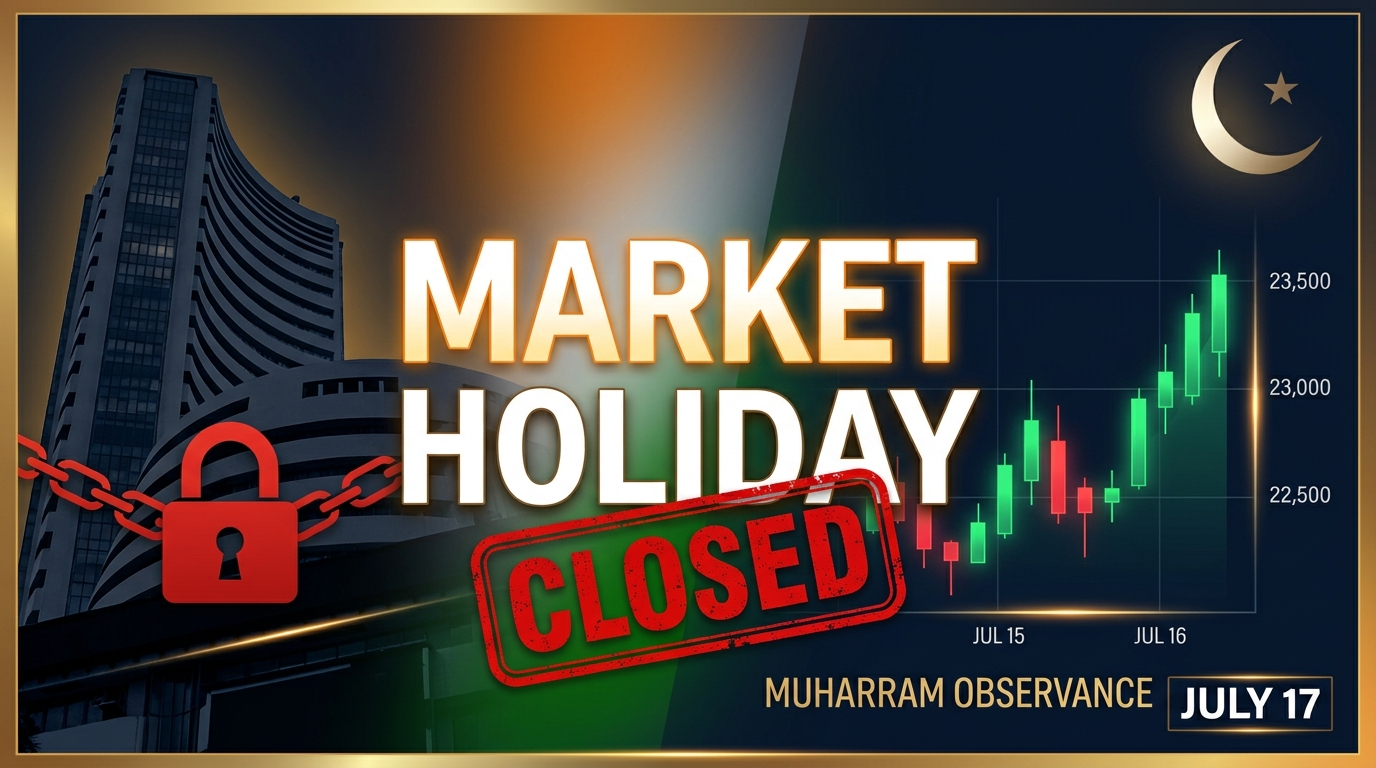
Meta Description: NSE & BSE are closed for Muharram on June 26, 2026. Here’s what it means for trading, settlements, and your portfolio before markets reopen Monday.
Quick Answer: Are Stock Markets Closed Today for Muharram?
Yes. The Indian stock market is closed on June 26, 2026, on account of Muharram, and no equity, derivative, or currency settlement obligations will be processed on either BSE or NSE that day. Trading across equity, equity derivatives, currency derivatives, NDS-RST, and Tri-Party Repo segments is suspended for the day. Regular trading resumes on Dalal Street on Monday, June 29.
If you’ve landed here trying to figure out whether you can place an order today, the short version is: you can’t on NSE/BSE, but there’s a partial workaround on commodities (more on that below).
I’ve tracked Indian market holiday calendars for years while advising retail investors on trade timing, and I can tell you this particular holiday trips people up more than most — not because it’s complicated, but because it lands awkwardly mid-week and people forget to plan their settlements around it. Let’s fix that.
H2: Why Are NSE and BSE Closed for Muharram?
Muharram marks the first month of the Islamic calendar and includes the Day of Ashura, a solemn day of mourning observed by Muslims worldwide. Indian stock exchanges follow a published holiday calendar each year that includes major religious observances across faiths — Muharram, Diwali, Eid, Christmas, Good Friday, and others — alongside national holidays like Independence Day and Republic Day.
This isn’t a discretionary closure. It’s pre-scheduled, published months in advance by NSE and BSE, and applies uniformly across the country regardless of region.
What Exactly Shuts Down
| Segment | Status on Muharram |
|---|---|
| Equity (cash) market | Closed |
| Equity derivatives (F&O) | Closed |
| Currency derivatives | Closed |
| Debt market | Closed |
| NDS-RST / Tri-Party Repo | Closed |
| MCX (Commodity) | Closed for morning session (9 AM–5 PM); evening session 5 PM–11:30/11:55 PM operates normally |
| NCDEX (Agri-commodities) | Closed for the entire day |
That commodity market detail trips up a lot of traders. If you’re active in MCX gold, silver, or crude contracts, you’re not entirely locked out today — you just lose the morning session.
H2: When Does Trading Resume?
Trading activity on Dalal Street resumes on Monday, June 29. That’s the key date to circle if you’re holding positions or planning entries.
Looking Further Ahead
After this Muharram holiday, the next scheduled market closure falls on Monday, September 14, 2026, for Ganesh Chaturthi. August 15 (Independence Day) falls on a Saturday this year, so it won’t add an extra trading holiday.
Across the full 2026 calendar year, exchanges have notified a total of 16 scheduled stock market holidays, though some of those fall on weekends and don’t actually result in additional closures beyond the regular weekend.
Practical tip from experience: I always tell clients to bookmark the exchange holiday calendar at the start of the year and cross-reference it against their SIP dates, F&O expiry dates, and any planned large transactions. A single missed holiday can throw off a margin call timeline or delay a settlement by a full extra business day — which matters more than people expect when interest is accruing on borrowed positions.
H2: How Does a Mid-Week Holiday Impact Settlements and Expiry?
This is where Muharram closures get genuinely consequential, not just a “markets are shut, go enjoy your day off” situation.
1. Settlement Cycle Adjustments
India runs on a T+1 settlement cycle. When a trading holiday lands mid-week, the settlement of trades executed on the preceding day gets pushed forward by one business day. On Muharram, no equity, derivative, or currency settlement obligations are processed at all — so any trade settling today simply rolls to the next working day.
If you sold shares on Thursday expecting funds Friday, expect them Monday instead. If you bought shares expecting delivery Friday, same story.
2. Weekly Expiry Shifts
NSE has moved weekly index derivatives expiry days around in recent years (Bank Nifty, Nifty, and other weekly contracts), and whenever an expiry day coincides with — or falls right before/after — a trading holiday, the exchange typically shifts the expiry to the preceding trading session. Traders running weekly options strategies need to check the exchange circular for the specific week, because getting this wrong can mean your position expires a day earlier than you assumed, with very different P&L implications.
From working with options traders: This is the single most common error I see around holiday weeks — someone holds a short straddle into what they think is Friday expiry, only to discover the actual expiry was Thursday because of the holiday shift. Always check the exchange’s official circular for that specific week rather than assuming the “usual” expiry day applies.
3. The Extended Weekend Effect
Because June 26, 2026 falls on a Friday, this creates a three-day break — Friday, Saturday, Sunday — before markets reopen Monday. Extended breaks tend to have a measurable, if modest, effect on positioning:
- Traders often reduce overnight risk before a long weekend
- Open interest in F&O typically dips slightly into the holiday
- Volatility can tick up in the first session after reopening as pent-up news and global cues get priced in
H2: Market Sentiment Going Into the Holiday
In the session before the holiday, Sensex rose 375 points to 77,366 and Nifty rallied 116 points to 24,136 in early deals, with Brent crude trading below $75 a barrel contributing to positive sentiment in Indian equities.
That crude oil angle matters more than casual readers might assume — India imports the vast majority of its crude, so cheaper oil typically eases inflation worries and currency pressure simultaneously.
Currency and Expert Commentary
The Indian rupee appreciated by 25 paise to close at 94.40/USD against the previous close of 94.65. According to Vinod Nair, Head of Research at Geojit Investments, a sharp decline in crude oil prices supported the rupee and provided some cushion. He added that while overall sentiment remains constructive, continued FII outflows can limit the upside, and near-term sentiment may be influenced by a muted Q1 earnings outlook and an uneven monsoon.
On the sectoral front, auto stocks outperformed heading into the holiday, driven by softer metal prices, easing supply chain constraints, and improving retail demand.
Before vs. After: What to Watch on Reopening
| Factor | Pre-Holiday Read | What to Watch Monday |
|---|---|---|
| Crude oil | Below $75/barrel, supportive | Any OPEC+ headline over the weekend |
| Rupee | Strengthened to 94.40/USD | Follow-through or reversal |
| FII flows | Net outflows pressuring upside | Whether outflows persist |
| Auto sector | Outperforming | Continuation of the rally |
| Global cues | Mixed | US Fed commentary, Asian market open |
H2: What Should Investors Actually Do During the Holiday?
You don’t need to do anything dramatic — but a few habits separate prepared investors from reactive ones.
- Don’t panic-react to “no trading.” A closed market isn’t a risk event by itself. It’s a pause.
- Use the downtime to review, not trade. This is a good window to revisit your watchlist, re-check stop-losses you’ll set Monday, and read up on global cues that built up over the break.
- Check your specific contract’s expiry date if you hold weekly F&O positions — don’t assume.
- Watch international markets over the weekend. Crude oil, US equity futures, and Asian market opens on Monday morning often set the tone for India’s reopening gap.
- Don’t confuse MCX’s partial operation with NSE/BSE being open. Plenty of traders have placed equity orders assuming markets are live because commodity trading was technically running in the evening.
H2: A Quick Word on Why This Matters Beyond Just “Markets Are Closed”
I’ve noticed something over the years advising both new and seasoned investors: holiday closures get treated as trivia (“oh, markets are shut today”) when they should be treated as logistics checkpoints. The real risk isn’t the holiday itself — it’s the settlement mismatch, the expiry miscalculation, or the margin call that lands a day later than expected because nobody adjusted for the closed session.
Read More
NSE Joins Hands with Bharat Metal: Strategic Partnership to Boost India’s Metals & Capital Markets
. It’s entirely avoidable with a five-minute calendar check. That’s the unglamorous, genuinely useful takeaway here.
FAQ: Stock Market Holiday for Muharram 2026
Q1. Is the stock market closed today for Muharram? Yes, Indian stock markets remained closed on Friday, June 26, 2026, in observance of Muharram.
Q2. When will NSE and BSE reopen after Muharram? Trading resumes on Monday, June 29.
Q3. Is MCX also closed today? MCX is closed for its morning session (9 AM–5 PM) but resumes for the evening session from 5 PM to 11:30/11:55 PM. NCDEX remains closed for the entire day.
Q4. Will my pending trade settlements be delayed because of this holiday? Yes — no equity, derivative, or currency settlement obligations are processed on the holiday, so any settlement due that day moves to the next working session.
Q5. What’s the next stock market holiday after Muharram in 2026? The next scheduled closure is Monday, September 14, 2026, for Ganesh Chaturthi.
Q6. Does Independence Day (August 15) count as an extra holiday this year? No — August 15, 2026 falls on a Saturday, so it doesn’t add a separate trading closure.
Q7. How many total stock market holidays are there in 2026? Exchanges have notified 16 scheduled stock market holidays for 2026, though some fall on weekends and don’t create additional closures.
Q8. Did the market rally or fall heading into the Muharram holiday? In the session before the holiday, Sensex rose 375 points to 77,366 and Nifty gained 116 points to 24,136 in early trade, supported by softer crude oil prices.
Conclusion: The Holiday Pause Is Routine — Your Prep Shouldn’t Be
Muharram closures are a fixed, predictable part of the Indian trading calendar, and there’s nothing alarming about a closed market in itself. What separates a calm investor from a scrambling one is whether they checked settlement timelines, expiry shifts, and global cues before the long weekend rather than after.
Use today to review your positions, not react to silence in the ticker. Markets reopen Monday, June 29 — and the global cues that build up over this extended weekend, especially around crude oil and FII flows, will likely set the tone for that first session back.
Stay ahead of the next market holiday and expiry shift — subscribe to our newsletter for weekly trading calendar alerts sent straight to your inbox, or drop a comment below if you’re holding positions into this weekend and want a second opinion on timing.

