

Meta Description: Tariff policy shifts are forcing U.S. retailers to completely rethink their supply chains. Here’s what’s changing, what it costs, and how smart retailers are adapting.
The Quick Answer
Since 2025, sweeping U.S. tariff policy changes — including IEEPA-based tariffs, the end of the de minimis exemption, and subsequent legal reversals — have fundamentally disrupted how American retailers source, import, and price merchandise. The result is a sector-wide scramble to diversify away from China, nearshore production, and build more resilient (if more expensive) supply chains. Retailers who adapt quickly are gaining a durable competitive edge. Those who don’t are watching their margins erode in real time.
Introduction: The Supply Chain Earthquake No One Fully Predicted
Ask any U.S. retail supply chain executive what the last two years have felt like, and you’ll likely hear some version of the same answer: “We were rebuilding the plane while flying it.”
From 2025 onward, the U.S. trade policy environment became one of the most volatile in modern retail history. Tariffs were imposed under the International Emergency Economic Powers Act (IEEPA), then challenged in court, then partially struck down by the U.S. Supreme Court in February 2026, then replaced with new duties under alternative legal frameworks. The de minimis exemption — a trade rule that allowed sub-$800 packages to enter the U.S. duty-free — was eliminated. Retaliatory tariffs from trading partners added another layer of complexity.
For retailers, this wasn’t abstract policy debate. It was a direct hit to the cost of nearly every product on their shelves.
Understanding what’s actually changed, what it means for your favorite brands and retailers, and what the smartest players in the industry are doing about it — that’s exactly what this post covers. Whether you’re an investor, a retail professional, or a consumer wondering why prices keep creeping up, you’ll find real answers here.
Internal linking opportunity: See also: “Kohl’s Earnings Report 2026: The $150 Million Tariff Refund That Tells Only Half the Story” and “Department Store Industry Outlook: 2025–2027.”
Part 1: What Actually Happened — The Tariff Timeline Explained
The IEEPA Tariff Era (2025)
In 2025, the U.S. government imposed significant new tariffs on goods imported from a wide range of countries, using the authority of the International Emergency Economic Powers Act (IEEPA). These tariffs — layered on top of existing Section 301 duties targeting China — hit retailers hard and fast.
The impact was immediate and broad:
- Apparel and footwear saw some of the steepest effective duty rates, given heavy import dependency on Asian manufacturing
- Home goods retailers faced sharply higher landed costs on furniture, décor, and seasonal items
- Consumer electronics accessories and small appliances sourced from China became significantly more expensive to import
Companies scrambled to absorb costs, negotiate vendor concessions, adjust pricing, and accelerate sourcing shifts that had been on their strategic roadmaps for years.
The Supreme Court Ruling (February 2026)
In February 2026, the U.S. Supreme Court ruled that the IEEPA-based tariffs exceeded the statutory authority granted under that law — in essence, that the President could not impose broad-based country tariffs under IEEPA’s framework.
This triggered a significant — and logistically complex — refund process. The U.S. Court of International Trade ordered Customs and Border Protection (CBP) to begin refunding IEEPA tariffs paid by importers. CBP launched its formal refund claims process in April 2026.
The refunds that flowed through in Q2 2026 created the headline-grabbing earnings beats you’ve probably read about:
- Target recognized $994 million in tariff refund benefits
- Kohl’s received approximately $150 million
- Williams Sonoma recorded approximately $167.8 million in cost-of-goods reductions
These were one-time windfalls — important to understand when evaluating retailer Q2 2026 earnings results.
What Replaced the IEEPA Tariffs
Critically, the Supreme Court’s invalidation of IEEPA tariffs did not create a tariff-free environment. Following the ruling, the administration announced a replacement 10% global ad valorem tariff effective February 24, 2026 (which expired July 24, 2026), after which new Section 301 duties of 10–12.5% on products from 80 countries were imposed.
The trade environment, in short, remains uncertain, costly, and subject to rapid change.
The De Minimis Elimination: A Seismic Shift for E-Commerce
Separate from the IEEPA saga, perhaps the most far-reaching supply chain disruption for retail has been the elimination of the de minimis exemption — a trade rule that previously allowed packages valued under $800 to enter the U.S. duty-free with minimal customs paperwork.
The de minimis rule was eliminated for China and Hong Kong imports in May 2025, then fully eliminated for all countries by August 29, 2025. The practical effects have been enormous:
- Shein and Temu — which built their entire business models around duty-free direct-to-consumer shipping from China — saw their cost structures upended almost overnight. Both raised prices in April 2025, citing “recent changes in global trade rules and tariffs.”
- Amazon had also used de minimis to keep prices low on its Amazon Haul marketplace. The exemption’s end put pressure on its ultra-low-cost competitive positioning.
- Lululemon estimated a $240 million hit to 2025 gross profit from higher duties and the de minimis removal — representing approximately 170 basis points of tariff-related gross margin decline.
For traditional U.S. brick-and-mortar and omnichannel retailers, the de minimis elimination was actually a partial leveling of the playing field. For years, Chinese e-commerce platforms had operated with a structural cost advantage that domestic retailers couldn’t replicate. That advantage has now been substantially reduced.
Image Alt Text Idea #1: “Cargo containers stacked at a U.S. port, representing retail import supply chains”
Part 2: How Retailers Are Restructuring Their Supply Chains
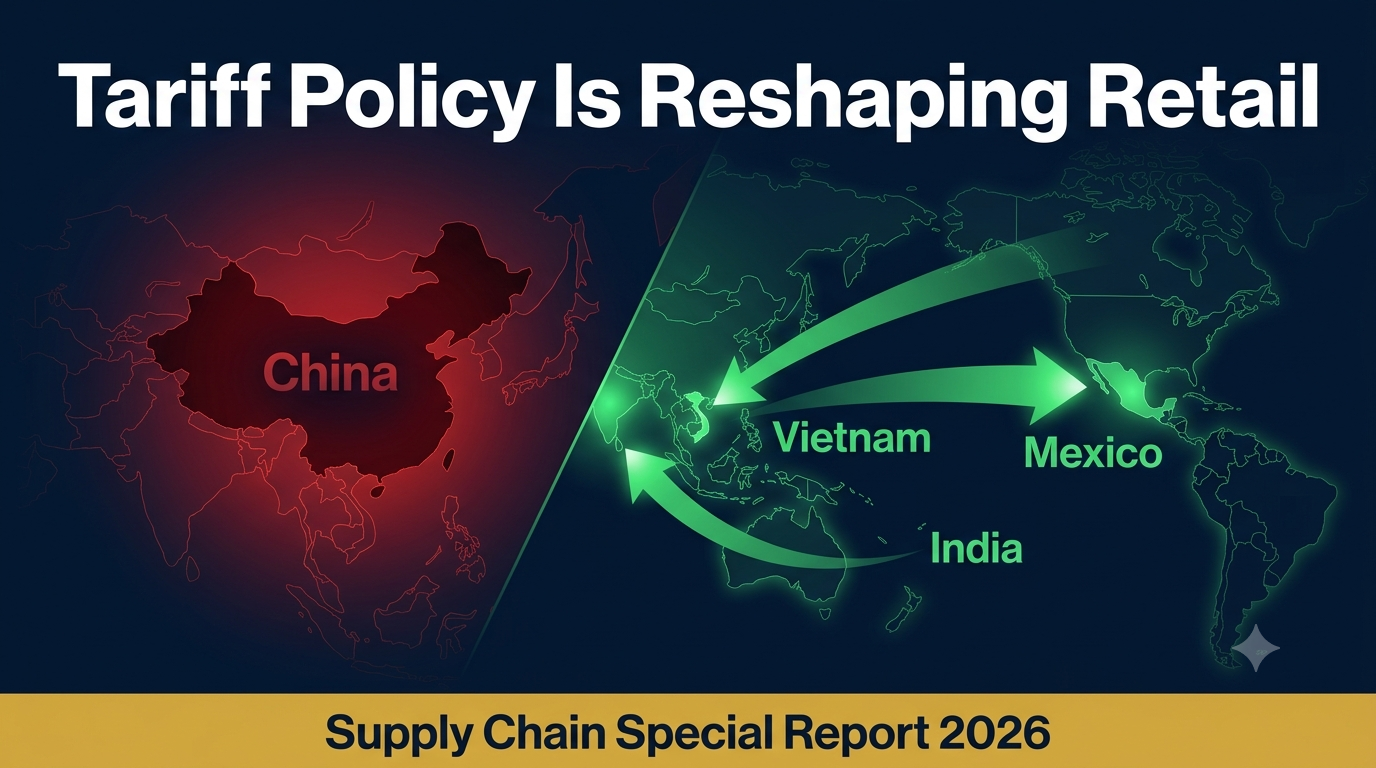
The China Decoupling — And Where It’s Actually Going
One of the most-discussed responses to tariff pressure is reducing dependence on Chinese manufacturing. But the reality is more nuanced than the headlines suggest.
China’s share of U.S. imports has already been declining for years. According to IMF research data, China’s share of U.S. imports dropped from roughly 21% in 2017 to approximately 13% by 2024 — a substantial shift driven by the first-term Trump tariffs, COVID-era supply chain disruptions, and corporate risk diversification.
The question is: where is production actually going?
According to a Harvard Business School working paper, the main beneficiaries have been Vietnam, Mexico, and Taiwan. A McKinsey analysis of apparel specifically found that while U.S. apparel imports from China dropped from 30% to 21% of total imports between 2019 and 2023, the gains went primarily to other Asian countries — Bangladesh, India, Sri Lanka, Vietnam — not to nearshored North American production, which held flat at 17%.
This matters because many of those Asian alternative sourcing countries were themselves hit with significant tariff rates under 2025 trade actions. Vietnam, for example — a major winner of early China diversification efforts — faced a 46% tariff rate on goods shipped to the U.S. The “China Plus One” strategy suddenly became “China Plus One, But Also That Country Has High Tariffs Now.”
The Nearshoring Push: Real Progress, Slow Execution
Survey data paints a picture of strong intent but slow execution on nearshoring:
- 77% of retail supply chain leaders have already shifted some sourcing away from China toward tariff-neutral countries, according to a WSI/Kase survey of 250 retail supply chain leaders
- 87% are increasing buffer inventory to hedge against volatility
- 81% of companies plan to bring supply chains closer to home markets over the next three years, per a Bain survey — up sharply from 63% in 2022
- But only 2% of respondents to Bain’s survey have actually completed their nearshoring or onshoring plans — 36% are still in the planning stage
The gap between intent and completion is real and significant. Nearshoring is complex, capital-intensive, and slow. You can’t move a garment manufacturing operation from Vietnam to Mexico in six months. Factory relationships, worker training, logistics infrastructure, and quality systems all require years to develop.
What this means practically: most retailers are currently in a messy middle ground — paying higher tariffs on existing supply chains while simultaneously investing in new sourcing relationships that won’t deliver cost benefits for 18–36 months.
The Buffer Inventory Hedge
One near-term adaptation that is visible in earnings filings across the retail sector: building buffer inventory ahead of anticipated tariff increases or supply disruptions.
This is a significant reversal from the “just-in-time” inventory philosophy that dominated retail for decades. The logic of JIT — order only what you need, when you need it, minimizing working capital tied up in stock — breaks down when tariff policy can change within weeks.
Now, many retailers are deliberately carrying more inventory, accepting the working capital cost as insurance against supply chain disruption and tariff volatility. This has implications for cash flow, storage costs, and markdown risk — but it’s a rational response to an unpredictable policy environment.
Image Alt Text Idea #2: “Retail warehouse with shelved inventory rows, representing buffer stock strategy”
Part 3: The Real Cost to Retailers — Sector by Sector
Apparel and Fast Fashion
Apparel retailers have faced some of the most severe tariff impacts, given the sector’s deep dependence on Asian manufacturing. The de minimis elimination hit fast-fashion models particularly hard.
Lululemon’s situation is instructive: the company anticipated a $320 million net impact on its 2026 operating margin from higher tariffs and de minimis removal combined. The retailer is taking a multi-pronged response: negotiating lower vendor rates, selective price increases, and evaluating distribution center network restructuring.
The broader fast-fashion sector — particularly Chinese platforms Shein and Temu — faces an existential challenge to their low-cost business model. Both had relied on de minimis to ship individual parcels from Chinese factories directly to U.S. consumers duty-free. Now, experts suggest they’ll need to shift to bulk import models and U.S.-based fulfillment centers — a fundamentally different, more expensive operating structure.
Department Stores and Mid-Tier Retail
For mid-tier department stores like Kohl’s, Macy’s, and JCPenney, tariff costs flow through in two ways: directly through higher import costs on private-label merchandise, and indirectly through vendor pricing pressure as national brands pass through their own tariff costs.
Kohl’s response has focused on:
- Receiving and deploying tariff refunds (the $150M IEEPA refund in Q2 2026)
- Sharing refunds with vendor partners to maintain relationships
- Investing a portion in customer value through promotional pricing
The challenge for department stores is that their private-label and exclusive merchandise programs — typically higher-margin than national brands — tend to be heavily manufactured in Asia, making them particularly exposed to tariff volatility.
Home Goods and Furniture
Home goods retailers — Floor & Decor, Williams Sonoma, Wayfair — face a distinctive challenge: furniture and large home goods are harder to nearshore than apparel because manufacturing expertise, tooling, and material supply chains are deeply concentrated in China and Southeast Asia.
Floor & Decor’s experience is telling: the company received approximately $7 million in IEEPA refunds by June 2026 from its refund claim — a fraction of what larger retailers received, reflecting both its scale and its sourcing mix.
Consumer Electronics and Tech Accessories
This sector faces a particularly complex calculus. Electronics supply chains are global, highly specialized, and deeply intertwined. Key components (semiconductors, displays, batteries) flow through multiple countries before reaching final assembly.
The additional challenge for electronics: surging demand from AI data center construction has already created scarcity and price pressure in components. Tariff volatility on top of capacity constraints makes this the most complex sourcing environment in the sector.
Image Alt Text Idea #3: “Retail store interior showing home goods and apparel sections, illustrating broad merchandise exposure”
Part 4: Strategic Playbooks — What the Best Retailers Are Doing
Playbook #1: Accelerated Supplier Diversification
The most proactive retailers began diversifying their supplier base years before 2025 tariff actions. Steve Madden, Yeti, and Traeger are among companies that had been moving manufacturing from China to Cambodia, Vietnam, and Mexico. The challenge: those countries also face tariff exposure.
The next evolution is true multi-country diversification: no single country or region represents more than 30–35% of sourcing, reducing exposure to any single policy action.
Playbook #2: Investing in U.S. Distribution Infrastructure
Several retailers and e-commerce players are investing in U.S.-based warehousing and fulfillment networks — both to serve customers faster and to reduce per-unit tariff exposure through bulk import models.
For Chinese e-commerce platforms, this is a forced pivot: without de minimis, direct parcel shipping from China becomes uneconomical. Building U.S. inventory positions requires significant capital and represents a very different business model.
Playbook #3: Strategic Price Increases — Selective, Not Broad
Smart retailers are being surgical about price increases. Broad, across-the-board price hikes risk accelerating the value migration that’s already hurting mid-tier retailers. Instead, leaders are raising prices selectively on:
- Categories where consumers have low price elasticity (premium beauty, branded footwear)
- Items with limited competitive alternatives
- Categories where they have strong private-label positions
The goal is protecting margin dollars without triggering a volume loss that more than offsets the price gain.
Playbook #4: Vendor Partnership Models
Rather than simply passing tariff costs to consumers, some retailers are working collaboratively with vendor partners to share the burden. This includes:
- Joint factory audits to identify production efficiencies
- Longer-term purchase commitments in exchange for price concessions
- Co-investment in new sourcing country development
- Transparent cost-sharing models for tariff fluctuations
Kohl’s explicitly mentioned sharing its tariff refund with vendor partners — a relationship-building move that can pay dividends in supply chain priority and pricing flexibility over the long term.
Playbook #5: Technology-Driven Supply Chain Visibility
Perhaps the most durable adaptation isn’t geographic — it’s technological. Retailers investing in supply chain visibility tools, demand forecasting AI, and real-time tariff classification systems gain an agility advantage that geographic diversification alone can’t provide.
According to the WSI/Kase survey, technology misalignment — not just geography or costs — is one of the biggest internal barriers to supply chain adaptation. Retailers that close that technology gap will be better positioned to respond to the next policy shift, whatever form it takes.
Image Alt Text Idea #4: “Supply chain management dashboard on computer screen, showing global logistics network”
The De Minimis Leveling Effect: An Underappreciated Opportunity for Domestic Retailers
Here’s a contrarian insight worth considering: the de minimis elimination, while painful for many retailers, has created a genuine competitive opportunity for U.S. domestic retailers.
For years, platforms like Shein and Temu operated with a structural tariff advantage — shipping individual packages from Chinese factories duty-free while American retailers paid tariffs on bulk imports. A consumer buying a $15 dress from Shein was paying a lower effective cost basis than a retailer buying the same dress wholesale.
With de minimis gone, that asymmetry has been dramatically reduced. Traditional retailers who source responsibly, build vendor relationships, and invest in the domestic consumer experience now compete on a more level fiscal footing.
The opportunity: retailers who can combine domestic fulfillment speed, physical store experience, and competitive pricing — now that Chinese platforms face similar tariff burdens — are well positioned to recapture customers who had drifted to ultra-low-cost online alternatives.
Before vs. After: U.S. Retail Supply Chain Reality Check
| Dimension | Before 2025 | After 2025–2026 |
|---|---|---|
| China sourcing share | ~30%+ for many retailers | Declining; 77% actively shifting |
| De minimis | $800 threshold, duty-free | Eliminated (May–Aug 2025) |
| IEEPA tariffs | Not in effect | Imposed, then struck down, refunds paid |
| Inventory strategy | Just-in-time, lean | Buffer inventory, 87% increasing stock |
| Sourcing diversification | China + limited Vietnam/Mexico | Active diversification; Vietnam, India, Mexico, USMCA focus |
| Landed cost certainty | High (predictable tariff schedules) | Low (volatile, policy-dependent) |
| E-commerce competitive dynamics | Chinese platforms had structural tariff advantage | Partially leveled; de minimis gone |
| Vendor relationships | Primarily transactional | Increasingly collaborative, cost-sharing |
What This Means for Consumers: Expect These Changes
If you’re a regular shopper — not an investor or supply chain professional — here’s what the tariff restructuring actually means for your wallet and shopping experience:
- Prices on Chinese-origin goods will rise — and already have. Shein and Temu both raised prices in 2025. Expect this to continue as the full de minimis impact works through supply chains.
- Domestic and nearshored products will become more price-competitive relative to imports, narrowing the gap between “cheap Chinese goods” and American-made alternatives.
- Availability may be patchy in some categories as supply chains transition. Retailers managing through sourcing shifts may carry reduced SKU counts or face occasional stockouts.
- Promotional intensity from traditional retailers may increase as they try to retain customers feeling the pinch. This is already visible in Kohl’s, Macy’s, and Target promotional calendars.
- Tariff uncertainty won’t resolve overnight. The current trade environment is likely to remain volatile through at least 2027 as legal challenges, policy adjustments, and retaliatory actions continue.
FAQ: What People Are Asking About Tariffs and U.S. Retail Supply Chains
Q1: What is the IEEPA tariff and why does it matter for retailers?
IEEPA stands for the International Emergency Economic Powers Act. The Trump administration used IEEPA to impose significant tariffs on imports from dozens of countries starting in 2025. These tariffs directly raised the cost of imported merchandise for retailers. In February 2026, the U.S. Supreme Court ruled that IEEPA didn’t authorize the President to impose tariffs this way, triggering a refund process for retailers who had paid these duties.
Q2: What was the de minimis exemption and why did its removal matter?
The de minimis exemption allowed packages valued under $800 to enter the U.S. duty-free with minimal paperwork. It was a major competitive tool for Chinese e-commerce platforms like Shein and Temu, which shipped directly from Chinese factories to U.S. consumers without paying import duties. Its elimination — for China/Hong Kong in May 2025, and for all countries by August 2025 — significantly raised costs for those platforms and partially leveled the playing field for domestic retailers.
Q3: Are U.S. retailers actually moving manufacturing out of China?
Yes, but slowly and incompletely. Data shows China’s share of U.S. imports has fallen from about 21% in 2017 to around 13% in 2024. The main beneficiaries have been Vietnam, Mexico, India, and Bangladesh. However, many of those countries also face U.S. tariffs, and only 2% of companies surveyed by Bain have actually completed nearshoring plans — most are still in planning or evaluation stages.
Q4: How are retailers protecting their profit margins amid tariff volatility?
Retailers are using a combination of strategies: negotiating vendor rate concessions, selective price increases on lower-elasticity categories, building buffer inventory ahead of policy changes, diversifying sourcing geographically, and investing in supply chain visibility technology. The most effective retailers are using all of these levers simultaneously rather than relying on any single approach.
Q5: Did all retailers benefit equally from the IEEPA tariff refunds?
No. The size of refunds varied significantly based on each retailer’s import volume, sourcing mix, and tariff exposure. Target received $994 million, Williams Sonoma ~$167.8 million, and Kohl’s ~$150 million. Retailers with higher import volumes from IEEPA-tariffed countries received larger refunds. Crucially, these are one-time payments — they won’t recur in future quarters.
Q6: What happens next — will tariffs go up or down from here?
The honest answer is: nobody knows for certain. The trade environment remains highly uncertain. IEEPA tariffs were struck down, replaced by 10% global tariffs (which have since expired), followed by new Section 301 duties. Ongoing litigation and policy negotiations mean the tariff landscape could shift again. Most supply chain professionals are planning for continued volatility rather than a clear resolution.
Q7: Is the “China Plus One” strategy working for retailers?
Partially. China Plus One — sourcing from one additional country to reduce China dependency — has helped some retailers reduce IEEPA exposure. But many of those “plus one” countries (Vietnam, India) also faced significant tariff rates under 2025 trade actions. The more resilient version is “China Plus Many” — true multi-country diversification where no single country represents too large a share of sourcing.
Q8: What’s the long-term outlook for U.S. retail supply chains?
The structural direction is toward more resilient, diversified, technology-enabled supply chains — even if that means higher costs than the ultra-lean, China-concentrated model of the pre-tariff era. Retailers who invest now in supplier relationships, nearshored capacity, and supply chain technology will be more agile and competitive in the long run. Those that delay adaptation risk being structurally disadvantaged when the next policy shift arrives.
Conclusion: Resilience Is the New Efficiency
For a generation, the organizing principle of retail supply chains was efficiency — squeeze every dollar of cost out of the system, optimize for lowest landed cost, build just-in-time relationships with Asian manufacturers. It worked brilliantly in a stable, predictable trade environment.
That era is over.
The tariff upheaval of 2025–2026 has made one thing unmistakably clear: supply chain resilience is now as strategically important as supply chain efficiency. The retailers who built their sourcing models around a single country or a handful of suppliers are paying the price in cost volatility, margin compression, and operational disruption.
The good news? The disruption has forced an overdue reckoning. Retailers who use this moment to genuinely diversify their supply chains, invest in technology, and build collaborative vendor relationships are laying the foundation for a structural competitive advantage.
The tariff environment will keep evolving. Policy will shift again. What won’t change is the value of being able to adapt quickly — because in the new retail landscape, agility isn’t a nice-to-have. It’s a survival skill.
Found this analysis useful? Subscribe to our newsletter for weekly retail supply chain and earnings insights. Working through your own supply chain strategy? Drop a question in the comments — we cover real situations from real businesses. Share this post with a supply chain or retail professional who needs the full picture.
Suggested Author Bio
[Aditi Rao is a supply chain strategy consultant and retail industry analyst with over 10 years of experience advising mid-market and enterprise retailers on sourcing diversification, trade compliance, and operational resilience. She/He has advised companies navigating U.S.-China trade tensions, USMCA compliance, and nearshoring transitions. Her/His writing synthesizes SEC filings, academic research, and practitioner experience into practical guidance for retail leaders and investors.
Connect on LinkedIn | Follow on Twitter/X | Read more retail supply chain analysis →
Internal Linking Suggestions
- “Kohl’s Earnings Report 2026: The $150 Million Tariff Refund That Tells Only Half the Story“
- “Comparable-Store Sales Explained: The Metric Every Retail Investor Must Know”
- “Sephora at Kohl’s: A Partnership Case Study in Retail Reinvention”
- “Department Store Industry Outlook: 2025–2027”
Data sourced from: U.S. Supreme Court IEEPA Ruling, February 2026 | Harvard Business School — Global Supply Chains Working Paper | McKinsey — Apparel Nearshoring Analysis | WSI/Kase Retail Supply Chain Survey 2026 | Deloitte — Global Supply Chain Resilience | EMARKETER — De Minimis & E-Commerce Impact

