

Meta Description: Dolat Capital has issued a rare ‘Sell’ call on NSE’s upcoming ~$3B IPO with a ₹1,550 target. Here’s what every investor needs to know before the listing.
The Direct Answer First: Should You Buy NSE IPO Shares?
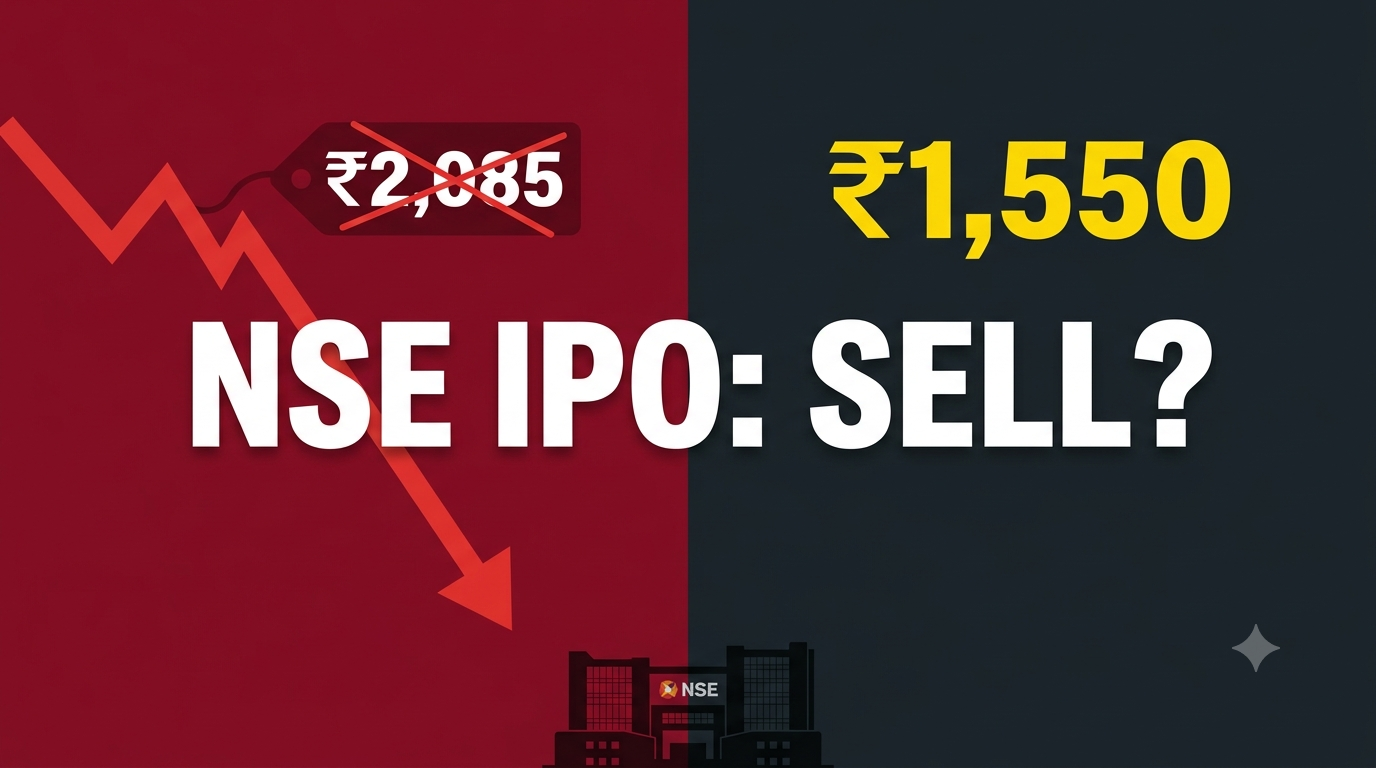
If you’re considering investing in NSE’s upcoming IPO — widely expected to be India’s biggest at nearly $3 billion — one rare but powerful signal is worth your full attention: Dolat Capital Market Pvt. Ltd. has issued a ‘Sell’ call on NSE’s unlisted shares, citing a target price of ₹1,550 against a current unlisted market trading price of ₹2,085. That’s a projected 26% downside from where shares are trading today in the grey market.
This doesn’t mean NSE is a bad company — far from it. What it means is that the price you might pay, either in the unlisted market now or at IPO, may already reflect more optimism than the underlying fundamentals and regulatory environment justify.
Let’s unpack exactly why, and what you should do with this information.
Introduction: When India’s Most Anticipated IPO Comes With a Warning Label
There’s a kind of investor excitement that’s hard to argue with. The National Stock Exchange of India — the institution that processes crores of trades every single day, the backbone of Indian financial markets — is preparing to go public. For years, market participants have waited for this moment. And now that it’s approaching, the buzz is almost deafening.
But here’s what the headlines aren’t saying loudly enough: a respected equity research firm has looked at NSE’s business, its regulatory environment, its financials, and its valuation — and told investors to sell.
That’s not a common thing. ‘Sell’ calls are rare in Indian equity research. They take professional courage. When one comes out on a marquee, headline-grabbing IPO, it deserves serious attention.
This post will walk you through:
- What Dolat Capital’s Sell call actually says and why
- The regulatory changes reshaping India’s derivatives market
- How NSE’s valuation compares to global peers
- What smart investors are actually doing with this information
- Your key questions, answered
Whether you’re a seasoned investor tracking unlisted shares or someone planning to subscribe to NSE’s IPO the day it opens, this analysis is for you.
What Is the NSE IPO, and Why Is Everyone Talking About It?
The National Stock Exchange of India (NSE) is not just any company. It is the world’s largest derivatives exchange by contract volume — a statistic that sounds almost unbelievable until you see the daily options trading numbers. Founded in 1992, NSE democratised stock trading in India and gave retail investors access to transparent, screen-based trading for the first time.
The exchange has been preparing for its own public listing for years, navigating regulatory scrutiny and ownership restructuring along the way. The target is now a September 2026 listing, subject to approval from the Securities and Exchange Board of India (SEBI), India’s capital markets regulator.
At current unlisted market valuations, NSE is priced at approximately ₹5.2 trillion (~$62 billion) — making it one of the most valuable companies in India, even before its IPO.
The IPO itself is expected to raise close to $3 billion, placing it among the largest public offerings in Indian history alongside the likes of LIC and Paytm.
So why is one prominent analyst saying: don’t buy?
The Dolat Capital Sell Call: Breaking It Down
In a note that made headlines across Indian financial media, Dolat Capital Market Pvt. Ltd., led by analyst Punit Bahlani, initiated coverage on NSE unlisted shares with a formal ‘Sell’ recommendation and a price target of ₹1,550.
Let’s put that in perspective:
| Metric | Value |
|---|---|
| Current Unlisted Market Price | ₹2,085 |
| Dolat Capital Target Price | ₹1,550 |
| Implied Downside | ~26% |
| NSE Unlisted Market Cap | ~₹5.2 trillion |
| IPO Expected Size | ~$3 billion (~₹25,000 crore) |
| Expected Listing | September 2026 (SEBI approval pending) |
This isn’t a casual dismissal. Dolat’s thesis rests on three core concerns: regulatory headwinds, valuation premium over peers, and deteriorating growth outlook in NSE’s most profitable business — derivatives trading.
The Regulatory Storm Reshaping NSE’s Core Business
Here’s the part of the story that most retail investors miss — and it’s the most important part.
What Changed in India’s Derivatives Market
Over the past two years, SEBI has systematically tightened rules around equity derivatives trading in India. The regulator was concerned about the explosive growth of retail participation in weekly options — a type of instrument that, while popular, carried significant financial risk for inexperienced traders.
The key changes SEBI implemented include:
- Increased contract sizes: Minimum lot sizes were raised, making it more expensive for small traders to participate
- Weekly options restricted to one benchmark index per exchange: Previously, multiple weekly expiries existed across many indices; SEBI has now mandated that each exchange can have weekly options on only a single benchmark index (Nifty 50 for NSE, Sensex for BSE)
- Higher margin requirements: Designed to reduce excessive leverage
The explicit goal, as SEBI has stated in its circulars, is to curb excessive speculation and protect retail investors from the high loss rates observed in the F&O (Futures & Options) segment.
Why This Directly Hurts NSE’s Revenue
NSE’s derivatives segment — particularly Nifty options — is its single biggest revenue driver. The exchange earns transaction fees on every contract traded. When SEBI restricts weekly options, raises lot sizes, and cools retail frenzy, fewer contracts trade, and NSE earns less.
Dolat Capital’s analysis projects that NSE’s options trading turnover will decline approximately 4% annually from FY2026 to FY2029 as a direct result of these changes. That is a sustained multi-year revenue headwind — not a one-quarter blip.
From conversations with market participants and traders, this impact is already visible. Many retail options traders who drove volumes in mid-cap index contracts have simply stepped back. The ecosystem that made NSE’s derivatives segment the world’s busiest is being deliberately, structurally cooled.
Valuation: Is NSE Priced for Perfection — or Beyond It?
The Numbers That Should Give You Pause
A company can be excellent and still be a poor investment — if you overpay for it. That’s the core of Dolat’s argument about NSE’s current valuation.
At ₹5.2 trillion, NSE trades at a significant premium to global exchange peers. Here’s how that looks when you stack it up:
| Exchange | P/E (Approx.) | Revenue Growth (3-yr CAGR) |
|---|---|---|
| NSE (Unlisted, current price) | ~45–50x | ~18% |
| CME Group (US) | ~25–28x | ~8–10% |
| London Stock Exchange Group | ~22–25x | ~9–12% |
| Hong Kong Exchanges (HKEX) | ~28–32x | ~6–8% |
| Deutsche Börse | ~20–24x | ~10–12% |
Note: NSE multiples are estimates based on unlisted market valuation and FY25 earnings.
The argument for NSE’s premium has always been India’s growth story — a young population, rising financial inclusion, and a derivatives market that seemed to grow without limits. That story hasn’t disappeared. But the regulatory clampdown has materially altered the growth trajectory, and at 45–50x earnings, you need exceptional growth to justify the price. That growth is now in doubt.
As Dolat’s note emphasizes: current valuations don’t adequately reflect regulatory risks. The market is pricing in the old NSE — the one with an unrestricted, booming derivatives segment. The new NSE operates in a more constrained environment.
The Unlisted Market Has Already Noticed
Even before Dolat’s report, the market was sending signals. NSE’s unlisted shares have declined approximately 3% over the past 12 months in grey market trading. In a period when broader Indian markets have generally performed reasonably well, this relative underperformance is telling.
It’s Not Just NSE: A Broader Bearish Signal on Indian Exchanges
One of the most striking aspects of Dolat’s research is that it isn’t isolated to NSE. The firm simultaneously initiated ‘Sell’ ratings on BSE Ltd. and MCX (Multi Commodity Exchange) as well.
This is a sweeping bearish view on the Indian exchange ecosystem — and it stems from the same regulatory logic. All three exchanges face headwinds from SEBI’s derivatives reforms. BSE has particularly felt the pressure given its aggressive push into weekly Sensex options, which now faces the same structural restrictions.
Why this matters to you: When a single analyst team issues Sell calls across an entire sector simultaneously, it’s worth taking seriously. It signals a structural view, not just stock-specific concerns. The entire Indian exchange sector may be facing a period of multiple compression and earnings deceleration.
The Bull Case: Why Some Investors Still Believe in NSE
To be fair — and being fair is what good financial analysis requires — there are genuine reasons why many investors remain excited about NSE’s IPO.
Arguments in Favour of NSE
- Irreplaceable market position: NSE has a near-monopoly on equity F&O in India. Regulatory headwinds don’t eliminate this advantage; they just temporarily constrain it.
- India’s financialisation story: The long-term story of more Indians investing in capital markets remains intact. SIP inflows are at all-time highs. Demat account additions continue.
- Diversified revenue streams: Beyond derivatives, NSE earns from cash equity, clearing, data and indices, technology services, and listing fees. Not everything is impacted equally by SEBI’s F&O reforms.
- IPO price discovery: The actual IPO price band, when announced, may reflect a discount to current unlisted market levels — potentially making it a more attractive entry point than buying in the grey market today.
- Regulatory risk may be priced in: Some analysts argue that the market has already adjusted expectations sufficiently.
The Bottom Line on the Bull Case
These arguments have merit. But they don’t address the valuation concern at current unlisted market prices. The Sell call from Dolat isn’t saying NSE is a bad company forever — it’s saying you’re being asked to pay too much, right now, for what you’re getting.
Read More
Millworks Technologies SME IPO Allotment: Everything You Need to Know (July 2026)
What Should You Actually Do? A Practical Framework
If you’re an investor — whether you’re holding unlisted shares, considering buying in the grey market, or planning to apply for the IPO — here’s a practical decision framework:
Before You Invest, Ask Yourself:
1. Are you buying in the unlisted market now? At ₹2,085, Dolat’s analysis suggests a 26% downside risk. The risk-reward is asymmetric — and not in your favour. Unless you have a strong independent thesis that overrides this, caution is warranted.
2. Are you planning to apply at IPO? Wait for the price band announcement. If NSE IPO is priced at a meaningful discount to current unlisted prices (say, ₹1,500–₹1,700), the calculus changes significantly. An IPO at ₹1,600 with a listing bump potential is a very different proposition than buying unlisted shares at ₹2,085.
3. Are you a long-term investor (5–10 year horizon)? NSE’s fundamental franchise is not broken. If India’s capital markets grow as expected over the next decade, NSE will benefit. A 10-year investor might look through regulatory cycles. But even long-term investors benefit from entry price discipline.
4. Have you sized your position appropriately? Given the uncertainty, this should not be a concentrated bet for most retail investors. Position sizing matters enormously in situations with genuine regulatory risk.
Pros and Cons at a Glance
| Pros | Cons |
|---|---|
| Market leader, near-monopoly in F&O | Regulatory headwinds reducing derivatives volumes |
| India’s long-term financial growth story | Valuation premium over global peers unjustified by near-term growth |
| Diversified revenue beyond F&O | Unlisted shares already down 3% in 12 months |
| IPO could be priced at discount | Sell call from Dolat with 26% implied downside |
| Brand trust and infrastructure moat | Weekly options restriction structurally reduces a core revenue driver |
Frequently Asked Questions (FAQ)
1. What is the NSE IPO expected price band?
The price band has not yet been officially announced as of July 2026. The IPO is expected in September 2026, pending SEBI approval. Unlisted shares currently trade around ₹2,085 in the grey market, but the actual IPO price band could be different — potentially lower.
2. Why did Dolat Capital issue a Sell call on NSE?
Dolat Capital, led by analyst Punit Bahlani, issued the Sell call primarily due to: (a) NSE’s high valuation relative to global exchange peers, (b) regulatory headwinds from SEBI’s derivatives market reforms, and (c) a projected ~4% annual decline in options trading turnover from FY26–FY29. Their target price is ₹1,550 vs the current unlisted price of ₹2,085.
3. Is it safe to buy NSE shares in the unlisted/grey market now?
Buying in the grey market carries inherent risks even in normal circumstances — limited liquidity, no regulatory protection, and no public disclosures. Given the current Sell call and 26% implied downside, buying NSE shares at ₹2,085 in the unlisted market carries significant risk. Consult a SEBI-registered advisor before making any decision.
4. How will SEBI’s F&O reforms impact NSE’s revenue?
SEBI’s changes — including increased contract sizes, restriction of weekly options to a single benchmark index per exchange, and higher margins — are projected to reduce NSE’s options trading turnover by approximately 4% annually between FY26 and FY29. Since F&O transaction fees are a significant revenue driver, this has a direct earnings impact.
5. What is the NSE IPO size and when is the listing expected?
The NSE IPO is expected to raise approximately $3 billion (around ₹25,000 crore), targeting a listing in September 2026. This would make it one of India’s largest IPOs ever. The listing is subject to final SEBI approval.
6. Are BSE and MCX also facing similar concerns?
Yes. Dolat Capital simultaneously initiated ‘Sell’ ratings on BSE Ltd. and MCX, reflecting a sector-wide bearish view on Indian exchanges amid SEBI’s derivatives reforms. BSE in particular has been aggressively growing its weekly Sensex options business, which now faces the same structural restrictions.
7. What is NSE’s current valuation in the unlisted market?
At the current unlisted trading price of ₹2,085 per share, NSE’s total market capitalisation is approximately ₹5.2 trillion (~$62 billion). Analysts at Dolat Capital argue this valuation is higher than global exchange peers and doesn’t adequately reflect the regulatory risks facing the business.
8. Should I subscribe to the NSE IPO when it opens?
This depends entirely on the IPO price band (not yet announced), your risk tolerance, investment horizon, and portfolio allocation. If the IPO is priced significantly below current unlisted market levels, the math changes. Do not base your decision solely on grey market buzz or historical NSE brand loyalty. Consult a qualified financial advisor and wait for the Red Herring Prospectus (DRHP/RHP) to be filed.
Conclusion: The Price of Excitement
The NSE IPO is genuinely historic. India’s premier exchange going public is a moment the market has waited years for. The excitement is understandable, and the long-term story of Indian capital markets remains compelling.
But excitement and investment returns are different things.
At current unlisted market prices, you are paying a valuation that already embeds India’s entire growth story — without adequately discounting for SEBI’s structural reforms to the derivatives market that is NSE’s biggest profit engine. One of India’s more respected equity research firms has looked at all of this carefully and said: the price is too high.
That’s not a reason to panic. It’s a reason to pause, wait, and be disciplined.
The IPO price band, when announced, may itself offer a more reasonable entry point. The RHP (Red Herring Prospectus), once filed with SEBI, will give you audited financials and risk disclosures to read carefully. The best investors don’t chase the excitement — they wait for the right price.
Your action items:
- 🔔 Watch for NSE’s DRHP/RHP filing with SEBI for financial details
- 📊 Wait for the official IPO price band before forming a view
- 📚 Read Dolat Capital’s full research note if you can access it via your broker
- 💬 Share this analysis with a fellow investor who might be caught up in the IPO hype
- 📩 Subscribe to our newsletter for IPO analysis, regulatory updates, and equity research summaries delivered every week
Have a question about NSE’s IPO or the Dolat Capital Sell call? Drop it in the comments below — we read and respond to every one.
⚠️ Disclaimer: This article is for informational and educational purposes only. It does not constitute financial advice. Always consult a SEBI-registered investment advisor before making investment decisions.
Sources and Further Reading:
- SEBI Official Circulars on F&O Reforms
- NSE India — Official Website
- Investopedia: How Stock Exchanges Make Money
- Moneycontrol IPO Section
Last updated: July 2026 | Category: IPO Analysis, Market Regulation, Indian Equities

