

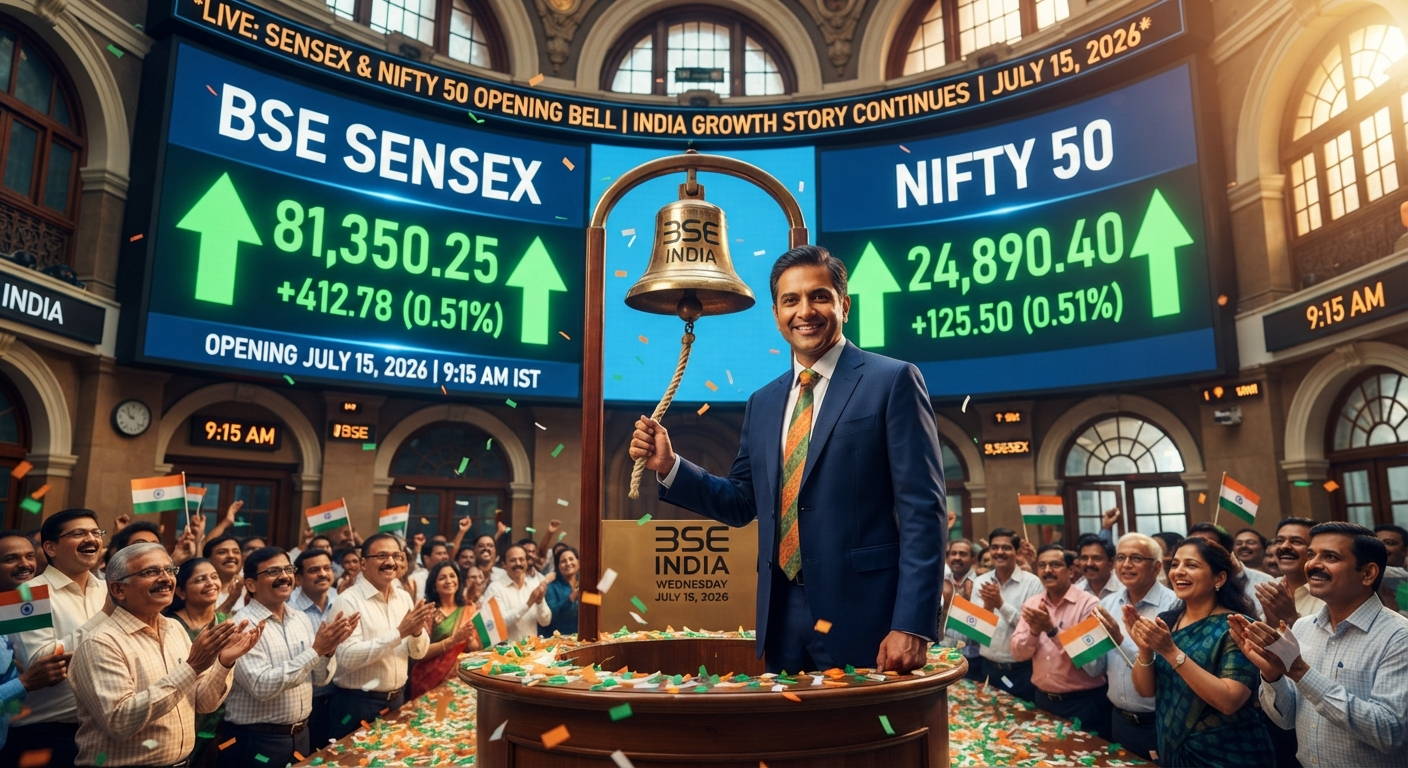
Meta Description: Sensex and Nifty opened higher on July 15, 2026. Discover the key drivers, sectoral winners, expert insights, and what this rally means for investors.
The Short Answer First
On Wednesday, July 15, 2026, Indian equity markets opened firmly in the green. The BSE Sensex opened at 77,192.76, gaining over 100 points, while the Nifty 50 kicked off at 24,085.85, up 33.80 points. By 10 AM, the rally deepened — the Sensex had climbed 443 points to 77,498 and the Nifty pushed close to 24,180, buoyed by easing geopolitical risks, positive global cues, and solid domestic institutional buying.
If you’re an investor trying to decode what this move means, this post breaks it all down — the what, the why, and most importantly, the so what for your portfolio.
Introduction: Reading the Market’s Morning Mood
Every morning, millions of Indian investors, traders, and curious observers check their phones before they even brush their teeth. “What’s Sensex doing?” has become a cultural reflex — like checking the weather before stepping out.
But here’s the thing: a market opening is not just a number. It’s a story. It reflects global events that unfolded while you slept, earnings calls that moved institutional desks in Mumbai and Singapore, geopolitical shifts that rippled from Tehran to Dalal Street.
Today — July 15, 2026 — that story is one of cautious but real optimism. And if you understand why the market opened higher, you’ll be far better positioned to make decisions than someone who just sees a green tick on Moneycontrol.
Let’s unpack it.
Why Did Markets Open Higher Today?
1. Positive Global Cues: Wall Street and Asia Set the Tone
Indian markets don’t open in isolation. Overnight action in the US and morning action in Asian markets function as a barometer — and on July 15, both were encouraging.
Wall Street logged gains overnight, and Asian markets followed suit. According to IANS, Indian equity benchmark indices opened higher amid positive global cues after gains across Wall Street and Asian markets. Whenever the Dow, S&P, and Asian indices like Nikkei and Hang Seng collectively move higher, foreign institutional investors (FIIs) tend to feel more confident deploying capital in emerging markets like India.
Think of it like this: if the global investment weather forecast is sunny, money flows more freely into growth markets. India — with its structural growth story intact — tends to be a beneficiary.
2. The US Dropped Its Strait of Hormuz Fee Proposal
This is the headline that truly moved the needle today, and it’s worth spending a moment on.
For weeks, geopolitical risk around the Middle East had been a dark cloud over Indian markets. The US had proposed a 20% transit fee on goods passing through the Strait of Hormuz, a narrow waterway through which a significant chunk of global oil flows — and through which India routes roughly 60–65% of its crude oil imports and nearly half its LNG needs.
When that proposal was dropped, markets exhaled. According to Business Standard’s live market updates, “the Nifty 50 and the Sensex were trading higher, tracking positive global cues as the US dropped [its] proposal of the 20 per cent fee for the Strait of Hormuz.” This single development reduced inflationary risk, eased pressure on oil marketing companies, and lifted investor sentiment in one move.
For context: earlier this year, when US-Iran tensions were at their peak and Brent crude crossed $100 per barrel, Indian markets had plunged sharply. The RBI was stretched, oil marketing companies were absorbing massive underrecoveries, and the rupee had weakened considerably. The normalization of this risk today is, therefore, genuinely significant.
3. Brent Crude: A Mixed Signal Worth Watching
Crude oil is India’s single biggest import vulnerability. Every dollar rise in Brent crude adds roughly ₹8,000–10,000 crore to India’s annual import bill. So oil prices are always on Dalal Street’s radar.
On July 15, Brent crude was trading above $85 per barrel — which, at face value, sounds concerning. But here’s the nuance: the geopolitical risk premium embedded in that price has eased significantly following the Strait of Hormuz news. Markets are also confident that Iranian crude supply resuming will put a ceiling on prices going forward.
Contrast this with earlier in the conflict when crude crossed $100 — a level that had triggered multi-billion-rupee losses for oil marketing companies, stoked inflation, and weakened the rupee to record lows. At $85, the situation is far more manageable.
Sector-by-Sector Breakdown: Where Is the Money Moving?
This is where today’s market gets particularly interesting — because the sectoral story is nuanced, not a uniform green sweep.
Banking and Financial Services: Today’s Clear Winners
Nifty Financial Services Ex-Bank rose around 1%, emerging as the day’s top-performing sector. Nifty Private Bank gained 0.58% and Nifty PSU Bank added 0.53%.
This is logical. When geopolitical fears ease and growth expectations improve, banking stocks — as proxies for economic activity — tend to rally. HDFC Bank and ICICI Bank, both heavyweights in these indices, were among the stocks contributing positively. Banking stocks are also sensitive to interest rate expectations, and easing crude-driven inflation reduces the pressure on the RBI to maintain a tight monetary stance.
Key insight: If you’re looking for defensive-yet-growth-oriented exposure in this environment, large-cap private banks remain a high-conviction sector for institutional investors.
Chemical Sector: A Quiet Outperformer
Nifty Chemicals advanced 0.71%, making it the second-best performing sector. Chemical stocks have been benefiting from China+1 supply chain diversification trends, with global companies increasingly sourcing specialty chemicals from Indian manufacturers.
The broader narrative here is structural, not just cyclical — which makes today’s gains meaningful beyond just a one-day bounce.
IT Sector: The Notable Laggard
Here’s the honest truth: not everything rallied today. The Nifty IT index declined 1.38% — the worst-performing sector of the day. TCS, Infosys, Tech Mahindra, Wipro, and HCL Technologies were all in the red.
This needs context. IT stocks are sensitive to:
- Global demand signals from the US and Europe (their largest markets)
- Currency dynamics — a stronger rupee hurts dollar revenue conversion
- Guidance caution — several IT majors have maintained conservative FY27 outlooks
HCL Tech had already dropped sharply on July 14 after maintaining its guidance despite strong quarterly results, signaling a cautious demand outlook. The broader IT sector is navigating a tricky period where AI investments are reshaping client spending but the revenue recognition from those shifts is still uneven.
What this means for you: If you hold IT stocks, don’t panic — but do expect range-bound performance until clearer revenue signals emerge from Q1 FY27 earnings season, which is now underway.
Broader Markets: Midcaps and Smallcaps Join the Rally
Today’s rally wasn’t just a large-cap affair. By 10 AM, Nifty MidCap was trading 0.6% higher and Nifty SmallCap was up 1.2% — a healthy sign of broad-based market participation.
When mid and smallcap indices rally alongside large caps, it typically signals that retail and domestic institutional investors are gaining confidence. This is a healthier market structure than one where only blue-chip stocks move.
The Bigger Picture: Goldman Sachs, FIIs, and India’s Long-Term Story
Let’s zoom out for a moment. Today’s rally is encouraging, but it sits within a larger context that’s worth understanding.
Earlier this year, FIIs made a record $30 billion in net outflows from Indian equities over just 3.5 months — one of the sharpest foreign selling episodes in recent memory. The combination of US-Iran tensions, elevated crude, a weakening rupee, and global risk-off sentiment pushed money out.
But something has shifted. Goldman Sachs, in its July India Strategy note, stated that “foreign selling in Indian equities is likely over” and that “sentiment should turn incrementally favorable toward Indian equities due to an improved domestic outlook and ultra-light foreign positioning.” Their analysts see the Nifty 50 potentially reaching 26,500 by June 2027 — implying approximately 10% upside from current levels.
In July alone, FIIs have already turned net buyers, with ₹15,157 crore of net inflows recorded — a meaningful reversal from the June outflow of ₹49,340 crore.
For long-term investors, this is the most important signal. The structural story — India’s GDP growth, demographics, consumption, infrastructure spending — remains intact. The near-term noise of geopolitics and crude has been the primary headwind, and that headwind appears to be easing.
What Should Investors Do Now?
Based on the current market environment, here’s a practical framework — not financial advice, but a way of thinking:
✅ If You’re a Long-Term SIP Investor
Keep investing consistently. Today’s green opening is not a reason to either celebrate wildly or pause your SIPs. Systematic investing works because it smooths out exactly these kinds of daily fluctuations. The structural story for India remains strong.
✅ If You’re a Short-to-Medium Term Trader
Watch the Nifty range carefully. Market experts expect Nifty to remain range-bound between 23,900 and 24,250 unless a fresh trigger emerges. A sustained close above 24,250 with strong volumes would be bullish. Below 23,900, be cautious.
✅ If You’re Evaluating Sector Rotation
- Overweight: Banking, Financial Services, Chemicals, Consumer Discretionary
- Neutral: Realty, Pharma, Infrastructure
- Underweight (for now): IT, Metals
✅ If You’re Worried About Volatility
The India VIX (Volatility Index) has been easing as geopolitical risks reduce — a positive sign. Lower VIX generally correlates with calmer, more directional market movements. That said, global events — particularly any new US-Iran developments — can reverse this quickly.
Key Data Snapshot: July 15, 2026 Opening
| Index / Sector | Level / Change | Signal |
|---|---|---|
| BSE Sensex | 77,192.76 (+0.18%) | Positive open |
| Nifty 50 | 24,085.85 (+0.14%) | Steady gains |
| Sensex at 10 AM | 77,498 (+443 pts, +0.58%) | Rally deepening |
| Nifty at 10 AM | 24,179.65 (+128 pts, +0.53%) | Strong momentum |
| Nifty Financial Services Ex-Bank | ~+1.00% | Top gainer |
| Nifty Chemicals | +0.71% | Strong |
| Nifty Private Bank | +0.58% | Positive |
| Nifty PSU Bank | +0.53% | Positive |
| Nifty IT | -1.38% | Underperformer |
| Nifty MidCap | +0.60% | Broad participation |
| Nifty SmallCap | +1.20% | Encouraging breadth |
| Brent Crude | ~$85/barrel | Elevated but stable |
Before vs. After: How the Market Context Has Shifted
| Factor | Peak Risk Period (Early July) | Today (July 15) |
|---|---|---|
| Geopolitical Risk | US-Iran tensions at peak | Easing; Hormuz fee dropped |
| Crude Oil | Crossed $100/barrel | ~$85 and stabilizing |
| FII Sentiment | Record net sellers | Turning net buyers |
| Rupee | At record lows (near 97/$) | Stabilizing |
| Market Mood | Fear-driven sell-off | Cautious optimism |
| VIX | Elevated | Declining |
Pros and Cons of the Current Market Environment
✅ Pros (Why Bulls Are Encouraged)
- Geopolitical risk premium is easing
- FIIs have turned net buyers in July
- Goldman Sachs forecasts Nifty at 26,500 by June 2027
- Banking sector fundamentals remain strong
- Broad market participation (midcaps, smallcaps gaining)
- India’s GDP growth story remains one of the strongest in the world
⚠️ Cons (Why Caution Is Still Warranted)
- IT sector facing demand headwinds
- India’s retail inflation at 4.38% in June — above RBI’s 4% target
- Brent at $85 is still elevated; any re-escalation could spike it
- FII flows, while improving, remain volatile
- Global uncertainty (Fed policy, US-China trade) lingers
FAQ: Real Questions, Honest Answers
Q1: Is today’s market rally sustainable?
It depends on two things: whether geopolitical calm holds and whether Q1 FY27 earnings season delivers positive surprises. The structural foundation for Indian markets is sound, but near-term sustainability hinges on macro variables staying cooperative. Don’t read too much into a single day’s move.
Q2: Why is the IT sector falling even when the overall market is up?
IT stocks are driven by global demand from the US and Europe, not just domestic sentiment. TCS, Infosys, and HCL Tech have all maintained cautious guidance for FY27 despite some strong quarterly metrics. Until client discretionary spending in the West picks up meaningfully, IT stocks may underperform the broader market.
Q3: Should I buy midcap stocks right now?
Midcap stocks have outperformed large caps over long periods in India, but they’re also more volatile. The current rally in midcaps is encouraging, but if you’re entering now, ensure you’re doing so with a 3–5 year horizon and through diversified funds rather than concentrated individual bets.
Q4: What is the Strait of Hormuz, and why does it matter for Indian markets?
The Strait of Hormuz is a narrow shipping lane between Iran and Oman through which roughly 20% of the world’s oil supply passes. India imports about 85–88% of its crude oil, and a significant portion transits through this strait. Any disruption or cost addition (like a transit fee) directly inflates India’s oil import bill, weakens the rupee, stokes inflation, and pressures corporate margins — all negative for markets.
Q5: What does Goldman Sachs’ bullish view on India mean for retail investors?
Goldman Sachs forecasting Nifty at 26,500 by June 2027 is a positive institutional signal. It suggests sophisticated global capital may increasingly flow into Indian equities over the next 12 months. However, institutional targets aren’t investment advice — they’re probabilistic forecasts. Use them as one data point, not a guarantee.
Q6: How do FII flows affect the Sensex and Nifty?
FIIs (Foreign Institutional Investors) manage billions of dollars of capital. When they buy Indian equities, demand rises and indices go up. When they sell — as they did to the tune of $30 billion earlier this year — markets feel the pressure. In July, FIIs have turned net buyers (₹15,157 crore), which is a constructive sign.
Q7: What’s the significance of the India VIX declining?
India VIX (Volatility Index) measures market participants’ expectation of near-term volatility. A declining VIX signals that traders are less fearful, premiums on options are falling, and the market expects calmer movement. It’s a positive backdrop for equity investing — though VIX can spike quickly on unexpected news.
Q8: Which sectors should long-term investors focus on right now?
Based on current trends, Banking & Financial Services, Chemicals, and Consumer Discretionary look well-positioned. For a 5–10 year horizon, sectors tied to India’s infrastructure buildout, domestic consumption, and energy transition (solar, green hydrogen) remain compelling. Always consult a SEBI-registered investment advisor before making sector bets.
A Note on What We Know — and What We Don’t
Transparency matters. Here’s what today’s data clearly shows: global cues are favorable, geopolitical risks are easing, and domestic institutional buying is providing a floor. What we don’t know is whether crude oil will spike again on fresh Middle East news, how Q1 FY27 earnings will surprise (or disappoint) across sectors, and how the US Federal Reserve’s next policy signal will affect global capital flows.
Good investing is about making informed bets under uncertainty — not waiting for certainty that never arrives. Today’s market opening is a data point in that ongoing journey.
Read More
How IT Stocks Rescued the Indian Market Today — And What It Means for Your Portfolio
Conclusion: Green Arrows Are a Beginning, Not an Answer
Today’s higher open in Sensex and Nifty is genuinely good news. It reflects a market that’s navigating through a complex global environment with resilience — aided by easing geopolitical pressures, strong domestic institutional flows, and an underlying economic story that remains one of the most compelling in the emerging market universe.
But here’s what the most successful investors know: a single day’s rally doesn’t define a portfolio. A consistent strategy, well-suited to your risk tolerance and time horizon, does.
If today’s market move has you curious — whether you’re tracking your equity mutual funds, thinking about direct stock exposure, or simply trying to make sense of the financial news — the right next step isn’t to act impulsively. It’s to learn, ask questions, and invest with intention.
The markets opened higher today. How you respond to that is entirely up to you.
📌 Internal Linking Opportunities: Link this post to your articles on “How to Read Market Indices,” “Sectoral Mutual Funds: Which One Is Right for You?”, “Understanding FII and DII Activity,” and “RBI Monetary Policy and Its Effect on Stock Markets.”
📷 Suggested Image Alt Texts: 1. “BSE Sensex and Nifty 50 opening bell July 15 2026 Indian stock market” 2. “India equity market rally sectoral performance heatmap July 2026” 3. “Strait of Hormuz map crude oil supply route India geopolitical risk” 4. “Goldman Sachs Nifty 26500 target India equity outlook 2027 chart”
📬 Found this helpful? Subscribe to our weekly market digest — no jargon, no hype, just clear insights for Indian investors. [Subscribe here →]
💬 What’s your take on today’s rally? Drop your thoughts in the comments — are you bullish, cautious, or sitting on the fence?
📲 Share this post with a fellow investor who’s trying to make sense of the markets right now.
Disclaimer: This article is for informational and educational purposes only. It does not constitute financial or investment advice. Investment in securities markets is subject to market risks. Please read all related documents carefully before investing and consult a SEBI-registered investment advisor for personalized guidance.
Sources: Business Standard Live Market Updates, IANS / NewsKerala, 5paisa Blog – US-Iran Deal & Indian Markets, Goldman Sachs India Strategy Note via Business Standard, Trading Economics – BSE Sensex Historical Data

