

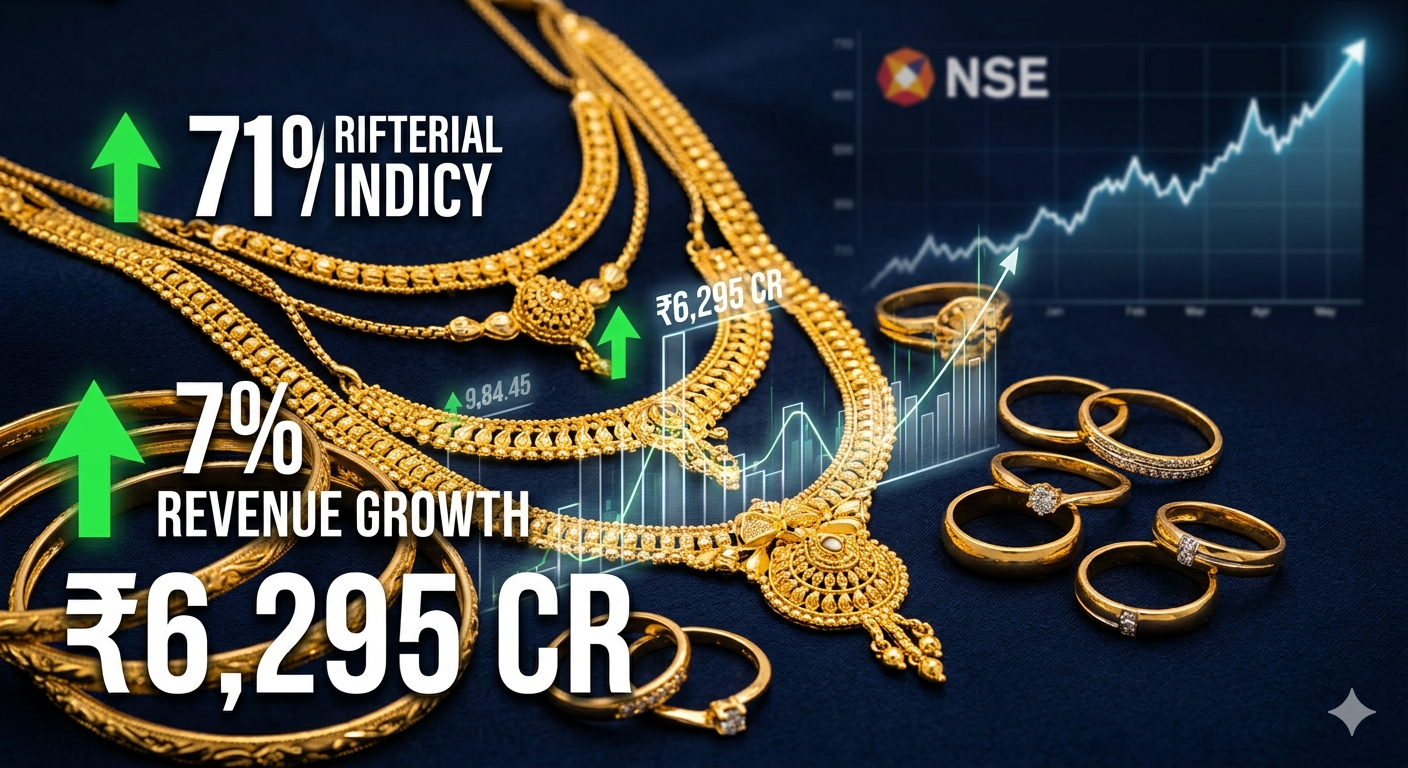
Meta Description: Sky Gold & Diamonds (NSE: SKYGOLD) posts ₹6,295 Cr revenue and ₹275 Cr net profit in FY26 — a 107% profit jump. Here’s a full breakdown for investors.
Quick Answer: How Did Sky Gold and Diamonds Perform in FY26?
Sky Gold and Diamonds Limited (NSE: SKYGOLD) delivered one of the most striking earnings reports in India’s organised jewellery manufacturing sector for FY2025–26. Full-year revenue surged 77.4% year-on-year to ₹6,295 crore, while net profit more than doubled — rising 107.5% to ₹275 crore. EBITDA margins expanded, EPS climbed sharply, and management raised its FY27 revenue guidance to ₹8,100 crore. For investors tracking India’s booming gems and jewellery consumer durables sector, this is a report worth reading closely.
Introduction: The Small-Cap That Keeps Delivering Surprises
If you had put ₹1 lakh into Sky Gold and Diamonds stock three years ago when it was trading near its lows, you’d be sitting on a gain of over 2,400% today. That’s not a typo.
But here’s the thing — most retail investors still don’t know this company exists. Sky Gold and Diamonds Limited isn’t a household name like Titan or Kalyan Jewellers. It doesn’t sell directly to consumers, and you won’t see its name on a store sign in a mall. It operates quietly in the background as a B2B gold jewellery manufacturer, supplying necklaces, rings, pendants, bangles, and custom jewellery to some of India’s biggest retail chains.
And yet, quarter after quarter, this Mumbai-based company has been posting numbers that larger, better-known peers would envy.
In this deep-dive, we break down the Sky Gold and Diamonds FY26 earnings report — every key metric, what drove the growth, what risks remain, and whether the stock still makes sense at current valuations. Whether you’re a long-term investor, a market analyst, or simply someone curious about where India’s jewellery sector is headed, this post has something for you.
Company Background: Who Is Sky Gold and Diamonds Limited?
Before we dig into the numbers, a quick primer. Sky Gold and Diamonds Limited (formerly Sky Gold Limited, renamed in March 2025) is listed on both the NSE and BSE (BSE: 541967). The company:
- Designs, manufactures, and sells gold and silver jewellery — necklaces, rings, pendants, bracelets, earrings, bangles, and more
- Operates as a pure B2B manufacturer, supplying to major wholesalers, showrooms, and retail chains across India
- Is expanding into international markets, especially the Middle East, with a Dubai office in the works
- Has major retail clients including Kalyan Jewellers, Malabar Gold, Thangamayil, CaratLane, and Indriya
The company recently confirmed a high-value recurring export order of 200 kilograms — a milestone that signals its growing global footprint.
FY26 Earnings Report: The Headline Numbers
Let’s start with what matters most — the actual financial performance.
FY26 Full-Year Performance (Consolidated)
| Metric | FY26 | FY25 | YoY Change |
|---|---|---|---|
| Total Revenue | ₹6,294.9 Cr | ₹3,548.0 Cr | +77.4% |
| Net Profit (PAT) | ₹275.3 Cr | ₹132.7 Cr | +107.5% |
| EBITDA Margin | ~6.9% | ~5.5% | +140 bps |
| PAT Margin | ~4.5% | ~3.7% | Exceeded Guidance |
| OPM (Operating Profit Margin) | 6.90% | 5.53% | Expanding |
Q4 FY26 Performance (Standalone Quarter)
| Metric | Q4 FY26 | Q4 FY25 | YoY Change |
|---|---|---|---|
| Revenue | ₹1,911.5 Cr | ₹1,058.2 Cr | +80.6% |
| Net Profit | ₹84.3 Cr | ₹38.2 Cr | +120.8% |
| EBITDA | ₹140.7 Cr | ₹63.0 Cr | +123.3% |
| EBITDA Margin | 7.4% | 6.0% | +140 bps |
| PBT | ₹126.2 Cr | ₹50.2 Cr | +151% |
These aren’t incremental gains — they represent a company in a fundamentally different phase of its growth curve.
What Drove the Revenue Growth? Breaking Down the Key Drivers
A 77% revenue jump doesn’t happen by accident. From studying the quarterly earnings calls and investor communications, here are the primary engines powering Sky Gold and Diamonds’ performance:
1. Volume Expansion and Capacity Ramp-Up
Sky Gold has been aggressively scaling its manufacturing capacity. The Q4 FY26 monthly production volume reached approximately 650 kg, while existing capacity stands at around 1.2 tonnes per month — implying roughly 55% utilisation, which leaves significant headroom for further growth without major near-term capital expenditure.
2. Deeper Retail Partnerships
The company’s B2B model is its biggest competitive moat. By serving as the manufacturing partner for large retail chains rather than competing with them, Sky Gold has aligned its growth with the explosive expansion of organised retail jewellery in India. Clients like Kalyan Jewellers, Malabar Gold, and CaratLane have been expanding aggressively — and Sky Gold grows with them.
3. Export Business Gaining Momentum
MD Mangesh Chauhan outlined the company’s vision of exports contributing 25% of revenues in the coming two years, anchored by a Dubai expansion that will position Sky Gold among the top integrated gold jewellery manufacturers from India. In Q1 FY26, exports already accounted for 12% of revenues.
4. Product Mix Upgrade — 18K, 9K, and Diamond Jewellery
The company has been expanding into higher-margin categories including 18kt, 9kt, and diamond-studded jewellery — currently representing 1.5% of sales — which will further bolster margins as this segment scales. This is a deliberate strategy to move up the value chain and reduce dependence on commodity-driven gold volumes.
5. Gold Metal Loans (GML) and Operational Efficiency
One of the less-discussed but highly impactful changes is the shift toward gold metal loans, where the client supplies the gold and the company charges a making charge. This model dramatically reduces working capital intensity and improves capital efficiency — a direct contributor to the margin expansion seen in FY26.
Profit Margins: The Story Behind the Numbers
Margin expansion is where the Sky Gold story gets genuinely exciting.
Sky Gold’s current net profit margins have improved to 3.9% from 2.4% last year, while the company’s earnings have grown at 61.8% per year over the past five years — with the past year’s growth of 203.7% significantly exceeding even that long-term average.
More importantly, FY26 PAT margins of ~4.5% came in ahead of management’s own guidance of 4.25%+. This matters because it shows the operational improvements are real, not just paper accounting.
FY26 saw record revenue and profit growth, with margins expanding and net debt effectively halved — with guidance for FY27 and FY30 raised, supported by an asset-light model, improved working capital, and a focus on value-added products and exports.
Before vs. After: Operating Leverage in Action
| Financial Metric | FY24 | FY25 | FY26 |
|---|---|---|---|
| Revenue | ~₹1,745 Cr | ₹3,548 Cr | ₹6,295 Cr |
| Net Profit | ~₹40 Cr | ₹133 Cr | ₹275 Cr |
| PAT Margin | ~2.3% | 3.7% | 4.5% |
| CFO (Cash Flow Ops.) | Negative | -₹272 Cr | -₹45 Cr |
The trajectory is unmistakable. Revenue and profit are scaling faster than costs — the classic hallmark of a business hitting its operating leverage inflection point.
EPS Performance and Shareholder Value
Sky Gold’s EPS for Q3 FY25 came in at ₹2.52, up sharply from ₹0.81 in the same quarter last year — a growth of over 210%. For the full year FY26, EPS has grown in tandem with the 107% net profit surge.
Estimated earnings per share for the next quarter are ₹3.60, and revenue is expected to reach ₹13.34 billion.
However, there is an important caveat for shareholders to keep in mind: shares outstanding increased by 36% over the past year — a major dilution risk that reduces per-share earnings growth even when absolute profits rise. This is typical for high-growth companies funding expansion, but it’s worth watching closely.
Management Commentary: The Vision for FY27 and Beyond
Perhaps the most telling part of any earnings report isn’t the numbers — it’s what management says after.
MD Mangesh Chauhan said: “Q4 FY26 marks a strong close to what has been a defining year for Sky Gold and Diamonds, with consistent execution across quarters translating into robust growth in revenue and profitability.”
The strategic priorities laid out for FY27 include:
- Revenue target of ₹8,100 crore (up from FY26 actual of ₹6,295 crore)
- Targeting positive Cash Flow from Operations of approximately ₹180–225 crore in FY27, compared to negative ₹45 crore in FY26 — supported by stronger operating efficiencies and disciplined working capital management.
- A strategic shift under “Sky Gold 3.0”: transitioning to an asset-light leased manufacturing expansion model, with operational cash generation expected to support a 50%+ reduction in net borrowings by next year-end.
One particularly revealing statement from the Q4 earnings call: management noted that the Q4 exit revenue run-rate of approximately ₹7,650 crore is already close to FY27 guidance of ₹8,100 crore — implying that the incremental working capital required for FY27 growth should be relatively low.
That’s a significant confidence signal.
Market Sentiment and Stock Valuation
Let’s be honest — at some point, fundamentals and valuation have to meet.
SKYGOLD reached its all-time high of ₹488.55 on December 17, 2024. The stock currently trades with a market capitalisation of approximately ₹68.29 billion, with a beta of 1.64 — meaning it is significantly more volatile than the broader market.
Sky Gold’s P/E ratio of approximately 45–50x is well above the average trailing P/E of 23x for the luxury industry in India — yet total shareholder returns over the past year have exceeded 219%.
Valuation Snapshot (as of June 2026)
| Metric | Value |
|---|---|
| Market Cap | ~₹8,069 Crore |
| P/E Ratio (FY26 trailing) | ~29x |
| P/E Ratio (FY27 estimated) | ~24x |
| EV/EBITDA (FY27 est.) | ~14x |
| Revenue (FY26) | ₹6,295 Cr |
| PAT (FY26) | ₹275 Cr |
Analysts consider the stock reasonably priced on a FY27 basis at 24x P/E and 14x EV/EBITDA for a company promising a 35% CAGR from FY26 to FY30 — with potential for re-rating to 25x+ P/E as FY30 earnings milestones are delivered.
The caveat? Execution risk is real. If FY27 PAT comes in below guidance, the current valuation quickly looks expensive. Margin of safety, by most analyst estimates, starts to appear meaningfully from FY28 onward.
Risks to Watch: What Could Go Wrong?
No earnings report review is complete without an honest look at the downside. Here are the key risks for Sky Gold and Diamonds investors:
1. Gold Price Volatility Sky Gold’s top-line revenue is heavily influenced by the price of gold. A sharp correction in gold prices could distort reported revenue growth even if volumes hold steady. Management has explicitly acknowledged this and has asked the market to focus on “cash in the bank” rather than top-line vanity metrics.
2. Client Concentration A significant portion of revenue flows from a relatively small number of large B2B clients. If any major retail partner scales back orders or switches vendors, the impact on revenue would be immediate and meaningful.
3. Share Dilution As noted earlier, the 36% increase in shares outstanding has diluted per-share metrics. Future rounds of fundraising for expansion could further dilute earnings per share.
4. Working Capital Intensity Despite significant improvement, cash flow from operations was still negative in FY26. Until CFO turns strongly positive, the business remains dependent on external financing.
5. Export Execution The Dubai expansion and international revenue ambitions are strategically sound — but international market entry carries its own execution risks, currency dynamics, and competitive pressures.
India’s Jewellery Sector: The Macro Tailwind
Sky Gold doesn’t operate in isolation. The company is riding a powerful structural wave in India’s gems and jewellery industry.
According to the India Brand Equity Foundation (IBEF), India is the world’s largest consumer of gold jewellery, accounting for roughly 25% of global demand. The organised sector’s share of the jewellery retail market has been expanding rapidly — from under 20% a decade ago to over 35% today — and is expected to cross 50% within the next five years.
This shift from unorganised to organised retail directly benefits B2B manufacturers like Sky Gold, who supply the large retail chains that are winning market share.
Additionally, India’s middle class expansion, rising disposable incomes, and the cultural significance of gold in weddings and festivals create a demand floor that is remarkably resilient even through economic cycles.
SKYGOLD vs. Peers: How Does It Stack Up?
| Company | Revenue (FY26 est.) | Revenue Growth (YoY) | PAT Margin | P/E |
|---|---|---|---|---|
| Sky Gold & Diamonds | ₹6,295 Cr | 77% | 4.5% | ~29x |
| Titan Company | ~₹55,000 Cr | ~10–12% | ~7% | ~80x |
| Kalyan Jewellers | ~₹22,000 Cr | ~20% | ~3.5% | ~55x |
| Thangamayil | ~₹4,500 Cr | ~18% | ~5% | ~25x |
Sky Gold’s revenue growth rate is in a different category. Its margin profile is lower than Titan (which has higher branded retail margins), but comparable to its B2B manufacturing peers. And at 29x trailing P/E, it appears meaningfully cheaper than the category-leading names.
Pros and Cons: Sky Gold and Diamonds at a Glance
✅ Pros
- Exceptional revenue and profit growth (77% and 107% YoY)
- Margin expansion beating its own guidance
- Expanding B2B client base with marquee retail names
- Export momentum building — Dubai hub in progress
- Shift to asset-light model and GML improving capital efficiency
- 35% revenue CAGR guidance for FY26–FY30
- Management has consistently met or beaten guidance
❌ Cons
- No dividend paid despite consistent profitability
- CFO still negative in FY26 (improving but not yet positive)
- Significant share dilution (36% increase in shares outstanding)
- High beta stock — significant price volatility
- Revenue heavily influenced by gold price movements
- Promoter holding has declined ~21.8% over three years
What Should Investors Do Now?
This is not financial advice — please consult a SEBI-registered investment advisor before making any investment decisions.
That said, here’s a framework for how different investor profiles might think about SKYGOLD:
Long-term growth investors (3–5 year horizon): The fundamental story is compelling. A 35% PAT CAGR guidance from FY26 to FY30, if delivered, makes the current valuation look reasonable. The key watch item is whether CFO turns meaningfully positive in FY27.
Momentum traders: The stock has a beta of 1.64 and has shown ability to move sharply in both directions. The Q4 exit run-rate already near FY27 guidance is a positive momentum signal.
Conservative or income investors: The lack of dividends, negative CFO, and high valuation multiple make this a poor fit. There are better income or low-volatility options in the broader consumer durables space.
Analysts and researchers: The shift from negative ₹272 Cr CFO in FY25 to near-neutral in FY26, and the guidance for ₹180–225 Cr positive CFO in FY27, is the single most important metric to track. If it arrives, the re-rating potential is significant.
FAQ: Your Questions About Sky Gold and Diamonds Answered
1. What does Sky Gold and Diamonds Limited do?
Sky Gold and Diamonds Limited is a B2B gold and silver jewellery manufacturer based in Mumbai, India. It designs, manufactures, and sells jewellery to wholesalers, showrooms, and large retail chains. It does not operate consumer-facing retail stores.
2. What were Sky Gold’s full-year FY26 results?
Revenue rose 77.4% to ₹6,295 crore, and net profit increased 107.5% to ₹275.32 crore. EBITDA margins expanded to approximately 6.9–7.4% and PAT margins came in at 4.5% — ahead of the company’s own guidance.
3. Is SKYGOLD a good stock to buy?
This depends entirely on your investment horizon and risk tolerance. The company has strong growth fundamentals, but trades at a premium valuation, has a high beta, pays no dividend, and has a still-negative cash flow from operations. It is better suited to growth-oriented investors with a 3+ year horizon. Always consult a registered investment advisor.
4. What is SKYGOLD’s EPS forecast for FY27?
Analyst estimates suggest EPS of approximately ₹3.60 per quarter for the next quarter, with full-year FY27 PAT guided to grow 30–35% from FY26 levels. The company is targeting revenue of ₹8,100 crore in FY27.
5. Why did Sky Gold rename itself “Sky Gold and Diamonds”?
The company added “and Diamonds” to its name in March 2025 to reflect its strategic push into diamond-studded and higher-value jewellery, including 18K and 9K gold categories and lab-grown diamonds — all higher-margin products than plain gold jewellery.
6. What are the biggest risks in investing in Sky Gold and Diamonds?
Key risks include gold price volatility affecting reported revenue, client concentration, share dilution (36% increase in outstanding shares in the past year), still-negative cash flow from operations, and execution risk in international expansion.
7. Who are Sky Gold’s main clients?
The company serves major B2B jewellery retail clients including Kalyan Jewellers, Malabar Gold, Thangamayil, CaratLane, and Indriya, among others.
8. Does Sky Gold pay dividends?
No. Despite reporting consistent profits, Sky Gold and Diamonds does not currently pay dividends. The company appears to be reinvesting all earnings into capacity expansion and growth.
Conclusion: A Defining Year — and a Defining Moment for Investors
Sky Gold and Diamonds FY26 earnings report is not just a set of impressive numbers. It is the story of a company that has quietly built one of the most compelling growth narratives in India’s mid-cap universe.
A 77% revenue jump. A 107% profit surge. Margins beating guidance. FY27 guidance raised. Net debt halved. Cash flow improving dramatically. An export business being built from scratch. A product mix moving toward higher-margin categories.
By almost any metric, FY26 was a defining year for SKYGOLD.
But here’s the honest truth: past performance, however dazzling, does not guarantee future returns. The real test begins now — with FY27 numbers, CFO conversion, debt reduction, and export execution. The market is already pricing in significant optimism. For the stock to continue rewarding investors, management must continue to execute with the same discipline it showed in FY26.
If you’re already invested: the fundamental case remains intact. Watch CFO and debt metrics in Q1 and Q2 FY27 as your key validation signals.
If you’re watching from the sidelines: do your research, consult a qualified advisor, and look carefully at the FY27 guidance delivery in the next two quarters before making a decision.
The jewellery is certainly shining. The question, as always, is whether the price is right.
📌 Found this analysis useful? Share it with a fellow investor or bookmark it for your next portfolio review.
💬 What’s your take on SKYGOLD’s FY26 results? Drop your thoughts in the comments below — we read every one.
📧 Subscribe to our newsletter for deep-dive earnings analyses on India’s fastest-growing small and mid-cap companies — delivered straight to your inbox, every week.
Read More
Opening Bell June 1, 2026: What Every Indian Investor Must Know Before Markets Open Today
Disclosure: This article is for educational and informational purposes only. The author and publisher do not hold any position in SKYGOLD at the time of publication. Past performance is not indicative of future results. Please consult a SEBI-registered investment advisor before making investment decisions.
Sources: Business Standard, JewelBuzz Magazine, Simply Wall St, NSE India, IBEF Gems & Jewellery Report, Screener.in

