

Meta Description: Sensex down 300 points? Here’s what’s really driving the fall, what history shows happens next, and a clear action plan for Indian investors.
The Short Answer
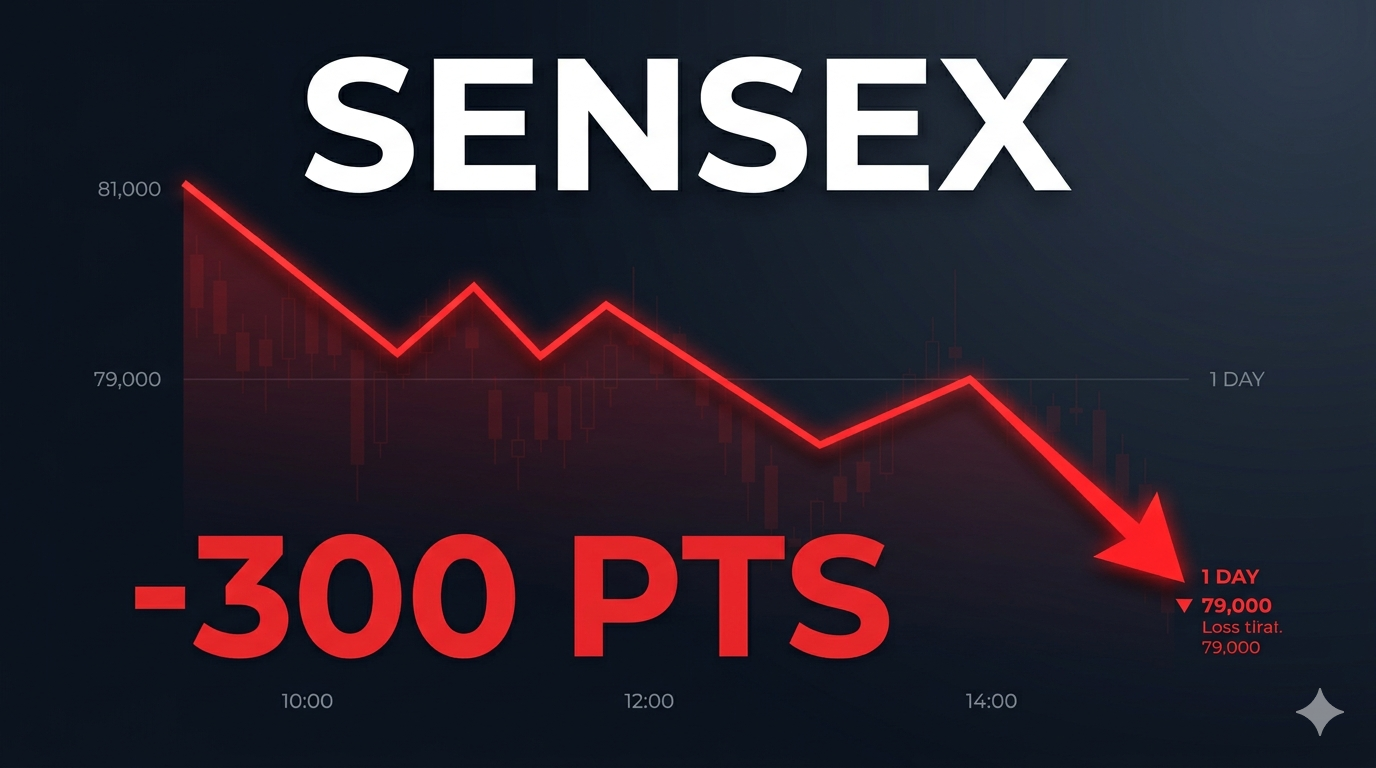
If you’ve landed here because your portfolio app just flashed red and you’re wondering whether to panic, here’s the direct answer: a 300-point fall in the Sensex is a 0.3–0.5% move on a 75,000+ index — well within the range of completely normal daily volatility, and not, on its own, a reason to make any big decisions.
It usually means one or more of these things are happening at the same time:
- Profit booking after a recent rally (the most common reason)
- Weak global cues from US, European, or Asian markets overnight
- Sectoral pressure, especially in IT, banking, or energy stocks
- Crude oil price swings affecting inflation and import-cost expectations
- Rupee depreciation adding to investor caution
- Mixed institutional flows — FIIs selling while DIIs buy, or vice versa
None of these, individually or together, tell you anything about where the market will be in six months. What they tell you is how traders are feeling today. That distinction matters more than almost anything else in this article, so keep it in mind as you read on.
I’ve spent over a decade tracking Indian equity markets and writing about retail investor behavior, and if there’s one pattern that repeats endlessly, it’s this: headlines like “Sensex slips 300 points” generate far more anxiety than the actual number justifies. Let’s break down why this happens, what’s really going on beneath the surface, and what a sensible response actually looks like.
What Does “Sensex Down 300 Points” Actually Mean?
Let’s ground this in real numbers, because percentages matter more than absolute points — and most financial headlines don’t bother explaining that.
On June 17, 2026, for context, the Sensex closed up 347 points to settle near 77,155, while the Nifty 50 crossed 24,085 — extending a four-day winning streak as Brent crude slid toward three-month lows ahead of the US Federal Reserve’s policy decision under new Chair Kevin Warsh. That’s the kind of backdrop that often sets up exactly the scenario you’re reading about now: a strong run-up followed by a reversal as the Nifty falls below 24,050 and the Sensex slips 300 points from the day’s high.
Here’s the math that financial news headlines often skip:
| Index | Approx. Level | 300-Point Move | % Change |
|---|---|---|---|
| Sensex (~77,000 range) | 77,000 | 300 points | ~0.39% |
| Nifty 50 (~24,000 range) | 24,000 | ~90–100 points | ~0.40% |
A 0.4% move is something most diversified equity portfolios experience multiple times a week. Compare that to March 2020, when the Sensex fell over 13% in a single session, or even a “normal” volatile day where the index swings 1,000+ points. A 300-point dip is closer to background noise than a market event.
The real story is rarely the number — it’s the intraday reversal. When markets open strong, climb through the morning, and then fade by afternoon, that pattern (sometimes called a “failed rally” or “distribution day” by technical analysts) tells you more about short-term sentiment than the headline figure does.
The 6 Real Reasons Markets Fall 300 Points (Explained Simply)
1. Profit Booking After a Rally
This is, by far, the most common and least alarming reason for a pullback like this.
When the Sensex or Nifty has been climbing for several sessions — say, a 4-day winning streak that pushed the Nifty past 24,000 — a chunk of that gain is held by short-term traders, not long-term investors. The moment the index touches a resistance level or a round number, many of them sell to lock in profits. This isn’t pessimism; it’s basic risk management.
From tracking market commentary across multiple sessions in 2026: this exact pattern played out with Nifty IT stocks, where the sector surged roughly 7–8% over two sessions on AI optimism, only to see Nifty IT fall over 4.6% in a single day shortly after — described by analysts as profit booking following an exceptionally strong, fast rally rather than any change in company fundamentals.
That’s the playbook: rally hard, pull back fast, fundamentals largely untouched.
2. Weak Global Cues
Indian markets don’t operate in isolation. Overnight moves in the Dow Jones, Nasdaq, and S&P 500, along with Asian markets like the Nikkei and Hang Seng, set the tone for our opening bell.
If US tech stocks slide on rate worries, or European markets dip on growth concerns, Indian IT and export-driven sectors typically open weak the next morning. This is a near-mechanical relationship at this point — Indian markets get the first 30–60 minutes of trade heavily anchored to how the US closed the previous night.
3. Sectoral Pressure (IT, Banking, Energy)
A broad market fall often isn’t broad at all — it’s concentrated in two or three heavyweight sectors that carry outsized weight in the index.
- IT stocks are sensitive to the US dollar, US interest rate expectations, and global tech sentiment. A weak US software earnings season or hawkish Fed commentary tends to hit Infosys, TCS, HCL Tech, and Wipro hardest.
- Banking stocks react to RBI policy expectations, credit growth data, and asset quality concerns.
- Energy stocks swing with crude oil prices — a sudden spike often hurts oil marketing companies and raises inflation worries, while a sharp drop can hit upstream producers like ONGC.
When two or three of these sectors move together against the broader market, that’s usually enough to drag the entire index down by a few hundred points even if most individual stocks are flat or slightly positive.
4. Crude Oil Volatility
This one deserves its own callout because of how disproportionately it affects Indian markets compared to many other economies.
India imports more than 80% of its crude oil needs, so oil price swings ripple through nearly every part of the economy — inflation, the rupee, fiscal deficit, and corporate input costs. When Brent crude is near multi-month lows, as it was around $79/barrel in mid-June 2026, it’s generally a tailwind: lower fuel import bills, better fiscal headroom, and reduced inflationary pressure. A sudden reversal upward in crude prices, even on geopolitical headlines, can immediately sour sentiment around banking and consumption stocks that are sensitive to inflation and rate expectations.
5. Rupee Depreciation
A weakening rupee cuts both ways. It tends to help export-oriented sectors like IT and pharma (since their revenue is in dollars), but it raises concerns for import-heavy sectors and adds to inflation worries, which makes the RBI’s job harder. When the rupee slides meaningfully in a short window, you’ll often see foreign institutional investors (FIIs) pull back, since currency depreciation erodes their dollar-denominated returns.
6. Mixed Institutional Flows
This is the one most retail investors don’t track closely enough, but probably should.
- FIIs (Foreign Institutional Investors) tend to be the more volatile, sentiment-driven flow — quick to sell on global risk-off days, quick to buy on rate-cut optimism.
- DIIs (Domestic Institutional Investors), including mutual funds and insurance companies, have historically been the stabilizing counterforce, often buying on dips that FIIs create.
When both groups are selling, that’s a meaningfully different signal than when one is buying while the other sells. According to data regularly published by the National Securities Depository Limited (NSDL), tracking the spread between FII and DII activity over a week — not a single day — gives a far more reliable read on institutional sentiment than any single day’s headline number.
Before vs. After: How a 300-Point Fall Usually Plays Out
Here’s a pattern I’ve seen repeat across dozens of similar sessions over the years, summarized as a simple before/after comparison:
| Stage | What Typically Happens |
|---|---|
| Before the dip | Index has rallied 3–5 sessions straight; sentiment is optimistic, often verging on euphoric in financial media |
| The dip itself | Strong opening, intraday reversal, 300-point fall from day’s high; IT/banking/energy lead the decline |
| Immediately after (1–2 days) | Volatility (India VIX) ticks up slightly; trading volumes rise as short-term traders reposition |
| Within 1–2 weeks | In the large majority of historical cases, the index either stabilizes or resumes its prior trend, unless a genuinely new negative catalyst (policy shock, geopolitical escalation, earnings miss) emerges |
This isn’t a guarantee — markets don’t run on guarantees — but it’s a consistent enough pattern that experienced market-watchers don’t treat a single 300-point fall as a trend reversal signal on its own.
What Should You Actually Do When You See This Headline?
This is the part most articles skip, and it’s the part that actually matters to you.
If You’re a Long-Term Investor (Mutual Funds, SIPs, Retirement Goals)
Do nothing dramatic. I mean this literally. If your investment horizon is 5+ years and your asset allocation matches your risk tolerance, a 0.4% daily move is statistical noise relative to your goal.
A few practical notes from working with long-term investors over the years:
- If you’re running a SIP (Systematic Investment Plan), a dip is mathematically a better entry point, not a worse one — you’re buying more units at a lower NAV.
- Resist the urge to check your portfolio multiple times a day during a falling session. This single habit change reduces panic-selling more than any amount of market analysis.
- If a 300-point fall genuinely makes you anxious, that’s useful information — it likely means your equity allocation is higher than your actual risk tolerance, not that the market is doing something wrong.
If You’re an Active Trader
- Check whether the fall is broad-based or sector-specific before reacting. A 300-point fall driven entirely by IT weakness is a very different setup than a fall with negative breadth across all sectors.
- Watch India VIX. A meaningful spike (not just a 1-2% tick) alongside the fall suggests genuine uncertainty rather than routine profit booking.
- Avoid revenge-trading. The fastest way to turn a manageable 0.4% index move into a personally damaging day is to overtrade trying to “win back” a paper loss.
If You’re New to Investing
Take this as a useful, low-stakes lesson rather than a crisis. Every investor’s first market dip feels disproportionately significant. The investors who build wealth over decades are, almost without exception, the ones who treat days like this as background noise rather than news to act on.
Pros & Cons of Reacting to Short-Term Index Moves
| Pros | Cons | |
|---|---|---|
| Reacting Immediately | Can limit losses if you’ve correctly identified a genuine trend change | Usually locks in losses on what turns out to be normal volatility; encourages emotional decision-making |
| Staying the Course | Avoids transaction costs and tax events from unnecessary trades; aligns with long-term compounding | Requires emotional discipline; can feel uncomfortable in the moment |
| Using Dips to Invest More | Historically rewarding for long-term SIP investors; lowers average cost | Requires available cash and the discipline to act against prevailing sentiment |
A Quick Word on Macro Triggers to Watch
Markets rarely move on a single factor in isolation. Right now, and in general, these are the macro releases and events that tend to amplify or dampen the impact of sessions like this:
- US Federal Reserve policy decisions — rate guidance shifts global risk appetite almost immediately
- RBI Monetary Policy Committee meetings — directly affects Indian bank and rate-sensitive stock valuations
- Crude oil inventory and OPEC+ announcements — given India’s import dependence, these move sentiment fast
- Quarterly corporate earnings season — sector-specific surprises (especially IT and banking) often explain single-day sectoral drags better than any macro story
- GDP, inflation (CPI), and IIP data releases — these reset expectations for both RBI policy and corporate earnings outlooks
You can track most of these through the Reserve Bank of India’s official publications and the SEBI website for regulatory and institutional flow data, both of which are far more reliable primary sources than aggregated headlines.
Frequently Asked Questions
1. Is a 300-point fall in Sensex a big deal? No, not on its own. At current Sensex levels above 75,000, a 300-point move is roughly 0.3–0.4% — within the normal range of daily volatility. Context (what’s driving it, and whether it’s broad-based or sector-specific) matters far more than the raw point figure.
2. Why does the Sensex fall even after a strong opening? This is called an intraday reversal, and it usually reflects profit booking — traders selling into strength after a rally to lock in short-term gains, rather than any new negative information entering the market.
3. Should I sell my mutual funds when Sensex falls 300 points? Generally, no, if you’re investing for a goal more than a few years away. Daily index moves of this size are not a reliable signal for tactical portfolio decisions. Consult a SEBI-registered financial advisor before making changes based on short-term volatility.
4. How does crude oil price affect the Sensex? India imports the large majority of its crude oil, so rising oil prices increase the import bill, pressure the rupee, and raise inflation concerns — all of which can weigh on banking, auto, and consumption stocks. Falling crude oil prices typically have the opposite, supportive effect.
5. What’s the difference between FII and DII flows, and why does it matter? FIIs (Foreign Institutional Investors) tend to be quicker to react to global risk sentiment, while DIIs (Domestic Institutional Investors like mutual funds) have historically provided more stable, dip-buying support. Watching the net direction of both over several sessions, not just one day, gives a clearer read on institutional conviction.
6. Does a Sensex fall mean a market crash is coming? Not typically. A “crash” usually refers to a much sharper decline — often 10%+ over a short period — driven by a major shock (a financial crisis, pandemic, or systemic event). A 300-point single-session fall is a routine market fluctuation, not a crash indicator.
7. Which sectors are usually most affected when Sensex falls? IT, banking, and energy are the most common drivers of broad index moves because of their large index weight and sensitivity to global rates, crude oil, and currency movements respectively. Checking sectoral indices (Nifty IT, Nifty Bank, Nifty Energy) tells you whether a fall is broad-based or concentrated.
8. How can I stay updated on real-time Sensex and Nifty movements? Reliable real-time sources include the official BSE website and NSE India, both of which publish live index values, sectoral performance, and institutional flow data directly from the exchanges.
Read More
Sensex & Nifty Trade Flat: What Crude Oil, Monsoon Fears, and Cautious Investors Are Really Telling You
The Bottom Line
A headline that reads “Sensex Down 300 Points” is designed to grab your attention — and it does its job well. But the underlying reality is almost always more mundane than the headline suggests: profit booking after a rally, some global jitters, a sector or two under pressure, and a market that’s doing exactly what markets do every single trading day.
The investors who build real wealth in Indian equities over the long run are rarely the ones reacting fastest to these headlines. They’re the ones who understand why the index moved, check whether anything has actually changed about the businesses they’re invested in, and then get back to their day.
If you found this breakdown useful, I’d genuinely encourage you to bookmark it for the next time a red headline catches your eye — because there will be a next time, probably sooner than you think. And if you want a deeper dive into how to structure your portfolio so days like this stop feeling stressful altogether, that’s a conversation worth having with a SEBI-registered advisor who can look at your specific goals and risk profile.
What’s your approach when you see a “market down” headline — do you check your portfolio, or do you scroll past? Share your take in the comments, and pass this along to anyone in your circle who panics every time the ticker turns red.

