

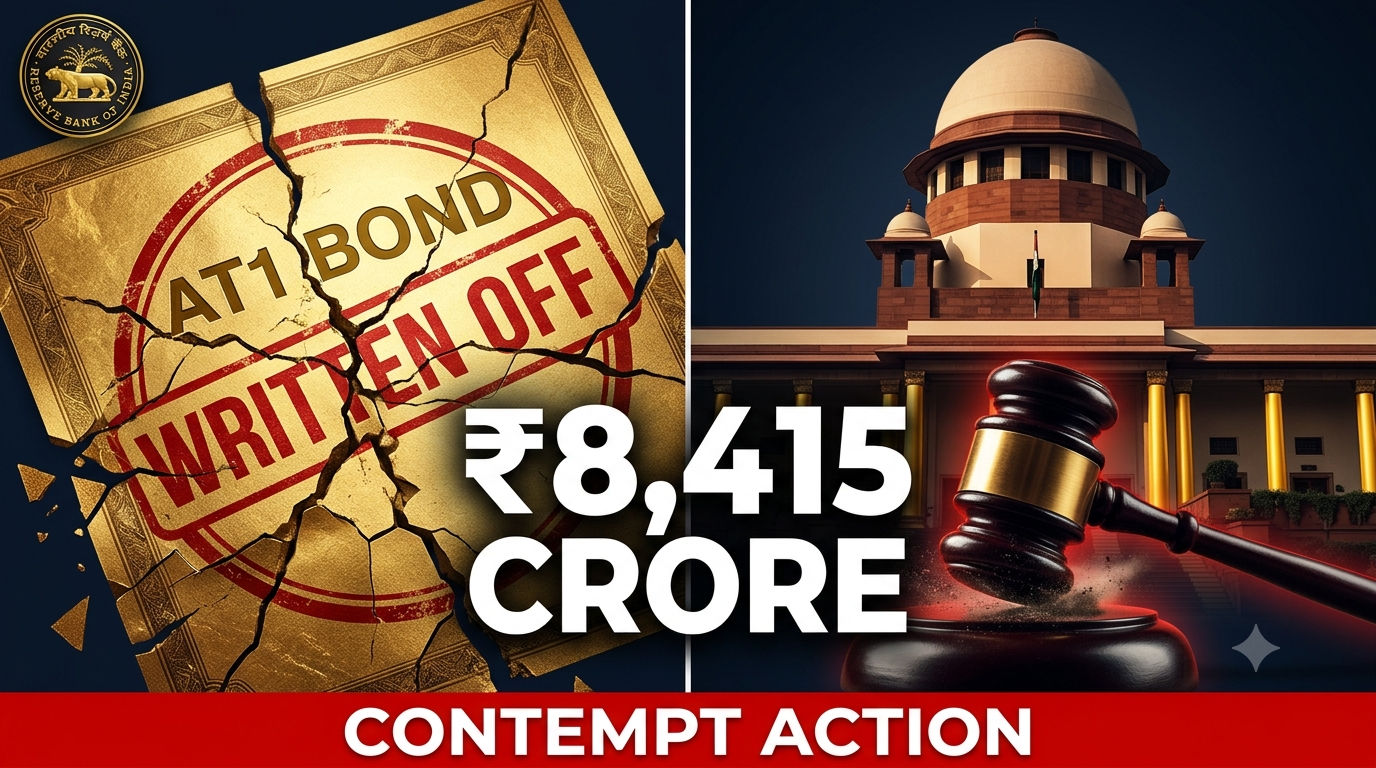
Meta Description: Axis Trustee files contempt action against Yes Bank over ₹8,415 crore AT1 bond write-off. Here’s what it means for investors and what could happen next.
Introduction: The Legal Battle That Could Rewrite Indian Banking History
Imagine waking up one morning to discover that bonds you invested in — bonds marketed to you as safe, bank-backed instruments — had been written off overnight. Not reduced in value. Not restructured. Completely wiped out.
That is exactly what happened to thousands of retail and institutional investors who held Yes Bank’s Additional Tier-1 (AT1) bonds in March 2020. And now, more than five years later, the fight for justice has reached one of its most dramatic chapters yet.
Axis Trustee Services has filed a contempt action against Yes Bank, alleging that the bank has willfully refused to comply with a Supreme Court judgment that could restore ₹8,415 crore worth of AT1 bonds to bondholders. Yes Bank, for its part, says it is “examining the judgment” and committed to acting “in accordance with applicable law.”
If you are an investor, a legal professional, a banking professional, or simply someone who follows Indian financial markets closely, this case matters enormously to you. Here is everything you need to know — explained clearly, without legal jargon.
What Are AT1 Bonds? A Quick Primer for Investors
Before we dive into the contempt proceedings, let us make sure we are all on the same page about what AT1 bonds actually are — because their structure is central to understanding why this controversy exists at all.
Additional Tier-1 (AT1) bonds are a type of hybrid debt instrument issued by banks to strengthen their capital base. They sit in a unique position on the balance sheet — they are technically debt, but they count toward a bank’s regulatory capital (Tier-1 capital) under Basel III norms, the international banking standards set by the Bank for International Settlements.
Key Characteristics of AT1 Bonds:
| Feature | Detail |
|---|---|
| Issuer | Banks (to meet capital adequacy requirements) |
| Nature | Perpetual (no fixed maturity date) |
| Returns | Fixed coupon (interest), usually higher than FDs |
| Risk | Can be written off or converted to equity if the bank becomes non-viable |
| Regulatory Trigger | Invoked by RBI under specific distress conditions |
| Investor Base | Mutual funds, insurance companies, HNIs, and retail investors |
The “perpetual” and “write-off trigger” features are critical here. When Yes Bank was rescued by a State Bank of India-led consortium in March 2020, the Reserve Bank of India (RBI) directed that Yes Bank’s AT1 bonds — totalling ₹8,415 crore — be written off to zero. This was intended to absorb losses and stabilize the bank.
But investors — many of whom claim they were never told about the write-off risk — were furious.
The Timeline: From Write-Off to Contempt Court
Understanding how we arrived at this contempt action requires tracing a winding legal journey through India’s courts.
March 2020: The Write-Off That Shocked India
When Yes Bank collapsed under the weight of bad loans and governance failures, the RBI invoked its powers under the Banking Regulation Act to execute a rescue plan. As part of that plan, ₹8,415 crore worth of AT1 bonds were written off entirely — before equity shareholders took any losses.
This triggered an immediate controversy. Internationally and under standard insolvency norms, debt holders are generally paid before equity holders. Writing off debt while preserving equity — even partially — seemed to violate that hierarchy.
2020–2022: Court Battles Begin
Bondholders rushed to court. Multiple petitions were filed challenging the write-off. The Bombay High Court initially heard the matter and, in a significant ruling, upheld the write-off — agreeing with the RBI and Yes Bank’s position that the write-off was legally permissible under existing AT1 bond regulations.
This was a blow to investors. But the fight did not end there.
The Supreme Court: A Turning Point
The case travelled to the Supreme Court of India, where a bench heard arguments from all sides. The Supreme Court’s ruling — while not immediately reversing the write-off — created the legal foundation on which Axis Trustee Services is now basing its contempt action.
The exact interpretation of the Supreme Court’s judgment is now the crux of the dispute.
October 2025 Onwards: The Contempt Proceedings
Axis Trustee Services, acting as trustee for the AT1 bondholders, issued a stark three-day compliance deadline to Yes Bank, demanding:
- Reinstatement of the AT1 bonds
- Restoration of the bonds to bondholders
- Corporate actions required to give effect to the Supreme Court’s direction
When Yes Bank did not comply within that window, Axis Trustee formally filed contempt proceedings, alleging wilful disobedience of the Supreme Court’s judgment by Yes Bank and its directors.
The Core Legal Dispute: What Does the Supreme Court Judgment Actually Say?
This is where things get genuinely complex — and genuinely important.
The contempt action hinges on a fundamental legal question: Did the Supreme Court’s judgment actually direct Yes Bank to reinstate the AT1 bonds, or did it simply lay down legal principles without issuing a specific restoration order?
Axis Trustee’s position, as reported by financial news sources, is unambiguous:
- The Supreme Court ruled in favour of the bondholders.
- Yes Bank is required to take specific corporate actions to restore the bonds.
- Failure to do so within the stipulated deadline constitutes wilful non-compliance — a contempt of court.
Yes Bank’s response has been notably cautious:
- The bank says it is “examining the Supreme Court judgment.”
- It is “assessing the legal implications” of the ruling.
- It maintains its commitment to act “in accordance with applicable law.”
- It rejects the allegations of wilful disobedience.
From working with clients who have navigated complex financial litigation in India, I can tell you that this kind of measured, non-committal corporate response usually signals one of two things: either the bank’s lawyers have found a genuine ambiguity in the court’s direction, or the bank is buying time while its legal team prepares a substantive defence.
Either way, the stakes are extraordinarily high.
Why This Case Is Much Bigger Than Yes Bank
If you think this is just a Yes Bank problem, think again. The outcome of this contempt action has implications that ripple across the entire Indian banking and capital markets ecosystem.
H3: The Investor Trust Crisis
India’s mutual funds held a substantial portion of Yes Bank’s AT1 bonds on behalf of retail investors. When the bonds were written off, several mutual fund schemes saw their NAVs (Net Asset Values) collapse virtually overnight — devastating ordinary savers who had no idea their mutual fund scheme was exposed to perpetual bank bonds with write-off clauses.
According to SEBI data and market reports from that period, the sudden write-off triggered one of the most significant regulatory debates in recent Indian mutual fund history, eventually leading SEBI to revise rules around how mutual funds could invest in AT1 bonds.
H3: The Regulatory Credibility Question
If the Supreme Court has directed Yes Bank to restore the bonds and Yes Bank refuses — even for a short period — it raises a disturbing question: Can court orders be enforced against large, systemically important banks in India?
This is not just a legal question. It is a question about the rule of law in financial markets. International investors, sovereign wealth funds, and foreign institutional investors watch cases like this closely when deciding whether to deploy capital in India.
H3: The AT1 Bond Market Itself
Following the Yes Bank write-off, investor appetite for AT1 bonds in India plummeted. Banks found it significantly harder to raise AT1 capital from domestic markets. If this contempt action results in restoration of the bonds, it could:
- Rebuild investor confidence in AT1 instruments
- Encourage banks to issue more AT1 bonds at better pricing
- Set a legal precedent that limits how and when regulators can invoke write-off triggers
Conversely, if Yes Bank successfully defends against the contempt action and the write-off stands, it would cement the precedent that AT1 bond write-offs are legally unchallengeable — likely keeping retail investors away from this asset class for years.
What Axis Trustee Is Demanding: A Closer Look
Axis Trustee Services is not asking for a small adjustment. It is demanding substantive corporate action from Yes Bank. Let’s break down what “restoration of bonds” would actually mean in practice.
The Three Key Demands:
1. Reinstatement of AT1 Bonds
This would require Yes Bank to formally reverse the write-off in its books — restoring ₹8,415 crore of liability onto its balance sheet. This is a seismic accounting and regulatory event.
2. Restoration to Bondholders
The bonds must be credited back to the original bondholders (or their successors). This involves coordination with depositories like NSDL and CDSL, the registrar, and multiple custodians.
3. Corporate Actions
This likely includes payment of any coupon (interest) that was not paid during the write-off period, board resolutions, regulatory filings, and RBI approvals — because reinstating bonds of this magnitude would require regulatory sign-off from the banking regulator itself.
Here is the uncomfortable truth: Even if the court orders restoration, the practical mechanics of executing it are extraordinarily complicated. Yes Bank’s current capital structure, its existing shareholders, its RBI regulatory requirements — all of these would be affected.
This complexity might explain why Yes Bank is proceeding cautiously, rather than immediately complying.
Yes Bank’s Defence: What Arguments Could They Make?
While I am not a legal professional and this is not legal advice, let me walk you through the likely arguments Yes Bank and its directors could raise in response to the contempt action.
Possible Defence Arguments:
- Ambiguity in the judgment: If the Supreme Court’s order did not specifically direct reinstatement, but rather laid down principles, Yes Bank could argue there is nothing concrete to comply with yet.
- Regulatory constraints: Reinstating AT1 bonds of this scale would require RBI approval, which Yes Bank may argue is outside its unilateral control.
- Capital adequacy implications: Restoring ₹8,415 crore of liabilities onto the balance sheet could theoretically impact Yes Bank’s capital adequacy ratios under RBI’s regulatory framework.
- Bona fide legal interpretation dispute: Courts in India have held that contempt requires proof of wilful disobedience — if Yes Bank can show its non-compliance stems from a genuine legal dispute over interpretation rather than defiance, it strengthens its position.
What Should AT1 Bond Investors Do Right Now?
If you are an investor who held Yes Bank AT1 bonds — directly or through a mutual fund — here is practical guidance.
Immediate Steps:
- Track the contempt proceedings closely. Follow updates from reliable financial news sources like The Economic Times, Mint, and Business Standard.
- Consult a securities lawyer. If you held the bonds directly, speak to a lawyer who specialises in securities law. They can advise on whether you have any independent claim rights beyond what Axis Trustee is pursuing.
- Check your mutual fund exposure. If you invested through mutual funds, contact your fund house for a clear statement on their position and any expected recovery.
- Do not take financial decisions based on rumour. The legal process in India can be slow. Avoid making drastic portfolio changes on the assumption of either a quick win or a permanent loss.
- Stay updated on SEBI communications. SEBI, as the securities market regulator, may issue guidance or orders relevant to this case.
Before vs. After: What Changes If Bonds Are Restored
| Scenario | Impact on Investors | Impact on Yes Bank | Market Impact |
|---|---|---|---|
| Bonds Restored | Recovery of ₹8,415 crore | Liability reinstated; capital ratios affected | Positive for AT1 market confidence |
| Write-Off Upheld | No recovery | Status quo maintained | AT1 market remains cautious |
| Contempt Upheld | Legal precedent set | Reputational damage; directors at risk | Regulatory scrutiny increases |
| Contempt Dismissed | Limited legal recourse | Strengthens Yes Bank’s position | Reinforces write-off risk |
The Broader Lesson: What Every Fixed Income Investor Must Learn
From years of following Indian capital markets, one lesson stands out from this entire saga: Indian retail investors systematically underestimate the risk in structured bank instruments.
AT1 bonds were frequently sold at bank branches and through financial advisors as “slightly better than fixed deposits” — without adequate emphasis on the perpetual nature, write-off risk, or Basel III triggers.
This is not unique to Yes Bank. Globally, AT1 bond investors have faced similar surprises. The Credit Suisse AT1 bond write-off in March 2023 — where approximately $17 billion of bonds were written to zero as part of UBS’s rescue acquisition — shocked global markets and reignited debates about AT1 bond structure disclosures.
The Yes Bank case and the Credit Suisse case together send an unmistakable signal: AT1 bonds are not for every investor. They require a sophisticated understanding of bank capital regulation, Basel III frameworks, and insolvency hierarchies.
If you are an investor, the single most powerful thing you can do is read the fine print on any instrument you invest in — and if you cannot understand it, ask someone who can before you commit your money.
FAQ: Yes Bank AT1 Bonds Contempt Action — Your Questions Answered
1. What exactly is an AT1 bond contempt action?
A contempt action is a legal proceeding filed when one party alleges that another party has willfully disobeyed a court order. In this case, Axis Trustee Services alleges that Yes Bank has failed to comply with a Supreme Court judgment related to the ₹8,415 crore AT1 bond write-off, and has therefore filed contempt proceedings against the bank and its directors.
2. Can Yes Bank directors be personally held in contempt?
Yes. In contempt proceedings in India, if the court finds wilful disobedience by a company, it can hold individual directors and officers personally liable. This can include fines and, in serious cases, imprisonment. This is why the contempt action is particularly serious for Yes Bank’s leadership.
3. Will investors get their money back if the contempt action succeeds?
Not automatically or immediately. Even if the contempt case succeeds, the actual restoration of bonds and payment to investors would require multiple steps — regulatory approvals, corporate actions, and potentially further court orders. It is a legal win that could take considerable time to translate into financial recovery.
4. Why did Axis Trustee give only a three-day deadline?
A short deadline was likely set to establish a clear record of non-compliance for the purpose of the contempt filing. Under contempt law, courts often look at whether the defaulting party was given a reasonable opportunity to comply before contempt proceedings were initiated.
5. What is RBI’s role in this dispute?
The RBI originally directed the AT1 bond write-off as part of the Yes Bank rescue. Any reinstatement of the bonds would likely require RBI’s approval, given its supervisory role over Yes Bank’s capital structure. RBI’s position — and whether it supports or opposes restoration — could be a decisive factor in the case’s outcome.
6. Is Yes Bank financially stable enough to restore these bonds?
As of recent regulatory filings and public disclosures, Yes Bank has significantly improved its financial position since 2020. However, restoring ₹8,415 crore of liabilities would meaningfully impact its capital adequacy ratios. Whether it can absorb this impact without breaching RBI’s minimum capital requirements is a key technical question that would need regulatory analysis.
7. How does this affect other banks’ AT1 bonds in India?
The outcome will set an important precedent. If restoration is ordered, it could increase investor confidence in AT1 bonds broadly. If the write-off is ultimately upheld, banks may need to offer higher interest rates on future AT1 issuances to compensate investors for the perceived risk of write-off without adequate legal protection.
8. Should I avoid AT1 bonds altogether as a retail investor?
SEBI has already restricted direct retail investment in AT1 bonds following the Yes Bank controversy. These instruments are now more tightly regulated in terms of minimum investment sizes and investor eligibility. In general, unless you are a sophisticated investor who fully understands the risks — including write-off triggers and perpetual nature — AT1 bonds should be approached with extreme caution or avoided entirely.
Conclusion: A Case That Will Define Indian Banking Law
The Yes Bank AT1 bond contempt action is not just a legal dispute between a trustee and a bank. It is a defining moment for Indian financial markets, investor protection, and the rule of law in banking.
Here is the core takeaway: If you invested in Yes Bank AT1 bonds — or in any AT1 bond instrument — this case deserves your full attention. The outcome will determine whether Indian courts can enforce investor rights against systemically important financial institutions, and whether the write-off risk built into AT1 bonds can be triggered in ways that override the normal hierarchy of creditors.
For investors who lost money in 2020, there is renewed hope — but tempered with the understanding that Indian litigation is a marathon, not a sprint.
For the broader market, this is a test of how seriously India takes its commitment to investor protection and market integrity as it seeks to position itself as a global financial hub.
Stay informed. Consult professionals. And never let complexity be used as a reason to keep you in the dark about your own investments.
💬 Have you or someone you know been affected by the Yes Bank AT1 bond write-off? Share your experience in the comments below — your story matters and could help others navigate this complex situation.
📩 Subscribe to our newsletter for weekly updates on major Indian financial litigation, regulatory developments, and investor protection news — delivered in plain English, directly to your inbox.
🔗 Share this article with anyone who holds bank bonds, invests in mutual funds, or works in Indian financial services. The more people understand this case, the stronger the push for accountability.
Last updated: October 2026. This article will be updated as the contempt proceedings progress.

