

Meta Description: Nearly 40% of U.S. seafood is mislabeled. Learn exactly how to read seafood labels, spot deceptive claims, and shop smarter — without needing a marine biology degree.
Quick Answer: Reading a seafood label accurately means checking six key things: the species name, country of origin, production method (wild vs. farmed), any third-party certifications, use-by information, and traceability codes. Most labels contain a mix of legally required information and optional marketing language — and knowing which is which is the difference between making an informed choice and getting fooled.
Introduction: The Label Is Lying to About 40% of You
Here’s a number that should change how you shop: according to a comprehensive 2025 meta-analysis by researchers at Chapman University, published in the journal Food Control, nearly 4 in 10 seafood products sold in the United States are mislabeled in some way. The researchers analyzed 35 studies covering more than 4,100 seafood samples collected across 32 states. Species substitution — where you get one fish sold as another — was the most common form of deception, occurring in more than 1 in 4 samples.
Let that sink in the next time you’re looking at a label that says “Atlantic Salmon” or “Wild Pacific Halibut.”
Now layer in the Amazon seafood greenwashing lawsuit filed in July 2026 — which alleges that even the sustainability language on labels may be unsubstantiated — and you start to understand why reading a seafood label is now a genuinely complex skill, not a formality.
The good news? You don’t need a marine biology degree or a DNA testing kit to shop smarter. You just need to know what the label is legally required to tell you, what it’s allowed to imply without proof, and where the two get deliberately blurred.
That’s what this guide is for.
Why Seafood Labels Are So Easy to Misread
Before we get into the how-to, it helps to understand why this problem is so persistent. There are a few structural reasons seafood labeling is more complicated than, say, reading a cereal box:
1. The Supply Chain Is Extraordinarily Long and Opaque
The FAO (Food and Agriculture Organization) has documented seafood fraud occurring at every stage of the value chain — from the fishing vessel itself, through processing plants, import brokers, wholesalers, and finally retailers. The more hands a product passes through, the more opportunities there are for mislabeling, species substitution, or false origin claims. The FAO report noted over 12,000 different species traded globally, across inspection authorities in dozens of countries. That complexity is a fraudster’s best friend.
2. “Product of” Doesn’t Mean What You Think It Means
This trips up even savvy shoppers. Under USDA Country of Origin Labeling (COOL) regulations, when fish is caught in U.S. waters but processed in a foreign country — say, filleted and packaged in China — the label must list that foreign country as the country of origin. So a package can legally say “Product of China” even if the fish was caught off the coast of Alaska. This is legal, disclosed, and almost universally misunderstood by consumers.
3. Some of the Most Important Spaces in the Supply Chain Are Exempt
Here’s something your restaurant server almost certainly doesn’t know: food service establishments are exempt from COOL (Country of Origin Labeling) requirements under federal regulations (7 CFR Part 60). That restaurant salmon you’re eyeing? The kitchen has no legal obligation to tell you where it came from or whether it’s farmed or wild. A 2024 study published in PLOS ONE specifically on Seattle sushi restaurants found that 32.3% of vendor-claimed “wild salmon” was actually farmed salmon — compared to 0% substitution at grocery stores. Restaurants are the highest-risk environment for seafood fraud, and they have the least disclosure obligation.
4. Marketing Language Lives in a Gray Zone
Labels are made up of two very different types of text:
- Legally required information (species name, country of origin, production method at retail)
- Voluntary marketing claims (sustainable, responsibly sourced, ocean-friendly, dolphin safe)
The second category operates under very different rules than the first — and that gray zone is exactly where the Amazon lawsuit lives.
The 6 Things on Every Seafood Label (And What They Actually Tell You)
Let’s walk through a seafood label section by section, the way a food scientist or consumer advocate would.
1. The Species Name
What it says: Usually a common name like “Salmon,” “Tuna,” or “Sea Bass.”
What it doesn’t say: Which species of salmon, tuna, or sea bass — and that distinction matters enormously.
“Sea bass” on a U.S. menu or label can legally refer to dozens of different fish. Chilean sea bass is actually Patagonian toothfish. “Snapper” is one of the most frequently mislabeled species in Oceana’s testing — in some markets, what’s sold as red snapper is actually one of over 20 substitute species.
What to look for: The more specific, the better. “Pacific Coho Salmon” is more trustworthy than just “Wild Salmon.” Better still is a label that includes the species’ scientific name (e.g., Oncorhynchus kisutch for coho salmon), which can’t be faked as easily. Premium seafood retailers increasingly include this, and it’s a meaningful signal of traceability.
Red flag: Generic names with no further qualification. “White Fish,” “Basa,” and vague restaurant menu descriptions like “fresh catch of the day” are the highest-risk scenarios.
2. Country of Origin
What it says: Where the fish was processed or, sometimes, caught.
What it doesn’t say: Necessarily where the fish was actually caught.
Under USDA COOL regulations that apply at grocery retail, the production method (wild-caught vs. farm-raised) AND the country of origin must be disclosed. But as noted above, “Product of China” can legally appear on Alaskan-caught fish that was sent to China for filleting.
As of 2025 and 2026, several U.S. states have strengthened their own disclosure laws:
- Texas (effective September 2025) now requires food suppliers to explicitly state whether shrimp is imported and prohibits restaurants from calling imported shrimp “Gulf shrimp” or “Texas shrimp.”
- Mississippi (effective July 2025) requires all seafood sold in the state — including restaurants and food trucks — to be clearly labeled as domestic or imported.
- Louisiana has had origin disclosure requirements since 2008, strengthened over time.
These are positive steps, but they’re patchwork. At the federal level, restaurant exemptions still apply.
What to look for: A specific country of catch and processing, ideally both stated. Some premium labels now list “Caught in the Pacific Northwest, Processed in the USA” — that level of specificity is a good sign.
Red flag: No country of origin listed at all (which can occur at restaurant counters and buffet service), or a vague “Imported” declaration without a named country.
3. Wild-Caught vs. Farm-Raised
What it says: The production method — where the fish grew up.
What it doesn’t tell you: Anything about how it was wild-caught or farmed. “Wild-caught” doesn’t mean the fishing method was sustainable, low-bycatch, or traceable. “Farm-raised” doesn’t mean the aquaculture operation was environmentally responsible.
Both terms are legally defined (7 CFR Part 60 defines wild fish as “naturally-born or hatchery-originated fish released in the wild and caught from non-controlled waters”), but neither requires any further disclosure about fishing practices, bycatch, habitat impact, or labor conditions.
The wild vs. farmed debate: Neither is automatically better. Wild-caught can mean bycatch-heavy trawling. Farm-raised can mean well-managed, low-impact aquaculture — or densely packed, antibiotic-dependent fish pens. The production method is a starting point for evaluation, not a verdict.
What to look for: A specific catch method if available — “pole-and-line caught,” “hook-and-line,” or “trap-caught” are lower-impact methods for wild fisheries. For farmed, look for “recirculating aquaculture system (RAS)” or “land-based aquaculture,” which generally have lower environmental footprints than open-net pen farming.
Red flag: “Wild-caught” with no country of origin, no species specificity, and no certification. That’s the triple combination that makes verification essentially impossible.
4. Third-Party Certifications (and What They’re Really Worth)
This is the section that takes most people by surprise, because we’ve been conditioned to trust the certification badge.
Here’s the honest landscape:
| Certification | Covers | Rigor | Key Limitation |
|---|---|---|---|
| MSC (Marine Stewardship Council) | Wild fisheries | High — third-party audited | Industry-funded; older certified fisheries have until 2030 for new standards |
| ASC (Aquaculture Stewardship Council) | Farmed seafood | High — third-party audited | Industry-funded; critics cite weak social standards |
| BAP (Best Aquaculture Practices) | Farmed seafood | Moderate | Variable enforcement |
| Dolphin Safe (NMFS) | Tuna (no dolphin sets) | Monitored, not verified on every vessel | No independent on-boat observer required for all vessels |
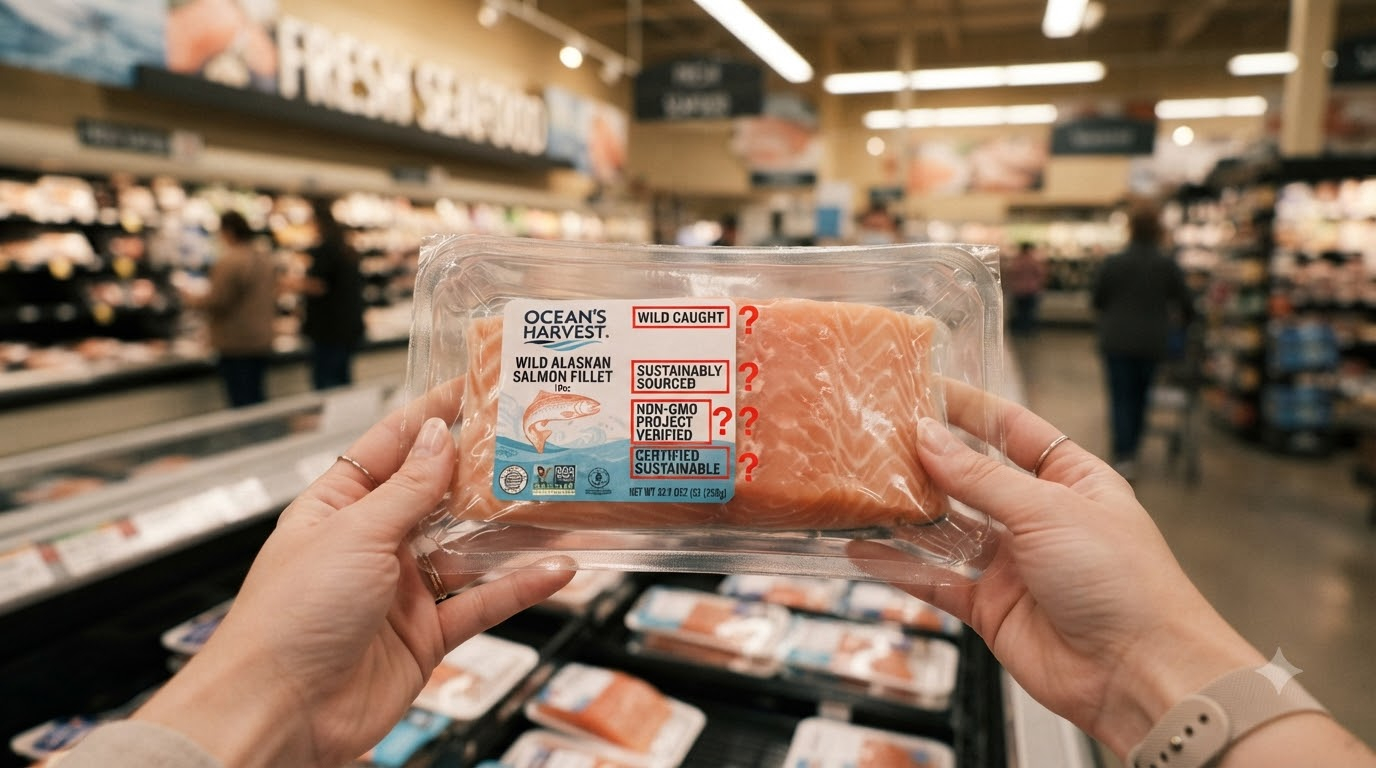
| “Sustainably Sourced” / “Ocean Friendly” | Nothing specific | None — self-declared | No standard, no audit, no verification |
| “Responsibly Sourced” | Nothing specific | None — self-declared | No standard, no audit, no verification |
The bottom two rows aren’t certifications at all — they’re marketing language that anyone can print on a package. They carry no external verification requirement, no universal standard, and no enforcement mechanism. They exist to make you feel good about your purchase. That’s it.
Even the more credentialed certifications have real limitations. A June 2026 industry report commissioned by the marine conservation coalition Make Stewardship Count warned that retailers face growing legal exposure when they rely on certifications as a substitute for comprehensive supply chain due diligence — rather than as one tool within a broader verification framework. The report pointed to a lawsuit against French retailer Carrefour over MSC-labeled tuna as an early example of this liability materializing in court.
What to look for: A named, audited third-party certification — MSC or ASC are the most rigorous commonly available options. Then go one step further and look for a certification number you can look up, or a QR code that links to sourcing details.
Red flag: Feel-good adjectives (“sustainable,” “responsible,” “ocean-friendly,” “eco-conscious”) with no named certifying body and no verification badge. These are legally permitted but tell you nothing verifiable.
5. Freshness, Freeze Dates, and Processing Information
What it says: Usually a “best by” or “use by” date, and whether the product has been previously frozen.
What to know: Most “fresh” seafood at retail counters has been previously frozen and thawed. This is not a fraud or a problem — freezing at sea is often better for quality than days of refrigeration. But “fresh” as a marketing term implies it was never frozen, which is rarely accurate for seafood outside of local, direct-from-boat purchases.
The FDA requires that previously frozen seafood sold as “fresh” be labeled “previously frozen” — but this requirement is unevenly enforced and frequently ignored at restaurant service counters.
What to look for: “Frozen at sea” is actually a positive label — it indicates rapid freezing on the vessel, which preserves quality and is increasingly used as a traceability signal. Look for the date of freezing if available.
6. Traceability Codes, Batch Numbers, and QR Codes
This is the fastest-growing area of seafood label innovation, and the most underused by consumers.
An increasing number of premium seafood brands and responsible retailers are now including:
- QR codes that link to a website showing the specific vessel, fishing date, and location
- Lot or batch numbers that allow supply chain verification
- USDC (U.S. Department of Commerce) Grade A shield, indicating voluntary federal inspection for quality and sanitation
- FDC (Fish Date Code) systems used by some sustainable fisheries
If you scan a QR code and it takes you to a sourcing story with a vessel name, GPS coordinates, and fishing date — that’s meaningful. If it takes you to a marketing page with a sunset photo of a fishing boat, that’s not.
What to look for: Any code that links to independently verifiable information — vessel name, fishing area, date, certification number.
Red flag: No traceability information of any kind, especially on higher-priced “premium” or “sustainable” products. The more a product costs and the more environmental claims it makes, the more transparency you’re entitled to expect.
Before You Buy: A 60-Second Label Checklist
Run through this the next time you pick up a seafood product:
✅ Species specificity — Is a specific species named (not just “tuna” or “salmon”)? ✅ Country of origin — Is a specific country listed? Is it the catch country or processing country? ✅ Production method — Wild-caught or farm-raised? Any catch method specified? ✅ Third-party certification — Is there a named certifying body (MSC, ASC, BAP)? Or just adjectives? ✅ Traceability — Is there a lot code, QR code, or vessel reference? ✅ Marketing language audit — Are there words like “sustainable,” “responsible,” or “eco-friendly” without a named certifier? Treat those as decorative, not informational.
If the product passes at least 4 of these 6 checks, it’s a meaningfully more transparent choice than average. If it fails 3 or more, the price premium you might be paying for “sustainability” is not supported by the information on the label.
Species-Specific Guide: The Highest-Risk Seafood to Buy
Not all seafood is equally risky from a mislabeling standpoint. Here’s where to be most careful:
🔴 High Mislabeling Risk
Snapper — One of the most frequently substituted fish in the U.S. market. Oceana’s studies found snapper mislabeling rates as high as 87% in some markets. If it’s not labeled with a specific type (e.g., “Gulf Red Snapper”) and verified by a retailer you trust, be skeptical.
Salmon (restaurant setting) — A 2024 PLOS ONE study found 32% of “wild salmon” at Seattle sushi restaurants was actually farmed Atlantic salmon. This is a restaurant-specific risk that grocery stores largely avoid, but it’s widespread.
Shrimp — A 2024 Chapman University study of frozen shrimp in Orange County found roughly a third of samples were mislabeled and/or weighed less than the label claimed. Shrimp is America’s most consumed seafood and among its most fraud-prone.
Grouper — Frequently substituted with lower-value Asian catfish or other white fish, especially in restaurant settings.
🟡 Moderate Risk
Tuna (canned) — Albacore, skipjack, and yellowfin are different species with different mercury levels and sustainability profiles, but they’re sometimes used interchangeably. Look for species-specific labeling.
Cod — Pacific cod and Atlantic cod are different species with very different sustainability profiles. Cheaper white fish from Asia is sometimes substituted.
🟢 Lower Risk
Mussels, clams, oysters (farmed, U.S.-origin) — Shellfish from domestic aquaculture operations are easier to trace, subject to more robust local regulation, and rarely substituted. They’re also among the most environmentally sustainable seafood choices available.
Canned sardines and mackerel — These typically involve less processing ambiguity and are harder to substitute, and they’re among the most nutritionally dense, affordable, and sustainable seafood options available.
Whole fish at retail — A whole fish is harder to misrepresent than a fillet, because its physical characteristics are visible. A whole red snapper is much easier to verify than a red snapper fillet.
Where You’re Buying Matters As Much As What You’re Buying
The same species, labeled the same way, carries different risk levels depending on the retail environment:
| Where You’re Buying | Mislabeling Risk | Disclosure Requirements |
|---|---|---|
| Grocery store (retail seafood counter) | Moderate | COOL required: species, origin, production method |
| Online grocery (Amazon, Walmart, Instacart) | Moderate–High | Label requirements same as retail; harder to verify before purchase |
| Restaurant | Highest | Exempt from federal COOL requirements |
| Specialty fishmonger (reputable) | Low–Moderate | Often above-baseline transparency; can ask directly |
| Direct from fishery / CSF (Community-Supported Fishery) | Very Low | Usually full traceability by design |
| Frozen supermarket aisle | Moderate | COOL required; frozen product often more reliably labeled than “fresh” |
Community-Supported Fishery (CSF) programs — the seafood equivalent of a farm CSA — deserve special mention. These programs connect you directly with a fishing operation, typically with named vessels, GPS catch locations, and sometimes even photos of the crew. They’re increasingly available in coastal cities and through online ordering with home delivery. If you eat seafood regularly and care about what you’re getting, a CSF subscription is the single biggest upgrade you can make to your seafood buying.
Tools That Actually Help
You don’t have to do this all from memory. These resources give you real leverage:
Seafood Watch (Monterey Bay Aquarium) — Free app and website. Search by species, origin, and purchase type (retail vs. restaurant vs. sushi). Color-coded recommendations (Best Choice, Good Alternative, Avoid) based on independent science. The most widely trusted consumer tool for sustainability assessment.
FishChoice — More supplier-facing, but useful for understanding which fisheries and certifications meet different sustainability benchmarks.
NOAA FishWatch — The federal government’s guide to U.S. seafood species. Excellent for understanding the biology, sustainability status, and fishing regulations for specific U.S. species. Best used to cross-reference a species you’re already considering.
Open Seas / Global Fishing Watch — For the deeply curious: vessel tracking data that shows where fishing is happening globally. Useful for understanding the transparency gap the Amazon lawsuit cited — and seeing firsthand how dark vessels operate.
FAQ: Reading Seafood Labels
Q1: Does “wild-caught” mean the fish is more sustainable than farmed?
Not automatically. “Wild-caught” is a production method, not a sustainability verdict. Some wild fisheries are well-managed and low-impact; others involve destructive practices like bottom trawling or high bycatch. Similarly, some farmed seafood — particularly bivalves like oysters and mussels, and land-based recirculating systems — is among the most sustainable seafood available. Use the Seafood Watch guide to evaluate your specific choice rather than relying on wild vs. farmed as a shortcut.
Q2: Is “dolphin safe” tuna actually dolphin safe?
The U.S. “Dolphin Safe” label (managed by NOAA and enforced under the Dolphin Protection Consumer Information Act) prohibits the use of fishing techniques known as setting on dolphins — where boats encircle dolphin pods to catch the tuna that swim beneath them. In the U.S. market, this practice is largely restricted, and the label has genuine meaning. However, the Amazon lawsuit specifically cited it as an example of an unsubstantiated claim, because independent observer coverage of fishing vessels is not universal and some vessels disable transponders. The label has more legal backing than “responsibly sourced” — but it’s not an absolute guarantee.
Q3: What does “Product of China” mean on my seafood, and should I be concerned?
It most commonly means the fish was processed in China — filleted, packaged, and frozen — regardless of where it was originally caught. China processes a huge volume of the world’s seafood, including fish caught in U.S. and Alaskan waters. Food safety concerns vary; FDA import alerts and inspection data are publicly available for flagged facilities. The label itself is legal and not inherently a warning sign, but it does mean the fish traveled a long supply chain, which increases traceability difficulty.
Q4: Is “MSC Certified” always trustworthy?
MSC certification is one of the most rigorous third-party standards available for wild fisheries, and it has driven measurable improvements in some operations. But it has documented limitations: its fees are paid by the fishing industry; some already-certified fisheries have until 2030 to meet updated standards; and certification cannot fully account for vessels that disable tracking devices. Treat it as a meaningful signal — not an absolute guarantee.
Q5: Are there any seafood labels I can simply trust without further research?
The combination of MSC or ASC certification plus a specific country of catch plus a specific species name plus a traceability code is about as confident as you can get without a DNA test. No single element alone is a guarantee. The more of those boxes a label checks, the more reliably you can trust what it says.
Q6: What’s the safest seafood to buy if I’m worried about mislabeling?
Whole fish (not fillets), domestic shellfish (oysters, mussels, clams), and canned sardines or mackerel are consistently lower-risk for species substitution. Buying from a local fishmonger with named suppliers, or through a Community-Supported Fishery, gives you access to information that retail packaging simply can’t match.
Q7: How does the Amazon greenwashing lawsuit connect to everyday label reading?
The lawsuit is a vivid illustration of the gap between label language and label substance. It alleges that sustainability terms used on Amazon’s seafood products — including “MSC Certified” — are misleading because the underlying supply chain verification is inadequate. For everyday shoppers, the lesson is this: a certification badge on a label is only as reliable as the audit behind it. The lawsuit is forcing that audit-behind-the-badge question into public and legal discourse.
Q8: What should I do if I suspect a seafood product I bought was mislabeled?
You can report suspected seafood fraud to NOAA Fisheries or the FDA’s Office of Criminal Investigations. You can also contact your state’s department of agriculture. If you made a purchase based on what turned out to be false sustainability claims, a consumer protection attorney can advise you on any potential recourse, particularly if there’s an active class-action lawsuit covering similar products.
Conclusion: The Most Powerful Thing You Can Do Is Ask More
The seafood industry has a transparency problem that starts on the boat and ends on your plate. That’s not a reason to stop eating seafood — most fishing operations are legitimate, and seafood remains one of the most nutritionally complete and environmentally efficient protein sources available. But it is a reason to be a more demanding consumer.
The good news is you don’t need to become an expert. You need four habits:
- Look past the adjectives. “Sustainable,” “responsible,” “ocean-friendly” — these are marketing claims, not certified facts, unless there’s a named certifying body attached.
- Demand specificity. A species name, a country of catch, a certification number. The more specific the information, the harder it is to fake.
- Know your venue. Restaurants have the least disclosure obligation and the highest mislabeling rates. Ask your server directly, and don’t be shy about it.
- Use the tools. Seafood Watch is free, takes thirty seconds to use, and is built on independent science. It’s the single best shortcut to a more informed seafood purchase.
The Amazon lawsuit is an uncomfortable reminder that even major retailers in the modern food system can mislead you with a well-designed label. But knowledge is leverage. The more you know how these labels work — what they’re required to say, what they’re allowed to imply, and where the two diverge — the harder it becomes to fool you.
That’s worth something. Share this guide with someone who buys seafood regularly. And the next time you’re staring at a label with a green badge and a scenic ocean backdrop, you’ll know exactly what questions to ask.
📩 Subscribe to our newsletter for weekly deep-dives on food labeling, corporate accountability, and how to be a more informed consumer — no jargon, no fluff.
→ Related reads:
- Amazon Seafood Greenwashing Lawsuit: What Every Conscious Shopper Needs to Know
Sources: Chapman University / Food Control Journal (2025) | PLOS ONE – Seattle Salmon Mislabeling Study (2024) | Oceana Seafood Fraud Report | NOAA Fisheries – Seafood Fraud | USDA COOL Regulations – 7 CFR Part 60 | SeafoodSource – Certification Overreliance Report (2026) | FAO Seafood Fraud Report

