

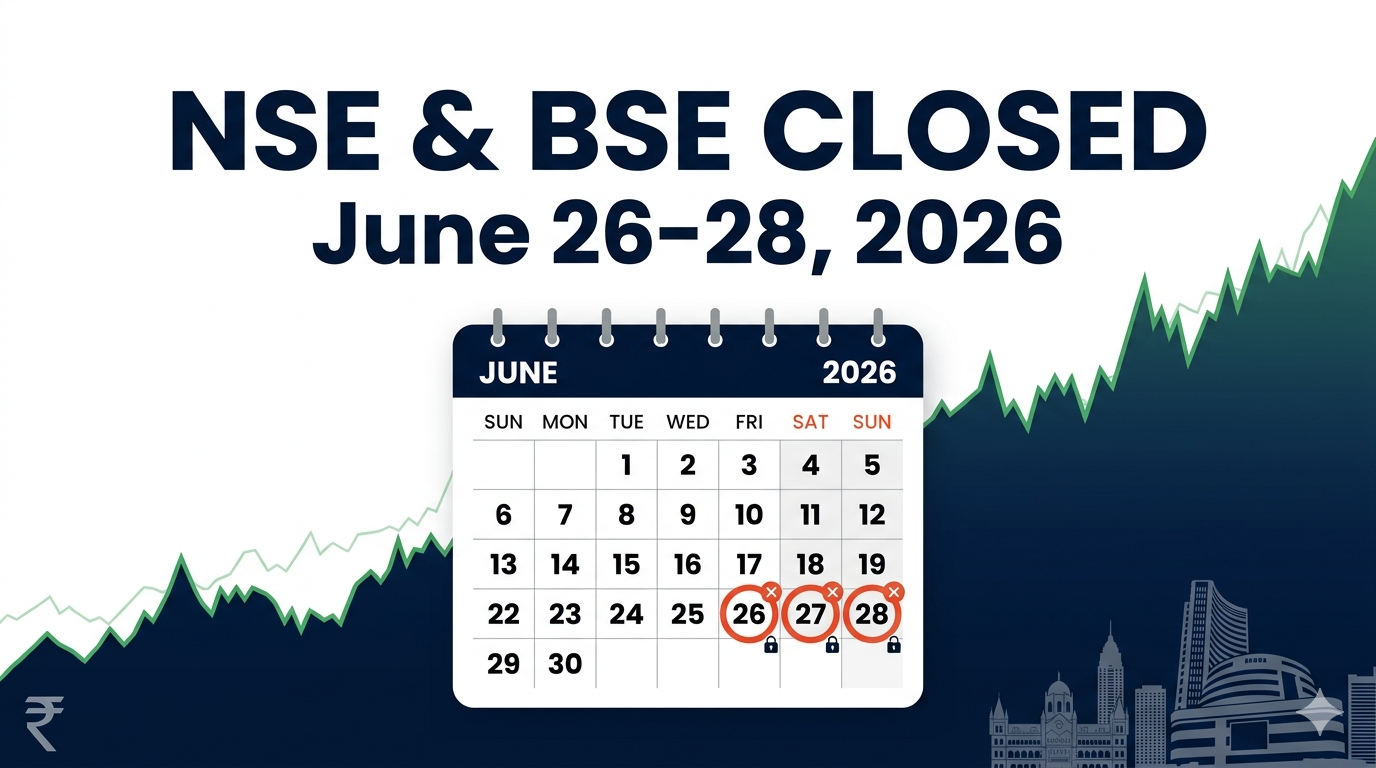
Stock Market Holidays June 26–28, 2026: Your Complete 3-Day Trading Break Guide for NSE & BSE
Meta Description: NSE & BSE close June 26–28, 2026 for Muharram + weekend. Get the full trading impact, settlement changes, expiry shifts & market outlook here.
Quick Answer: Are Indian Stock Markets Closed June 26–28, 2026?
Yes. The BSE and NSE will be completely shut for three consecutive days — June 26, 27, and 28, 2026. June 26 (Friday) is closed for Muharram/Ashura, while June 27 (Saturday) and June 28 (Sunday) are the regular weekly closures. This is confirmed directly in NSE’s official 2026 trading holiday circular, which lists June 26, 2026, a Friday, as a trading holiday for Muharram.
If you trade actively, this is your long weekend to plan around. If you’re a long-term investor, here’s the good news upfront: your mutual fund SIPs and NAV calculations carry on as normal — this only affects exchange trading, not your underlying investments.
Let’s walk through exactly what shuts down, what stays open, how settlement gets pushed, and what’s actually moving the market right now.
1. The Holiday Schedule, Day by Day
| Date | Day | Status | Reason |
|---|---|---|---|
| June 25, 2026 | Thursday | Open (last trading day before the break) | Regular session |
| June 26, 2026 | Friday | Closed | Muharram/Ashura |
| June 27, 2026 | Saturday | Closed | Weekly holiday |
| June 28, 2026 | Sunday | Closed | Weekly holiday |
| June 29, 2026 | Monday | Open | Regular session resumes |
Including the regular weekend, NSE and BSE will be closed for a total of nine days in June 2026, with the Muharram holiday on June 26 being the only weekday closure that month, according to Angel One’s market update on the June 2026 holiday schedule. So while it feels like a “three-day shutdown,” only one of those days is a true market holiday — the other two are just the weekend stacking on top of it, creating a long weekend effect.
From working with traders around festival holidays, I’ve noticed the same pattern every year: people assume a three-day closure means three days of “lost” trading. It doesn’t. It means one extra non-trading day attached to a weekend you’d have had anyway. The real planning issue isn’t the holiday itself — it’s what happens to your open positions and settlement timelines during it. More on that below.
2. What Actually Shuts Down on June 26
This is where people get tripped up. Not every market segment closes the same way.
Fully Closed on June 26
- Equity cash market — no buying or selling of stocks
- Equity Futures & Options (F&O) — no derivatives trading
- Securities Lending & Borrowing (SLB)
- Interest rate derivatives
Per Zee Business’s coverage of the June 2026 holiday list, trading will be suspended in the equity, equity derivatives, currency derivatives, and securities lending and borrowing segments on both the NSE and BSE. Currency derivatives are closed too, so if you’re hedging USD/INR exposure, factor that in before June 25 closes.
Partial Closure: MCX (Commodity Market)
This is the detail most retail traders miss. According to Business Today’s report on the Bakri Id and Muharram holiday schedule, the Multi Commodity Exchange observes a partial closure, suspending its morning session from 9 am to 5 pm before reopening for its evening trading session from 5 pm onward.
In plain terms: if you trade crude oil, gold, or silver futures on MCX, your daytime window is gone on June 26, but you get the evening session back. Don’t assume MCX mirrors NSE/BSE — they don’t, and this is a recurring mismatch every holiday cycle.
What Stays Open
- Global markets (US, Europe, most of Asia) trade normally on June 26
- Mutual fund NAVs are calculated as usual — SIPs are unaffected
- You can still place orders for the next session; they just won’t execute until June 29
3. The Settlement Trap: Why T+1 Timing Matters Here
This is the part that actually costs people money if they’re not paying attention.
India runs a T+1 settlement cycle — meaning a trade executed today settles (funds/shares actually move) the next working day. A holiday in between breaks that chain.
Here’s the practical impact:
- Trades executed on June 25 would normally settle on June 26. Since June 26 is a holiday, settlement pushes to June 29 instead.
- That’s a 3-day gap between trade and settlement instead of the usual 1-day gap.
Why this matters to you:
- If you sold shares on June 25 expecting funds in your account quickly — they won’t land until June 29. Plan any withdrawal or reinvestment timing accordingly.
- If you’re using margin or leverage, your funds are tied up three extra days, not one. That’s a real cost if you were planning to redeploy capital.
- If you bought shares on June 25, they won’t reflect in your demat holdings for trading purposes until the 29th — confirm exact holding statement timing with your broker.
I’ve seen traders get caught off guard by this exact gap before a long weekend — assuming “T+1 means tomorrow” without checking whether tomorrow is actually a trading day. It’s a small detail with real cash-flow consequences if you’re managing tight margins.
For a deeper explainer on how this cycle works generally, SEBI’s investor education page on the T+1 settlement framework is a reliable primary source.
Weekly Expiry Shift
Because June 26 (normally a trading day) is now a holiday, weekly F&O expiry dates that would have fallen on or around that Friday shift to the preceding trading day — in this case, June 25 (Thursday) becomes the effective expiry session. If you’re holding weekly options, confirm the exact expiry date in your broker’s contract notes before June 25, because rolling over a day late isn’t possible once the market’s shut.
4. Where the Market Stood Heading Into the Break
Numbers matter for context — they tell you whether you’re walking into this holiday from strength or weakness.
As of the most recent session before the break, per Yahoo Finance’s BSE Sensex data and Yahoo Finance’s Nifty 50 data:
- Sensex: 76,802.90, closing down about 0.78%, or 607.08 points, on the session, though it had been on a strong run beforehand.
- Nifty: 24,013.10, down roughly 0.64% or 154.90 points on the day.
Despite that late-week dip, Business Standard’s market wrap noted the Nifty still managed to close above the psychologically important 24,000 mark on a weekly basis despite the late-week pullback. According to Trading Economics’ Sensex tracker, the index had been on track for a weekly gain of around 1.5% before the Friday IT-led selloff trimmed those gains.
What drove the late-week dip
Per Trading Economics, technology shares led the decline, with investors also weighing global growth signals and foreign fund flows for direction. Business Standard’s coverage adds that IT stocks specifically dragged the market after Accenture’s latest earnings raised concerns about sector demand — shares of Tata Consultancy Services, Infosys, Tech Mahindra, and HCL Tech all fell between roughly 5% and 8%. That’s a sharp, sector-specific move, not a broad market panic.
On the flip side, Business Standard also reported that Nifty Pharma rose the most on the day, while Nifty Realty, Nifty Auto, and Nifty Oil & Gas underperformed.
Crude Oil and the US-Iran Factor
According to Goodreturns’ market outlook report, crude oil was trading around $79.50 a barrel, dipping below the $80 mark on the back of a US-Iran interim ceasefire agreement signed overnight. Motilal Oswal’s Head of Research, Siddhartha Khemka, was quoted in that report saying Indian equities are expected to sustain their upward momentum as investors await formalization of the US-Iran understanding, with softer crude prices seen as reducing geopolitical risk.
The honest takeaway here: this wasn’t a market in distress. It was a market digesting a sector-specific earnings shock (Accenture’s guidance) while broader macro tailwinds (cheaper oil, a ceasefire) provided some cushion. That distinction matters when you’re deciding whether to hold or trim positions over a three-day closure.
5. Pros & Cons of a Holiday-Shortened Trading Week
| Pros | Cons |
|---|---|
| Extra time to review your portfolio without market noise | Funds from June 25 trades are locked up 3 days instead of 1 |
| No pressure to react to intraday volatility for 3 days | Monday’s open (June 29) can gap up or down sharply on overnight global news |
| Global markets keep trading — you get a “preview” of sentiment before Indian markets reopen | F&O traders carrying weekend risk face extended exposure to news over 3 non-trading days |
| Good natural checkpoint to rebalance or set alerts | MCX’s split session schedule can confuse same-day commodity traders |
6. Before vs. After: How to Position Yourself
Before June 25 closes, if you’re an active trader:
- Square off or review any short-term/intraday positions you don’t want exposed to 3 days of news risk
- Confirm your weekly expiry contract notes reflect the shifted date
- Check margin requirements — some brokers raise margin ahead of long weekends specifically because of extended settlement gaps
After June 29 reopens:
- Don’t rush into the first 15–30 minutes of trading. Long weekends often produce gap-up or gap-down openings as the market catches up on three days of global news.
- Check what happened in US, European, and Asian markets over the weekend — they kept trading while India was closed.
- If you’re a SIP or long-term investor, there’s genuinely nothing urgent to do. Your fund continues buying units on schedule; NAVs simply reflect Monday’s prices.
7. The Bigger Picture: What’s Shaping Markets Beyond This Week
Holidays are a good moment to zoom out, because the three-day pause doesn’t happen in a vacuum. A few forces are actively shaping the medium-term backdrop:
US Fed policy. Per Trading Economics’ market commentary, the Federal Reserve kept rates unchanged but signaled a hike could still be on the table later this year — a cautious, “higher-for-longer” stance that keeps global liquidity conditions tighter than markets might prefer. For the Fed’s own statements, the Federal Reserve’s official press releases page is the primary source.
RBI’s parallel caution. The Reserve Bank of India has maintained its own watchful posture, with inflation risk — particularly food inflation tied to monsoon performance — remaining a key variable. The RBI’s official monetary policy statements are the best place to track this directly.
Monsoon trajectory. This is an underrated risk factor for retail investors. Rural demand and food inflation are both heavily monsoon-dependent in India, and a weak or erratic monsoon season can ripple into consumer durables, auto, and FMCG earnings well before it shows up in headline inflation data. The India Meteorological Department’s monsoon forecasts are the authoritative tracker here.
Global trade developments. Trade arrangements involving the US and UK are being watched as a potential source of gradual improvement in export-linked sectors, though these tend to play out over months, not days.
None of this should change what you do on June 26–28 specifically — the market’s closed either way. But it’s useful context for how you think about positioning when trading resumes on June 29.
Frequently Asked Questions
1. Is the stock market closed on June 26, 2026? Yes. Per NSE’s official 2026 circular, June 26, 2026 (Friday) is a trading holiday for Muharram, affecting both NSE and BSE.
2. Why are markets closed June 27 and 28 too? Those are simply the regular Saturday and Sunday weekend closures that Indian exchanges always observe — they’re not holiday-specific, they just happen to follow immediately after the Muharram closure, creating a three-day stretch.
3. Will my mutual fund SIP be affected by this holiday? No. SIP debits and NAV calculations follow the fund’s own processing calendar and are unaffected by short exchange holidays like this one. The AMFI investor education portal has more on how NAV cut-off timings work generally.
4. What happens to trades I place on June 25? They’ll settle on June 29 instead of June 26, because the usual T+1 settlement cycle is pushed by the holiday plus weekend. Budget for a 3-day fund lock-up instead of 1 day.
5. Is MCX also closed on June 26? Partially. Per Business Today’s reporting, MCX suspends its daytime session (9 am–5 pm) but reopens for its evening session from 5 pm onward, so commodity traders aren’t fully shut out.
6. Does the weekly options expiry shift because of this holiday? Yes. Since June 26 is normally a trading day, the weekly expiry that would have landed there moves to the prior trading session — June 25 (Thursday) in this case. Always verify with your broker’s contract notes.
7. Will global markets also be closed on June 26? No. US, European, and most Asian markets trade normally — only Indian exchanges are observing this specific holiday. Keep an eye on overnight global moves via a source like Yahoo Finance’s world markets summary.
8. Where can I check the official 2026 holiday list? Always refer to NSE’s official exchange communication page rather than social media posts or forwarded messages, since holiday dates and segment-specific closures are occasionally revised.
Conclusion: Plan the Pause, Don’t Just Wait It Out
The three-day closure from June 26–28, 2026 isn’t really a “three-day market holiday” — it’s one genuine trading holiday (Muharram) sitting next to a weekend you’d have had regardless. The part that actually requires your attention isn’t the closure itself; it’s the settlement lag, the weekly expiry shift, and the MCX split-session quirk that catch people off guard every single time a holiday lands midweek.
If you’re an active trader, use June 25 to square off intraday exposure you don’t want to carry into a long, newsy weekend. If you’re a long-term investor or SIP holder, this is genuinely a non-event for you — let the market take its breather and check back in on June 29.
Want holiday-by-holiday trading alerts like this one delivered before every market closure? Subscribe to our newsletter and never get caught off guard by a settlement delay or expiry shift again. And if you found this breakdown useful, share it with a trading group or colleague who’s still figuring out their June 25 exit plan — it might save them a margin headache.

