

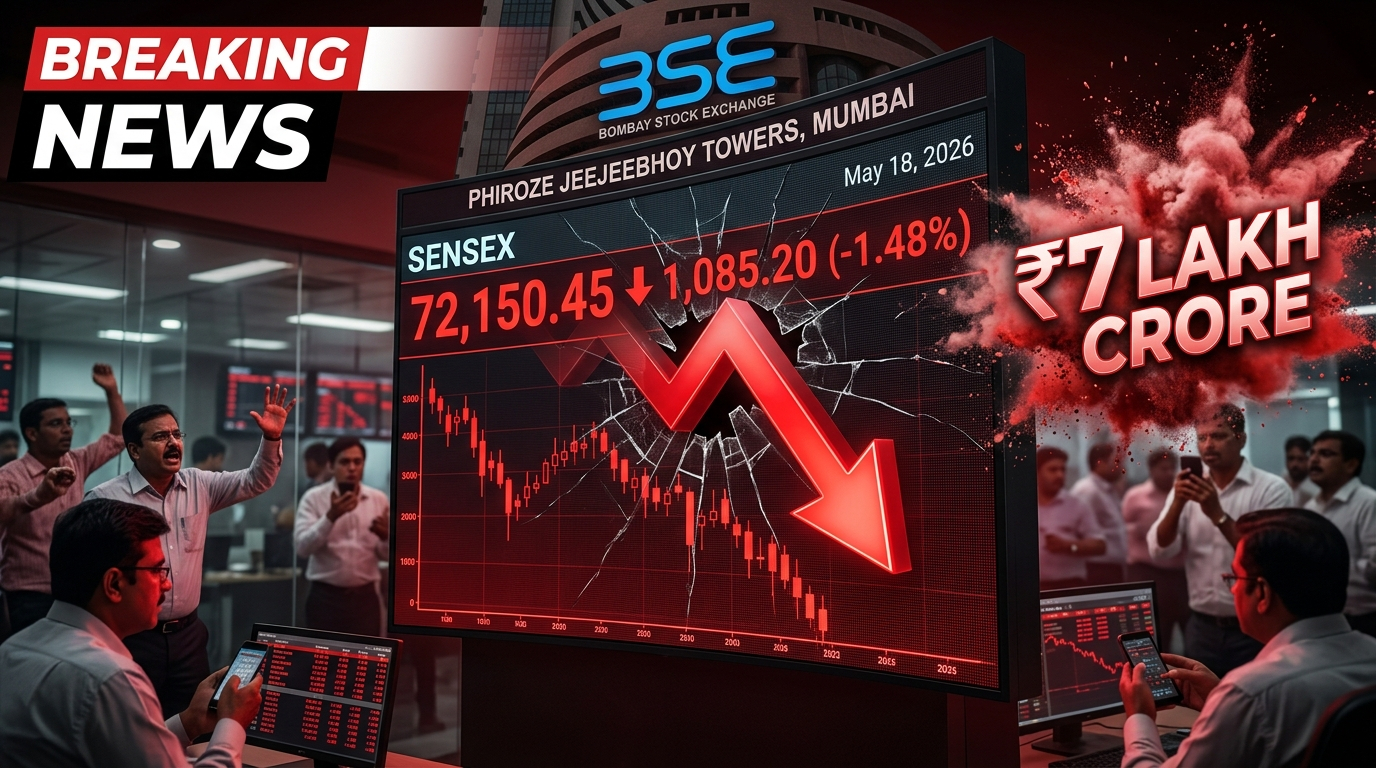
Sensex Crash today wipes out over ₹7 lakh crore as Nifty plunges below 23,350. Rising oil prices, weak rupee, and escalating US-Iran tensions trigger panic. Full analysis, key losers, and what investors should do right now on this volatile Monday.
Breaking: Just now on Monday, May 18, 2026, Indian stock markets have witnessed a sharp Sensex Crash, with the benchmark index plunging over 1,000 points in early trade. Panic selling gripped Dalal Street as global tensions, skyrocketing crude oil, and a record-weak rupee combined to erase massive investor wealth in hours. Millions of retail investors are watching their portfolios bleed red, raising fears of deeper losses ahead.
This sudden downturn isn’t just numbers on a screen — it’s hitting dreams, savings, and retirement plans across India. From first-time SIP investors to seasoned traders, the anxiety is real. Here’s a clear, timely breakdown of what triggered today’s Sensex Crash, which sectors are worst hit, and what it means for you.
Why Did the Sensex Crash Today? The Perfect Storm Unfolding Right Now
The Sensex Crash today stems from a dangerous mix of global and domestic pressures colliding at once. Escalating geopolitical tensions in the Middle East, particularly US President Trump’s strong “clock is ticking” warning to Iran, have sent oil prices soaring and risk appetite crashing worldwide.
Brent crude has surged above $111 per barrel, while WTI crossed $108, raising fears of higher inflation and input costs for Indian companies. At the same time, the Indian rupee hit a fresh all-time low near ₹96.18 against the US dollar, making imports costlier and adding fuel to the fire.
Global markets are also deep in the red — Nikkei, Hang Seng, DAX, CAC, and FTSE all tumbled, creating a negative sentiment loop. Foreign institutional investors (FIIs) continued their selling streak, pulling out billions and amplifying the downward pressure on Indian equities.
For ordinary investors, this feels personal. Families who invested during the recent rally are now seeing hard-earned gains vanish. The fear is palpable: Is this the start of a longer correction, or just a temporary storm?
Nifty Slips Below 23,350: How Deep Will This Correction Go?
As of mid-morning trade today, the NSE Nifty has dropped below the critical 23,350 level, extending losses sharply. The BSE Sensex mirrored the pain, shedding more than 1,000 points and dragging the broader market into turmoil.
This move has wiped out approximately ₹7 lakh crore in market capitalization in a single session, a staggering blow to investor wealth. India VIX, the fear gauge, jumped over 5% to 19.78, signaling heightened nervousness among traders.
Analysts note that the index is testing important support zones. A decisive break below 23,200 could open the door for further downside, while any recovery above 23,600 might signal short-term relief. However, with oil prices volatile and geopolitical headlines changing by the hour, uncertainty remains sky-high.
Geopolitical Tensions and Oil Shock: The Real Triggers Behind Today’s Panic
The core trigger for today’s Sensex Crash appears to be the worsening US-Iran standoff. Trump’s latest remarks have raised fears of potential military escalation, while reports of a drone strike near a UAE nuclear plant have added to global risk aversion.
Higher oil prices directly hurt India, a major importer. They increase the current account deficit, pressure the rupee further, and raise costs for transportation, power, and manufacturing sectors. Bond yields have also soared — the US 10-year yield touched 4.632% and Japan’s 30-year JGB reached 4.170% — making global capital more expensive.
This macro environment has left little room for domestic positives to shine through, even as some sectors try to hold ground.
Sectoral Bloodbath: Big Losers and Surprising Gainers Today
The selling was broad-based, but some sectors suffered more than others. Heavyweights dragged the indices lower, while defensive pockets showed relative resilience.
Major losers included Power Grid, Tata Steel, Titan, Bajaj Finance, HDFC Bank, and Maruti Suzuki. Banking, auto, metals, and consumer durable stocks faced intense pressure as rising interest rates and input costs weighed on sentiment.
In contrast, IT stocks like Infosys, Tech Mahindra, and TCS managed modest gains of around 1%, acting as a cushion. Export-oriented sectors such as pharmaceuticals also showed relative strength, benefiting from a weaker rupee that makes their products more competitive abroad.
Mid and small-cap stocks were hit harder, amplifying losses for retail investors heavily exposed to these segments. The divergence highlights how selective buying is still present even in a crashing market.
What Should Investors Do Now? Practical Advice Amid the Chaos
In times like these, emotions run high, but knee-jerk reactions often lead to bigger mistakes. Today’s Sensex Crash serves as a reminder that markets can turn swiftly on global events.
Focus on quality businesses with strong balance sheets. Review your asset allocation — ensure you’re not overly exposed to high-debt or cyclical sectors. For long-term investors, this dip could eventually offer buying opportunities in fundamentally strong companies, but only after volatility cools.
Stay updated on oil prices, rupee movement, and any de-escalation signals from the Middle East. Diversification, rupee-cost averaging through SIPs, and avoiding leverage remain timeless strategies during turbulent phases.
Key Stats and Takeaways from Today’s Sensex Crash
- Sensex plunged over 1,000 points in early trade, with Nifty dropping below 23,350.
- BSE Market Cap wiped out approximately ₹7 lakh crore in a single session.
- India VIX surged 5% to 19.78, reflecting rising investor fear.
- Brent crude above $111/barrel and WTI at $108/barrel, pressuring inflation.
- Rupee hits fresh record low at ₹96.18 per US dollar.
- Global markets in red: Nikkei, Hang Seng, DAX, CAC, and FTSE all declined sharply.
- US 10-year bond yield at 4.632%; Japan’s 30-year JGB at 4.170%.
- IT and pharma stocks show relative resilience amid broad sell-off.
- Top losers: Power Grid, Tata Steel, Titan, Bajaj Finance, HDFC Bank, Maruti Suzuki.
These figures underline the scale of today’s turmoil and the interconnected risks facing the Indian economy.
As the trading day unfolds on this tense Monday in May 2026, the Sensex Crash has left millions questioning the road ahead. Yet history shows that markets have always recovered from geopolitical shocks and oil spikes. The key lies in staying informed, disciplined, and focused on the long term rather than daily swings.
For now, caution is the watchword. Keep a close eye on global developments, especially any progress or escalation in the Middle East. Your portfolio’s health depends not just on today’s red candles, but on how calmly you navigate them.
Read More
Dow Jones Financial Services Headlines Impacting Markets
About the Author
Rajesh Sharma is a seasoned financial journalist with over 15 years of experience covering Indian stock markets, macroeconomics, and global geopolitics. Based in Mumbai, he has reported live from the floors of BSE and NSE during multiple market crashes and rallies. Rajesh is passionate about helping retail investors make smarter decisions through clear, unbiased analysis. When not tracking market movements, he enjoys reading economic history and mentoring young journalists. Follow him for timely insights on Sensex, Nifty, and investment strategies.

