

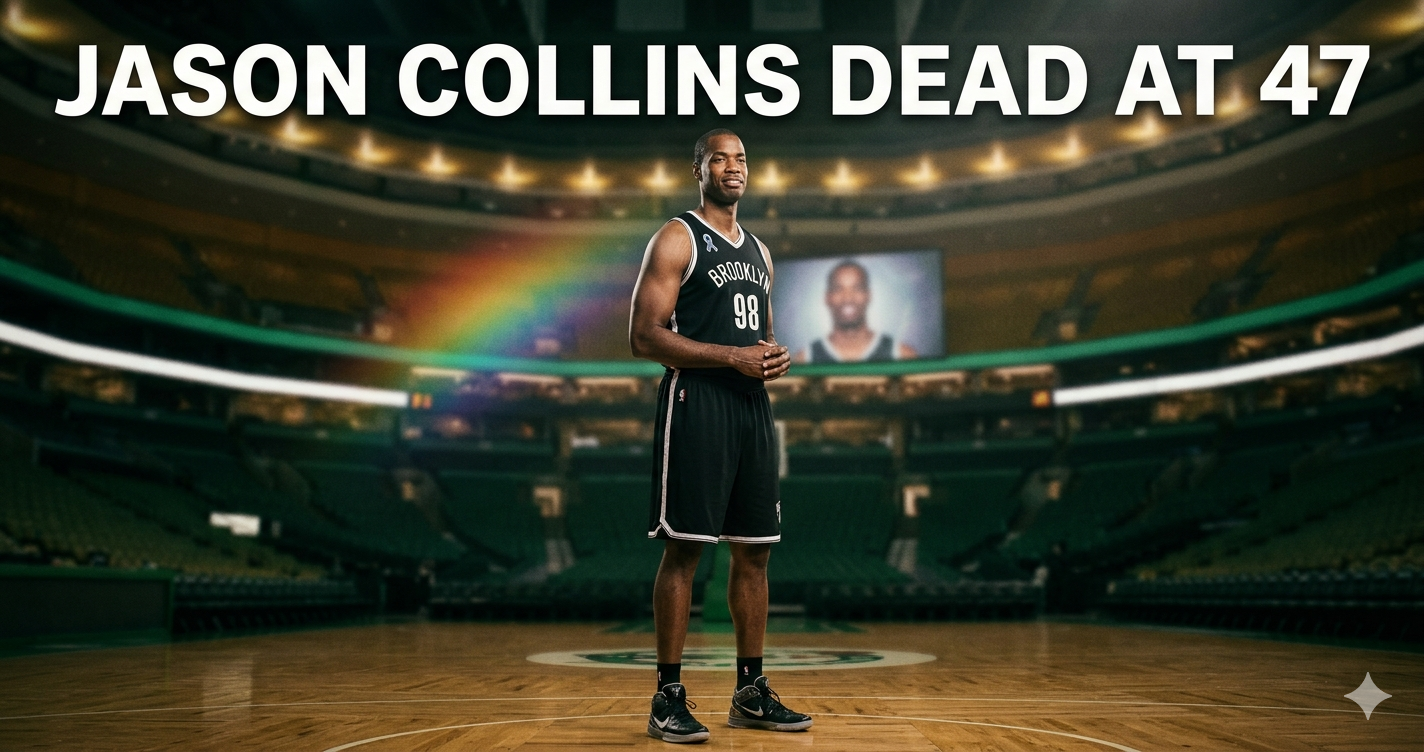
Meta Description: Jason Collins, the NBA’s first openly gay player, has died at 47 after an eight-month battle with Stage 4 glioblastoma. His legacy forever changed sports.
The sports world woke up to devastating news today. Jason Collins, the trailblazing NBA center who made history in 2013 as the first openly gay active player in any of North America’s four major professional sports leagues, has died. He was 47 years old. His family announced his passing on May 12, 2026, confirming that he died after a “valiant fight” with glioblastoma, one of the most aggressive and deadly forms of brain cancer known to medicine. The announcement hit hard — not just for basketball fans, but for every person who had ever felt seen because a 6-foot-11 center from Stanford had the courage to say, “I’m Black. I’m gay. And I play in the NBA.”
This is not just a sports story. This is a story about courage, love, loss, and the kind of legacy that outlasts any final box score.
Breaking: Jason Collins Dies — What His Family Said
Just hours before this story was published, Jarron Collins — Jason’s identical twin brother and fellow former NBA player — along with sister-in-law Elsa Marie Collins, released a statement on behalf of the entire family. The words were simple, heartbroken, and deeply human.
“We are heartbroken to share that Jason Collins, our beloved husband, son, brother and uncle, has died after a valiant fight with glioblastoma,” the statement read. “Jason changed lives in unexpected ways and was an inspiration to all who knew him and to those who admired him from afar. We are grateful for the outpouring of love and prayers over the past eight months and for the exceptional medical care Jason received from his doctors and nurses. Our family will miss him dearly.”
The NBA released the statement on behalf of the Collins family, and within minutes, tributes flooded in from every corner of the league. NBA Commissioner Adam Silver described Collins as someone whose “impact and influence extended far beyond basketball,” adding that he “helped make the NBA, WNBA and larger sports community more inclusive and welcoming for future generations.”
Just one week before his death, Jason Collins received the inaugural Bill Walton Global Champion Award at the Green Sports Alliance Summit. He was too ill to attend. His twin brother Jarron accepted it on his behalf and told the crowd: “I told my brother this before I came here — he’s the bravest, strongest man I’ve ever known.”
What Was Jason Collins’ Cause of Death? Understanding Glioblastoma
Jason Collins’ cause of death was Stage 4 glioblastoma, a form of brain cancer that begins in the brain or spinal cord and carries no known cure. It is widely regarded by oncologists as the most lethal form of primary brain tumor, with a median survival time that often measures in months rather than years.
Collins’ family first disclosed in September 2025 that he was undergoing treatment for a brain tumor, keeping details deliberately vague to protect his privacy. By December 2025, Jason spoke for himself in an extraordinary first-person piece for ESPN, refusing to hide from the diagnosis any longer.
“I have Stage 4 glioblastoma, one of the deadliest forms of brain cancer,” he wrote. “It came on incredibly fast.”
He described how his tumor had grown in a “butterfly shape,” already spreading into both hemispheres of his brain by the time doctors caught it. A biopsy confirmed it was a glioblastoma with a 30% growth factor — meaning that without immediate intervention, doctors estimated he might have had only six weeks to three months to live. He called his particular strain “wild type,” explaining it carried multiple mutations that made it even harder to treat.
“What’s that mythical creature where you cut off one head, but it learns to grow two more? The Hydra,” Collins wrote. “That’s the kind of glio I have.”
He underwent radiation, chemotherapy, immunotherapy, and even sought experimental treatments as far away as Singapore, driven by the same relentless competitive instinct that had defined his NBA career. In his words: “Shut up and go play against Shaq. You want the challenge? This is the challenge.”
Ultimately, the cancer did not yield.
Jason Collins’ NBA Career: A Legacy Built in the Paint
Before he became an icon of LGBTQ+ courage, Jason Collins’ NBA career was one built on toughness, reliability, and an unshakeable team-first mentality.
Born on December 2, 1978, in Northridge, California, Collins grew up alongside his twin brother Jarron, and the two were virtually inseparable — in the classroom, on the court, and in life. They attended Harvard-Westlake High School in Los Angeles, then both went on to Stanford University, where Jason became one of the program’s most respected bigs, shooting an astonishing 61% from the floor over his collegiate career — a Stanford record that still stands today.
The Houston Rockets selected him with the 18th overall pick in the 2001 NBA Draft, though he was immediately traded to the New Jersey Nets, where he would spend the bulk of his professional life. Over 13 NBA seasons, Collins played for six teams: the New Jersey/Brooklyn Nets, the Atlanta Hawks, the Boston Celtics, the Memphis Grizzlies, the Minnesota Timberwolves, and the Washington Wizards. He finished his career back with the Brooklyn Nets in 2014.
Jason Collins’ stats across 735 career games were modest by traditional measures — 3.6 points per game, 3.7 rebounds, and 0.9 assists — but those numbers tell only a fraction of the story. Collins was a defensive anchor, a shot-blocker, a locker-room veteran who made teammates better simply by showing up every night. The Brooklyn Nets honored that legacy in their tribute, recalling how he helped them reach back-to-back Eastern Conference Finals in 2002 and 2003.
“He was a constant in our locker room — selfless, tough, and deeply respected by teammates, coaches, and staff alike,” the Nets said in their statement.
Who Was Jason Collins’ Husband? The Love Story Behind the Headlines
If Jason Collins’ coming-out in 2013 was the moment that changed sports forever, then his marriage to Brunson Green in May 2025 was the moment that gave that story its most beautiful chapter.
Brunson Green is a film producer best known for producing The Help, the acclaimed 2011 drama that starred Viola Davis, Emma Stone, and Octavia Spencer. Collins and Green first met at a party shortly after the famous Sports Illustrated coming-out letter was published. They dated for more than a decade before tying the knot at an intimate ceremony in Austin, Texas, in May 2025.
“In May I married the love of my life, Brunson Green, at a ceremony in Austin, Texas, that couldn’t have been more perfect,” Collins wrote in his ESPN piece just months after the wedding — and just weeks after learning he had a terminal diagnosis.
Octavia Spencer, who attended the wedding, posted a radiant photo of the couple and wrote: “Welcome to the family @jasoncollins_98. You’ve chosen well, and so has he! Love you, B!” Fellow The Help cast member Allison Janney was also in attendance.
Jason Collins died with Brunson Green by his side — peacefully at home, surrounded by family. He and Brunson were married for just under one year.
The Historic 2013 Coming-Out: Why Jason Collins Changed Sports Forever
It is impossible to tell Jason Collins’ story without lingering on the moment that defined his public life — and redefined what was possible in professional sports.
In April 2013, Collins penned a first-person essay for Sports Illustrated with a seven-word opening that stopped the world: “I’m a 34-year-old NBA center. I’m Black. And I’m gay.”
No active male athlete in any of the four major North American sports leagues — the NFL, NBA, MLB, or NHL — had ever publicly come out while still playing at the top level. Collins did not wait for retirement. He did not ask for permission. He simply told the truth.
The response was overwhelming. President Barack Obama called him personally to express his support. Former teammates rallied around him. The broader sports community, though not unanimously welcoming, largely embraced the moment as a turning point.
The following year, Collins signed with the Brooklyn Nets, officially becoming the first openly gay player to appear in an NBA game. He played 22 games that season before retiring. After leaving the court, he became an NBA Cares Ambassador, spending the better part of a decade traveling the world, speaking at schools, and working to make professional sports more inclusive for everyone who might come after him.
In December 2025, even as he wrestled with his diagnosis, Collins found a way to connect it back to that 2013 moment. “So if what I’m doing doesn’t save me,” he told ESPN, “I feel good thinking that it might help someone else who gets a diagnosis like this one day.”
The courage never left him.
Jason Collins and His Twin Brother Jarron: An Unbreakable Bond
One of the lesser-told threads of the Jason Collins story is the relationship between Jason and his twin brother Jarron.
Jarron Collins is also a Stanford alumnus and a 10-year NBA veteran, having been selected by the Utah Jazz in the second round of the 2001 NBA Draft — the same year Jason was picked in the first round. They grew up together, were educated together, played college basketball together, and navigated NBA life together. After retiring from playing, Jarron transitioned into coaching, most recently serving as an assistant coach with the New Orleans Pelicans.
It was Jarron who announced Jason’s death to the world. It was Jarron who stepped up to accept that award when his brother was too sick to stand. And it was Jarron who, in one of the most quietly devastating moments of the week, told a room full of strangers: “He’s the bravest, strongest man I’ve ever known.”
When Jason was first hospitalized and unable to speak for himself, it was his family — led by Jarron — who protected him. When Jason was ready to speak again, it was Jarron who stood beside him. That is a bond that no statistic will ever capture.
Key Facts and Takeaways: Jason Collins at a Glance
- Born: December 2, 1978, in Northridge, California
- Died: May 12, 2026, at the age of 47
- Cause of death: Stage 4 glioblastoma (diagnosed December 2025; battle lasted approximately 8 months)
- NBA career: 13 seasons (2001–2014), 735 games, 6 teams (Nets, Hawks, Celtics, Grizzlies, Timberwolves, Wizards)
- Career stats: 3.6 PPG, 3.7 RPG, 0.9 APG, 359 career blocks
- Drafted: 18th overall pick, 2001 NBA Draft, Houston Rockets (traded immediately to New Jersey Nets)
- Historic milestone: First openly gay active player in any of the four major North American professional sports leagues (April 2013)
- Education: Stanford University (set a school record with 61% career field-goal percentage)
- Twin brother: Jarron Collins, also a former NBA player and current assistant coach
- Husband: Brunson Green, married May 2025 in Austin, Texas
- Treatment sought: Radiation, chemotherapy, immunotherapy, and experimental treatment in Singapore
- Final honor: Inaugural Bill Walton Global Champion Award, May 2026
The NBA Grieves — A Dark Day for Basketball
May 12, 2026, was a uniquely sorrowful day for the NBA community. Earlier that same Tuesday, news broke that Memphis Grizzlies forward Brandon Clarke had died suddenly at just 29 years old. Hours later, the announcement of Jason Collins’ passing compounded the grief across the entire league.
Two men. Two losses. One aching day.
NBA players, coaches, and officials took to social media in droves to honor Collins. Veteran reporter Shams Charania broke the news with characteristic precision: “13-year NBA veteran Jason Collins has died at 47 years old after a battle with Stage 4 glioblastoma. Collins was the first active, openly gay player in NBA history. RIP.”
Commissioner Adam Silver’s statement captured what so many were feeling: “He exemplified outstanding leadership and professionalism throughout his 13-year NBA career and in his dedicated work as an NBA Cares Ambassador.”
Jason Collins’ Enduring Legacy: What He Leaves Behind
It would be easy — and inaccurate — to reduce Jason Collins to a single moment, a single headline, a single act of bravery. But the truth is broader and deeper than that.
Jason Collins leaves behind a husband who loved him for over a decade before the world knew his name. He leaves behind a twin brother who was his mirror and his champion. He leaves behind parents Paul and Portia Collins, who raised two sons who played in the highest league in the world. He leaves behind teammates who called him selfless. He leaves behind a sport that is genuinely more open, more human, and more honest because he walked through its doors first.
Read More
Brandon Clarke Dead at 29: Memphis Grizzlies Star’s Shocking Death Leaves NBA in Mourning
He leaves behind a generation of young athletes — gay, straight, Black, white, every background imaginable — who saw him and understood that the truth, however scary, is always worth telling.
He spent his final months not hiding, not bitter, but fighting — and sharing that fight with the world in the hope it might help someone else someday. He compared going up against his cancer to guarding Shaquille O’Neal in his prime. He faced it the same way: with preparation, with grit, and with absolute refusal to pretend it wasn’t happening.
Jason Collins did not win this particular game. But in every way that matters most, he never stopped leading.
Rest in peace, Jason Collins. The world is smaller without you.
© 2026 — All rights reserved. This article was written for informational and journalistic purposes. If you or someone you know has been affected by a brain cancer diagnosis, the National Brain Tumor Society offers resources and support.

